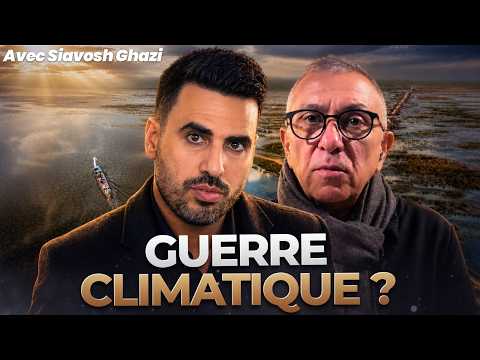
Quand les radars sont détruits, la pluie revient en force en Iran...
AI Summary
The video explores the controversial topic of climate warfare, specifically questioning whether Iran and Turkey have been victims of such tactics. The discussion emphasizes the importance of intellectual honesty in journalism, acknowledging what is unknown and the existence of secret, decades-long research that can make definitive statements difficult. The presenter contrasts this with "negationists," who, despite lacking scientific expertise, adamantly deny the existence of climate weapons.
The existence of climate weapons is affirmed, distinguishing between the technology and the intention. Historically, the United States has openly acknowledged using weather modification methods in warfare, citing Operation Popeye during the Vietnam War, which employed chemical methods like silver iodide for cloud seeding. These early methods, dating back to World War I, were focused on practical applications like dispersing fog. President Lyndon B. Johnson also expressed interest in using climate manipulation for strategic advantage.
The presenter argues that current capabilities in climate manipulation are far more advanced and sophisticated than commonly perceived. The concept of citizen journalism is introduced, encouraging viewers to apply journalistic methods to debunk negationist claims by questioning peremptory assertions of impossibility. The discussion then delves into the scientific underpinnings, referencing the study of electromagnetic wave propagation in the upper atmosphere during World War II for radar technology, which aimed to extend radar range beyond the horizon by utilizing the ionosphere. This research, while initially focused on radar, revealed potential impacts on cloud formations.
A crucial distinction is made between precise weather control and influencing probabilities. While exact control over rainfall might be highly classified, the current plausible capability lies in "climate tariffs" – increasing the probability of precipitation in a given area. This is likened to compound interest in finance, where gradual, consistent influence can have significant long-term effects on a system. In the context of climate, this can impact harvests, national stability, and water security, effectively becoming a form of financial warfare by manipulating water availability in arid regions with plausible deniability.
The presenter posits that Iran is particularly vulnerable to climate warfare due to its geographical location. Moist air masses feeding Iran originate from the Indian Ocean and are influenced by monsoons. The presence of numerous American bases equipped with powerful radar systems along the path of these air masses, capable of emitting waves into various atmospheric layers, is highlighted. These military methods are known to induce cloud aggregation and initiate precipitation, a form of "radar cloud seeding" that complements traditional chemical methods. This capability is not exclusive to the US; Russia, China, and India are also mentioned as having such technologies.
The personal conclusion, presented as that of a citizen journalist, is that Iran has indeed been subjected to climate warfare. This conclusion is based on intelligence, observations of extreme weather events deviating significantly from the statistical norm (4-5 standard deviations), and objective measurements like reservoir levels and precipitation. The timing of these events, coinciding with Iran targeting American radar stations in the region, strengthens this assertion. The impact extends to Turkey, with reports of excessive rainfall and overflowing reservoirs.
The interview then introduces Siavoch Razi, an Iranian journalist who was allegedly censored on French television (LCI) for his reporting. Razi confirms the existence of climate weapon technology and the intent to use it, emphasizing the strategy of plausible deniability. He notes that when combined with statistically anomalous weather events, the case for the use of climate weapons in Iran becomes "solidly certain."
Razi explains that while countries like France, with diverse weather patterns, might be less vulnerable, Iran's climate has specific "bottlenecks" that make it more susceptible. He also raises questions about whether China or Russia have been targeted, suggesting Russia would be a difficult target. The principle that "absence of evidence is not evidence of absence" is invoked, reminding the audience that in warfare, a "fog of war" is inevitable.
Razi details his extensive journalistic career, spanning 38 years, including work with prominent French media outlets like Radio France Internationale and France 24. He returned to Iran in 1998 and has since reported from the country, covering its central role in global affairs. He recounts his experience with LCI, where he was allegedly cut off mid-sentence while discussing sensitive topics, leading to a public display of his protest message by a courageous technician.
The conversation revisits the ENMOD Convention of 1976, which prohibits environmental modification techniques for hostile military purposes, underscoring that these concerns have been public for decades. Operation Popeye and the use of Agent Orange are mentioned as historical precedents. Razi highlights former Iranian President Mahmoud Ahmadinejad's accusation at the UN in 2011 that the US was using climate weapons to disrupt Iranian cloud formations, an accusation initially met with skepticism.
Razi provides firsthand accounts of the severe drought in Iran prior to the recent increase in rainfall. He describes the critical state of Tehran's reservoirs, which were at less than 10% capacity, leading to water rationing. The complete drying up of Lake Urmia, a significant ecological concern, is also mentioned. He then contrasts this with the current situation, where many dams are overflowing and Lake Urmia has regained a meter of water, a phenomenon he attributes to the ongoing conflict. He notes that this dramatic shift, from severe drought to excessive rainfall, has surprised both the public and meteorologists.
The presenter corroborates Razi's account with news reports and satellite imagery showing increased vegetation and water levels in Iraq and Iran, including historical highs for the Tigris River and Iraqi marshes. He points to social media discussions and analyses from specialized accounts that link these events to strikes on radar installations in the region, extending to Turkey.
Razi further elaborates on the Iranian perspective, with anecdotal evidence from farmers experiencing unusually heavy rainfall, reminiscent of decades past. He mentions internal migration due to drought and the subsequent return of water. The explanation offered within Iran for this climatic shift involves alleged strikes on American radar installations in Iraqi Kurdistan and the UAE, impacting cloud patterns over Iran.
The discussion touches upon prior Iranian statements regarding "cloud infertility" and the US document "Weather as a Force Multiplier: Owning the Weather in 2025," which outlines plans for weather control. The historical context of Gulf countries practicing chemical cloud seeding and the resulting competition for cloud masses, disadvantaging Iran, is also brought up.
Finally, the conversation shifts to geopolitical issues, including the UAE's potential exit from OPEC and China's continued oil imports from Iran. Razi asserts that US sanctions on Iranian oil exports are largely ineffective, with Iran successfully exporting its oil through various channels, including its own tankers and Chinese vessels, and leveraging its strategic position in the Strait of Hormuz. He also discusses Iran's development of trade routes with Pakistan and China, bypassing the perceived US blockade. The interview concludes with a brief discussion on emerging criticisms of US and Israeli strategies in the region, highlighting the importance of diverse journalistic perspectives.