Observation d'électroculture sur les tulipes et pavots avec la spirale Ighina et une tour ronde
AI Summary
In a video recorded on March 8th, Yannick Van Doorne shares an observation from his garden regarding the impact of electroculture on plant growth. The experiment compares two groups of identical plants—poppies and tulips—positioned in different areas of the garden. One group is surrounded by a set of electroculture tools, while the other serves as a control group located further away.
The tools used in the experimental zone include double spirals (one pointing upward and one downward), a paramagnetic cone, and a 52 cm round paramagnetic tower. Van Doorne explains that the spirals, known as Igen spirals, were originally made of aluminum but are also effective when constructed from copper or iron. The round tower is a specific design he has utilized since 2018, noting that its height of approximately 52 cm has yielded consistently superior results in his trials.
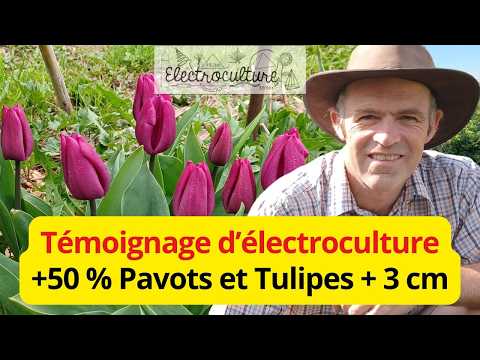
The measurements recorded during the demonstration reveal a significant disparity in growth. In the area enhanced by electroculture, the poppies and tulips both measure approximately 32 to 33 cm in height. Conversely, in the control area, the tulips reach only 26 to 28 cm, and the poppy is notably stunted at just 15 cm. Van Doorne points out that the plants in the experimental zone also appear to be developing faster, suggesting they will bloom sooner than those in the control group.
Regarding the range of these devices, Van Doorne notes that spirals have a very localized effect. However, the round towers have a much broader reach, radiating energy across a radius 10 to 20 times their height. This means a 50 cm tower can influence a garden space of 5 to 10 meters. He also highlights the utility of paramagnetic cones made of basalt. These are ideal for fruit trees and can be buried during planting or placed on the soil surface. While a single cone has a limited influence of about 30 cm, a group of cones can create a collective energy field across an entire parcel. He concludes by showing a cone placed next to a tree to aid its development and encourages viewers interested in these techniques to engage with his community.