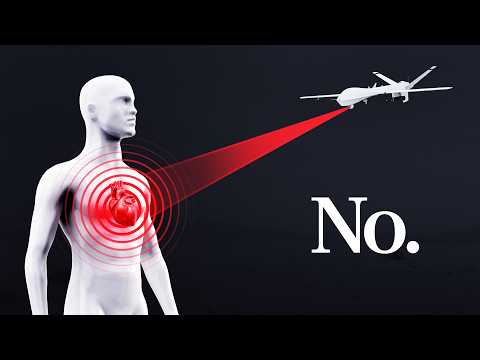
Can the CIA really track your heartbeat from 60 km away?
AI Summary
On April 3rd, 2026, an American fighter plane was shot down over Isfahan, Iran. The pilot was rescued quickly, but the weapon system officer (WSO) landed deep within hostile territory, injured. He had a rescue beacon but could only use it sparingly to avoid detection. The US needed to pinpoint his location in hundreds of square kilometers of desert. Surprisingly, the WSO was rescued just 40 hours after the crash.
According to a New York Post article, the CIA deployed a futuristic device called "Ghost Murmur" that could detect the magnetic field produced by his heartbeat from kilometers away. This technology would need to overcome magnetic signatures from other sources like soldiers, vehicles, animals, and Earth's magnetic field. The article stated that advances in quantum magnetometry, specifically sensors built around microscopic defects in synthetic diamonds, made this possible. This claim sparked a media frenzy, with many questioning its feasibility.
To determine if Ghost Murmur is fact or fiction, we investigated three key aspects: whether the heart produces detectable magnetic fields, what these synthetic diamonds are, and if detection at such distances is possible.
Our bodies generate faint magnetic signals from electrical impulses. The heart muscles, firing in a coordinated way, produce the strongest magnetic field in the body, around 50 to 100 pico Teslas. This is 10 to 100 times stronger than the brain's field, but still a million times weaker than Earth's magnetic field. The heart's magnetic field was first detected in 1963, requiring remote, still environments to avoid magnetic noise.
In the 1970s, superconducting quantum interference devices (SQUIDs) were developed, capable of detecting fields as weak as a few femto Teslas. The US military attempted to use SQUIDs to detect submarines, but the project didn't gain traction. While SQUIDs could detect heart magnetic fields, they required tightly controlled, shielded conditions and couldn't handle large background fields or electromagnetic interference, making them impractical for field use.
However, in the 1990s, physicists began exploring diamonds as potential magnetic field sensors that could overcome these drawbacks. These "new quantum magnetometers work at room temperature operation" and are "solid state sensors," making them more robust and practical. These are the synthetic diamonds mentioned in the New York Post article.
A pure diamond, an ordered lattice of carbon atoms, does not meaningfully react to magnetic fields. But introducing defects changes this. Replacing a carbon atom with nitrogen and removing an adjacent carbon creates a nitrogen-vacancy (NV) center. These NV centers become useful when they trap two unpaired electrons, which possess an intrinsic property called spin, analogous to tiny bar magnets. An electron's spin aligns with or against an external magnetic field.
The two trapped electrons in an NV center can arrange their spins in three ways, corresponding to spin magnetic quantum numbers (ms) of 1, -1, or 0. This ms number acts as a bar magnet for the entire NV center, making it sensitive to external magnetic fields.
To measure this response, light is used. Atoms absorb light if the photon has enough energy to excite an electron to a higher energy level. In a pure diamond, the large band gap means only ultraviolet photons are absorbed, making it transparent to visible light. However, defects like NV centers create "secret platforms" or different energy levels within this band gap, allowing nearby electrons to jump to them by absorbing lower energy light.
The NV center generates unique energy levels for its trapped electrons. The lowest level actually contains three closely spaced energy levels, corresponding to the three possible ms numbers (0, -1, 1). The ms=0 state is the lowest energy, while ms=1 and ms=-1 states are at an equal, slightly higher energy. A microwave photon of 10.4 centimeters is enough to jump between these levels.
Applying a magnetic field causes the +1 and -1 energy levels to shift, a phenomenon called Zeeman splitting. The ms=-1 level drops slightly, and the ms=1 level rises slightly, while the ms=0 level remains unchanged. The stronger the magnetic field, the further apart these levels become. This relationship is described by a formula linking the energy split to the magnetic field strength.
In the presence of a periodic magnetic field, like that from the heart, a rhythmic separation of these lines would theoretically be observed. These two energy levels absorb light at different microwave wavelengths, which change depending on the field strength. By measuring the spacing of these absorption lines, the magnetic field strength can be determined. This is how an NV diamond magnetometer works.
While NV diamond magnetometers have been used to detect magnetic fields generated by neurons (first seen in 2015), detecting a heartbeat from kilometers away is far more challenging. In 2022, researchers detected a rat's heart magnetic field, but it required an open chest and the diamond being less than two millimeters from the heart.
The strength of a magnetic field falls off with the cube of the distance. If a heart's magnetic field is 50 pico Tesla at the chest, it drops to 5 x 10^-20 Tesla at 100 meters. At 50 to 100 kilometers, this could be as low as 10^-30 Tesla. Experts state that the most sensitive measurements ever made at heartbeat frequencies are at 10^-15 Tesla in a shielded room. This means a system would need to be 15 orders of magnitude more sensitive than SQUIDs and 18 orders of magnitude more sensitive than diamond NV sensors, which sounds unfeasible. Moreover, the hills of Iran are not devoid of animal life, which also have heartbeats, and there's the magnetic field of the drone or helicopter the device would be mounted on. A magnetic field of 10^-30 Tesla is even weaker than an electron's magnetic field a meter away.
Given the New York Post's reputation for "amusing fiction" and the existence of known rescue beacons, the Ghost Murmur story is likely a fabrication or a deception story, possibly intended to protect a vulnerability or distract from real intelligence methods, much like the World War II myth about carrots improving night vision to cover up radar technology.
However, the secrecy surrounding NV diamond research, with many experts signing NDAs, suggests something confidential is at play. NV centers in diamonds are also used for quantum computing and, more interestingly, as navigation devices. Earth's magnetic field creates a unique pattern globally, and NV magnetometers could potentially be used to infer location without GPS, which is increasingly vulnerable to spoofing and jamming.
So, NV magnetometers with synthetic diamonds do exist and have potential military applications, but detecting heartbeats kilometers away is likely not one of them.