Finding and Funding a Good Life
Audio Summary
AI Summary
This discussion, deemed potentially the most important ever, aims to redefine personal finance beyond merely accumulating money. While money is a crucial tool for living and problem-solving, it is not the ultimate goal. Instead, personal finance should be about funding a "good life," a subjective concept yet extensively researched for its common elements. Many societal perceptions of what constitutes a good life contradict reality.
A "good life" can be measured in two ways: experienced (hedonic) happiness, which is how one feels in the moment, and reflective (eudaimonic) happiness, which is an overall evaluation of one's life. Both are vital. For instance, one might have a life that appears good on paper (job, house, family) but feel constantly stressed, or conversely, enjoy daily pleasures but feel unfulfilled upon reflection. This tension complicates the definition of a good life.
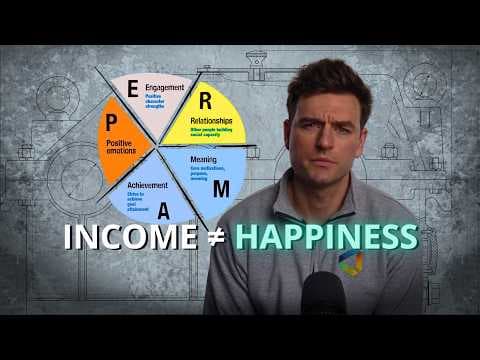
The PERMA-V model from positive psychology offers a framework for understanding human well-being. Its factors — Positive Emotion, Engagement, Relationships, Meaning, Accomplishment, and Vitality — indicate what generally contributes to well-being, though without prescribing optimal allocations.
* **Positive Emotion:** Feeling good, like enjoying a meal or a walk.
* **Engagement:** Being absorbed in a challenging task that matches one's skills, known as a state of flow.
* **Relationships:** Having strong connections with friends and family.
* **Meaning:** Belonging to and serving something larger than oneself, like community involvement or religious groups.
* **Accomplishment:** Achieving difficult goals for their inherent value, such as mountaineering.
* **Vitality:** Prioritizing physical well-being through good eating, sleeping, and exercise.
Many erroneously believe that a promotion, a big stock win, or a lottery jackpot will automatically lead to a good life. However, the pursuit of money itself can be detrimental. While a baseline income is necessary, the relationship between money and a good life becomes complex thereafter.
A 2010 study suggested that life evaluation steadily increases with income, but experienced happiness plateaus around $75,000 (approximately $112,000 today). This indicated that high income buys life satisfaction, but not necessarily daily happiness, and low income correlates with both low life evaluation and emotional well-being. A 2018 study identified income satiation points: about $105,000 for life evaluation in North America (around $137,000 today) and $65,000 for experienced happiness (around $85,000 today). Interestingly, some regions, including North America, showed a decline in life evaluation at the highest income levels. This decline might not be due to the income itself, but rather associated factors like increased demands on time, less leisure, greater materialism, and heightened social comparison.
A 2021 study, using real-time smartphone reports, found that both experienced and reflective happiness continued to increase with higher incomes, with no observed satiation point. To reconcile these conflicting findings, the authors of the 2010 and 2021 studies collaborated on a 2023 paper. They discovered that happier individuals experienced increased well-being at higher income levels, while less happy people saw their happiness plateau at higher incomes, aligning with the earlier finding.
It's crucial to note that these studies examine the relationship between log-scale income and happiness, meaning each income point represents a doubling, not a linear increase. Even with these significant income jumps, the correlation between income and happiness is weak. For instance, a four-fold income difference is roughly equivalent to the happiness effect of being a caregiver for a disabled family member, twice the effect of being married, and less than a third of the effect of a headache. Given this small impact, people often overestimate how much happier more money would make them. Even the wealthiest tend to believe they need significantly more wealth to be perfectly happy. Individuals focused on extrinsic goals (money, fame, image) tend to be less happy and overestimate the emotional benefits of achieving these goals. Therefore, while more money is beneficial, its impact on well-being is limited, and its pursuit for its own sake can be detrimental.
Setting financial goals is challenging because people are poor at predicting future happiness due to adaptation. We quickly adapt to new circumstances, even major financial changes like winning the lottery. Big financial goals, like buying a larger house, offer only a short-term happiness boost before fading—the "hedonic treadmill." We often focus on single large future achievements without considering how they will affect our daily time, which is more predictive of happiness than stable circumstances. Personalities, values, and preferences also evolve, but people tend to believe their current self is their permanent self—the "end of history illusion." This makes setting long-term goals based on current desires risky, as future selves might not resonate with them.
Given these challenges, it's sensible to focus on how financial decisions impact how we spend our time, rather than striving for a perfectly imagined future, especially if the path to that future makes the present unpleasant. While adaptation is common, some negative circumstances are harder to adapt to, such as noise (especially variable or intermittent noise) and a lack of control over one's circumstances. Commuting in traffic, for example, increases stress and is not easily adapted to. Social comparison is another happiness drain, often leading people to live beyond their means, jeopardizing financial security.
To cultivate a good life, embrace positive emotion, engagement, relationships, meaning, accomplishment, and vitality. Money provides some happiness, but less than expected, and how we spend our time is a major determinant of well-being. Prioritizing time over money by, for instance, working fewer hours, generally leads to greater happiness, better social connections, and more enjoyable work, even if it means less income. Regularly assessing how time is spent and considering trading money for time to align with one's definition of a good life is a valuable exercise.
Housing, often the largest expense, is a basic need. While homeownership offers stability and control (like installing a basketball hoop), studies in Canada, Switzerland, Germany, and the US suggest that homeowners are not inherently happier than renters, after controlling for other factors. Homeownership also demands significant time for maintenance, akin to a second job, which may detract from more enjoyable activities. The decision to buy a home, or a cottage, should be approached cautiously, considering how it affects time, relationships, and potential stressors like maintenance and commutes, rather than just the perceived benefits of ownership.
When spending discretionary money, experiences generally yield more happiness than material possessions. Experiences foster engagement, are more likely to be shared (strengthening relationships), and are remembered and anticipated more vividly. They are also harder to adapt to than static things. While not all material purchases are bad, it's worth evaluating their contribution to a good life.
Financial independence and security are common goals, offering a sense of control. Saving for financial independence is a valid objective but must be balanced against living well today. Work, when enjoyed, can contribute significantly to engagement, meaning, and accomplishment. Some studies show purpose loss in retirement, while others indicate purpose gain when leaving dissatisfying jobs. Planning to work longer in an enjoyable job can free up more spending for today.
To navigate the uncertainty of future happiness, making frequent, small, experiential purchases is often better than fewer large material ones. These purchases should contribute to positive emotion (e.g., savoring coffee), engagement (e.g., a hobby), relationships (e.g., dinner with friends), meaning (e.g., community spending), and accomplishment (e.g., a course). The simple test for expenses is to consider how they impact your time and whether that aligns with your definition of a good life.
Regret also offers insights into a good life. People often regret inactions more than actions, and these regrets tend to linger. Playing it safe in financial decisions, like declining a job offer or not starting a business, might feel painless initially but can lead to long-term pain from missed opportunities. Compounding also plays a role in regret; small daily decisions, like poor eating or insufficient saving, have minimal immediate impact but lead to irreversible states later in life. The human brain struggles to process these long-term compounding effects.
Finally, setting meaningful goals is crucial. When asked directly, people often state surface-level goals (e.g., "I want to retire"). Using categorical prompts, like the PERMA-V model, or a master list of goals, helps elicit deeper, value-driven objectives. A study conducted by the