Bitcoin Looks Boring Right Now. That’s the Signal.
AI Summary
The market is showing resilience, with Tesla experiencing a nearly 7% surge. MicroStrategy had a notable trading anomaly earlier in the day, though its exact nature is unclear. NVIDIA continues its strong upward trend, up 9%.
In the crypto space, Bitcoin and Cardano are both hedged against each other and currently in a loss. Bitcoin has encountered resistance at the yellow marked upward channel. A break above this resistance could lead to a significant bounce, potentially towards $83,000-$87,000.
Oil is showing signs of a breakdown, trading outside its channel on smaller timeframes, with a breakdown and retest currently in play. It remains uncertain whether it will resume its downward trend or re-enter the channel.
The S&P 500 is exhibiting potential triple top formation. While double and triple tops can be resistance levels, they are also often broken. A breakout above this level could catch traders off guard, but a subsequent retest will be crucial to determine its sustainability. A sharp ascent often leads to mean reversion. The current narrative appears to favor continued market extension, supported by strong CTA buying this week. Earnings from hyperscalers and big tech are a key focus in the coming weeks.
Tech stocks are lagging slightly, with the NASDAQ less than a percent away from its all-time high. The speaker questions whether this is indicative of a bear market or recession, especially given the economy's resilience. However, a worsening situation with Iran and sustained high oil prices could pose a significant problem, potentially leading to stagflation – a scenario of declining growth and rising inflation, which is detrimental to risk assets.
The US appears to be in a position of strength regarding geopolitical tensions, possibly using a show of force to bring Iran to the negotiating table or as a prelude to further action. This strength is expected to be maintained leading up to elections.
The US Dollar is breaking down, retesting support around 98 and potentially heading towards 96. This weakness in the dollar favors global liquidity. The Fed's balance sheet is expanding, now at $40 billion per month, which is seen as a form of quantitative easing disguised as reserve management. This increase in liquidity is generally bullish for risk assets, although it can take several weeks to permeate the system.
While M2 is a poor indicator, the monetary base is rising. Bitcoin's price action mirrored the decline in the monetary base, and it is now stabilizing. The speaker believes the current market strength is due to liquidity rather than a cyclical bear market, but acknowledges the risk of stagflation if energy prices remain elevated. Such a scenario would be devastating for risk assets.
Ethereum is approaching a critical break point, currently in a strong downtrend and facing heavy resistance. The market has seen a significant rally in equities, with an 8-day streak of up days and a 13-14% rally from the lows. The question is whether this move has been too fast and if it's forming a triple top. The speaker contrasts the current situation with the 2000 and 2007-2008 periods, noting that while there are similarities in drawdowns, the current market structure, particularly the retest of the November-March all-time high without taking out the previous low, looks structurally sound.
CTAs have been actively selling on the way down and buying on the way up, while hedge funds have led this recent squeeze, which is unusual. Retail investors are perceived as not leading this rally and are currently buying puts out of fear.
The speaker emphasizes that the market's resilience in brushing off geopolitical events and economic concerns is a strong signal. However, the impact on earnings and future expectations for companies needs to be monitored. There's a notable pullback in hyperscalers' data center investments due to energy constraints, with available compute being bought up but limited by energy supply. The potential impact of upcoming IPOs from companies like Anthropic and SpaceX on liquidity is also a consideration.
Regarding Tesla, there's speculation about news-related catalysts, such as the Shanghai production plant becoming a hub for Optimus production. It's unclear if this is driving the current price action. The speaker highlights the importance of knowing when to take profits or add to positions, especially at resistance levels.
The CTM V4 system is showing strong performance, with TQQQ up 10% and NVIDIA also performing well. A pure play on NVIDIA without V2 filters entered quicker and is showing higher profits, though the V2 system with all filters is also performing well. Forward testing of both versions is planned.
MicroStrategy is also showing signs of entering the market, a significant development for the year. While these entries could be at a top, the mechanical systems lack emotion and will exit if momentum turns. The speaker notes that equities are now beginning to lead, which is a positive sign following the halt of QT and the start of balance sheet expansion. This market shift is described as a "war" that has affected the macro but has so far been shaken off by the market.
A forward test on FNGU (long) and FNGD (short) is working well. NVIDIA and MicroStrategy are showing potential long entries, and Tesla is catching up after a significant decline. The Tesla V2 system had a tight stop and successfully exited the market before a 30% drawdown, highlighting the value of knowing when to be in or out of the market.
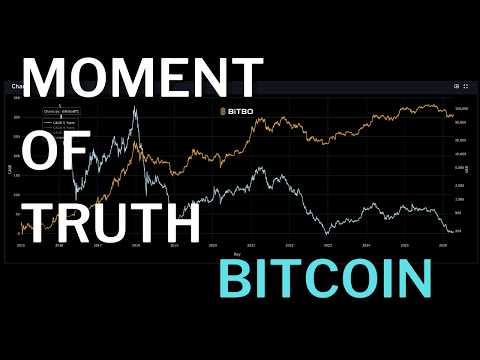
Spot Bitcoin ETFs (GBTC, IBIT) are lagging but approaching long entry signals, similar to Bitcoin's bull runs. Bitcoin itself is described as "boring" and a good time for accumulation, despite being at resistance. Historically, periods of low 5-year CAGR have led to significant gains in the following years, and the speaker believes this could be another such opportunity, despite predictions of a 2026 bear market recession.
Bitcoin has tagged its previous highs, and breaking above the upward sloping yellow resistance line could trigger sharp upside momentum. Ethereum is also at resistance. While Bitcoin miners are a point of discussion, the speaker is unsure about their transition to different energy contracts and chip types. NVIDIA is benefiting from this transition.
Equities have seen a remarkable 14% gain in the last 10 days, raising questions about sustainability. The speaker reiterates that knowing when to be in the market and on which side is crucial. The conflict situation and potential US-China agreements are also factors. Crude oil's price action is being watched closely for potential liquidity grabs or a move back up the range.
The speaker finds oil and gas ETFs like GUSH to be less ideal for momentum-based trading, despite their volatility. Commodities are seen as interesting, with a long-term holding strategy in raw materials making up 25% of the portfolio. Momentum plays in tech, such as NVIDIA, Tesla, TQQQ, FNGU, and Bitcoin ETFs, are used to supplement this longer-term portfolio.
Bulls, a tech-related ETF, is performing well with a 50% CAGR, and similar to FANG, is seen as having significant upside potential. Gold and silver have been outperformed by active trading, but the speaker seeks more robust solutions and is open to new assets.
The speaker concludes that while Bitcoin appears boring, it presents an opportunity for accumulation. The leading role of tech, coupled with stabilizing monetary base, suggests that Bitcoin could soon play catch-up. The market remains resilient, but uncertainty persists. A breakdown in the S&P 500 could lead to a sharp mean reversion. The key is to navigate day by day, and the speaker encourages viewers to like the video and have a blessed day.