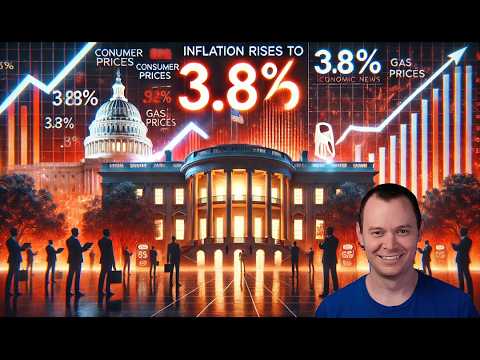
Inflation Rises to 3.8%
AI Summary
Headline inflation has risen to 3.8%, primarily driven by a supply-side energy crisis stemming from geopolitical conflicts in the Middle East, rather than increased demand. This surge in energy prices has significantly impacted markets, particularly higher-risk assets compared to lower-risk ones. While the S&P 500 remains near all-time highs, the inflation rate coming in hotter than expected (3.8% vs. 3.6-3.7% expected, and core inflation at 2.8% vs. 2.6-2.7% expected) has drastically shifted expectations for rate cuts.
The market now anticipates no rate cuts in 2026 or 2027, and it's even considered more likely to see a rate hike in 2027 than a cut. This is a complete reversal from last year's outlook, which priced in several rate cuts for 2026. Despite this, some pockets of optimism persist in the market, with the S&P M2 correlation appearing intact. However, the impact is evident in higher-risk assets like altcoins, which are bleeding against Bitcoin, driving up Bitcoin dominance. This trend reinforces the long-held understanding that crypto is more sensitive to liquidity and rate cuts than the stock market, largely due to its speculative nature and lack of traditional earnings reports. Without the necessary liquidity and rate cuts, these assets continue to underperform.
The current inflationary spike raises concerns about its duration and potential for a sustained inflationary wave, similar to the 1970s, which would have negative consequences for the stock market, as seen in 2022. The Federal Reserve faces a potential "checkmate" scenario. Its dual mandate is maximum employment and price stability. While the labor market has been cooperating, with a relatively flat unemployment rate and low initial claims and layoffs, a weakening labor market combined with rising inflation would create a difficult situation for the Fed. They cannot cut rates too soon without risking a resurgence of inflation, as occurred in 2022. The administration's desire for rate cuts, while simultaneously contributing to an energy crisis, complicates the Fed's position.
Looking at specific categories, year-over-year inflation shows food and beverages above 3%, housing increasing from 3.37% to 3.63% (a significant contributor to the hot CPI print), apparel back up to 4%, and transportation nearing 7% (its highest since 2022). Core inflation has also shown a concerning trend, rising from a low of 2.47% in February to 2.74%. The resolution of geopolitical conflicts and the energy crisis remains uncertain, but historically, a rise in oil prices in a late business cycle environment often leads to the end of the cycle because the Fed gets "checkmated."
The "checkmate" analogy highlights the Fed's ability to address one weakness (e.g., weak labor market by lowering rates, or rising inflation by raising rates) but not two simultaneously (rising inflation and rising unemployment). We are not at that point yet, as the labor market has not shown significant weakness, partly due to the stock market remaining at all-time highs. A key indicator to watch for a potential recession is initial claims, which have remained around 200k for several years; a jump to 300k would signal a recession.
The S&P's continued all-time highs are bullish for energy stocks, as historically, energy has topped after the broader stock market in a late business cycle environment. This was observed in 2000, 2022, and the financial crisis of 2007-2008. While index funds are generally advisable for the long term, investors should be mindful of expense ratios. The primary market concern is the combination of rising inflation and potential labor market weakness. Higher-risk assets like crypto are particularly vulnerable to these dynamics. The current market, while tough, still shows strength in energy, manufacturing, and potentially metals like gold in the latter half of the year. The question remains whether the 3.8% inflation is a one-off or a continuing trend, contingent on the resolution of the geopolitical conflict and energy crisis.