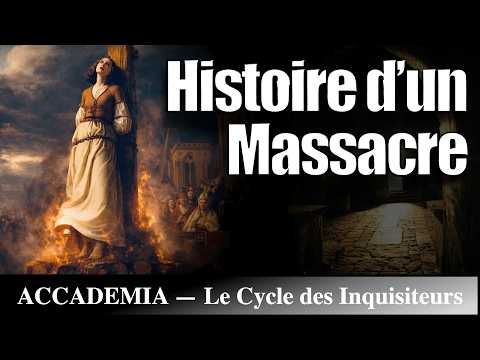
La Chasse aux Sorcières : Histoire d’un massacre - Le Cycle des Inquisiteurs
AI Summary
This episode of L'Academia for March 2026 delves into the broad concept of "inquisitors," extending beyond the historical Catholic Church organization to encompass any ecclesiastic, judge, magistrate, philosopher, or theologian who opposed, combatted, and, to some extent, persecuted certain philosophical and mystical currents. This episode specifically focuses on the "hunt for witches."
The discussion begins by defining witchcraft. Etymologically, the term derives from the Latin "sortiarius," meaning "to cast spells" or "to tell fortunes." In ancient Greek, "goessia" referred to the art of invoking spirits. Modern definitions often associate witchcraft with negative magical practices, aiming to harm individuals, animals, or plants, and causing misfortune. However, the speaker emphasizes that the original meaning of "sorcellerie" (witchcraft) was more neutral, referring to someone who could "tell sorts" or consult destiny, implying the ability to alter or change fate through invisible forces, natural laws, or otherworldly entities. This original sense was neither inherently good nor bad; the morality of the act depended on the individual's intentions.
The history of witchcraft is then explored, starting with its origins, which are difficult to pinpoint due to the lack of written records from prehistory and protohistory. However, it's understood that as human consciousness emerged, so did the need to explain the inexplicable – death, disease, natural disasters. Beyond rational means, supernatural methods were sought, akin to how religions conceptualized gods or invisible forces to explain the cosmos. Witchcraft, in this sense, is seen as a practical application of interacting with these invisible forces to influence reality. Anthropological methods, comparing prehistoric archaeological findings with the practices of so-called "primary societies" from the 19th and early 20th centuries, suggest that magical practices aimed at influencing destiny have existed since ancient times.
In antiquity, a distinction began to emerge between official religion and marginal magical practices. While early societies had codes of totems and taboos, designating actions as "licit" or "illicit" magic, antiquity saw a more pronounced separation. In Egypt, Mesopotamia, and Greece, organized clergy performed public rituals, which could be seen as a form of "licit" magic integrated into religion. However, practices outside this religious framework were considered marginal magic or "goessia." Figures like Circe and Medea in Greek mythology, and the Witch of Endor in the Bible, are mentioned as early representations of individuals wielding significant, often feared, powers. In Egyptian and Mesopotamian cultures, specific deities were associated with magic, such as Isis and Thoth. Methods employed by ancient sorcerers included curse tablets, enchantments, and, in less negative contexts, divination and necromancy.
The legal perspective on witchcraft evolved over time. In antiquity, there wasn't a widespread "witch hunt" as understood later, but legal representations of hostile magical practices existed. The focus was on harmful magic, not magic in general. During the early Middle Ages, witchcraft was often viewed as illusion or superstition rather than a genuine crime, with condemnation often directed at pagan worship or charlatanism as Christianity gained prominence. However, by the late Middle Ages (13th-15th centuries), witchcraft began to be considered a real, diabolical crime, often assimilated with heresy. The concept of pacts with the devil emerged, a crucial development for the later persecutions. In the early modern period, witchcraft was perceived as an organized, collective threat, leading to mass trials and executions, characterized by the idea of a "satanic conspiracy." This period, from the Renaissance to the early modern era, marked the peak of witch hunts, contradicting the notion that they stemmed solely from medieval obscurantism. By the contemporary period (19th century onwards), witchcraft largely exited penal law, reverting to superstition.
The speaker highlights that the condemnation of magic and witchcraft was not exclusive to Europe or Christianity. Ancient Mesopotamia had laws against sorcery, as seen in the Code of Hammurabi, which used ordeals like river trials to determine guilt. The Neo-Assyrian laws and later Mesopotamian codes also addressed magic. The Hebrew Bible explicitly condemns sorcery, with passages in Exodus and Deuteronomy mandating the death penalty for sorcerers, diviners, and necromancers. This marked a significant rupture by condemning all forms of magic, not just harmful practices. Ancient Greece and Rome also had laws against certain magical practices, particularly those that harmed society or public order, like poisoning or profaning graves. However, they didn't condemn magic universally. India also had laws against harmful magic. The Code of Theodosius in the Roman Empire, after its Christianization, began to condemn certain harmful magical practices, showing a gradual shift influenced by Abrahamic legal models. In the Islamic world, from the 8th century onwards, "shirk" (sorcery) was condemned in religious law, mirroring the Jewish prohibition of all magic. Japan also had regulations concerning magic. The speaker notes that the global condemnation of all magical acts is a specificity of Abrahamic religions.
Examples of trials and executions for witchcraft predate the major European witch hunts and occurred outside Europe. These include incidents in ancient Egypt (conspiracy against Ramses III), ancient Greece (the trial of Theoris of Lemnos), Rome (accusations of poisoning and bacchanals), China (Han Dynasty), and later in the Persian world, the Ottoman Empire, Korea, West Africa, and the Kingdom of Congo. While precise statistics are scarce, it's estimated that tens of thousands of people were accused, condemned, and executed for witchcraft outside of Europe throughout history.
Even in the contemporary world, accusations and persecution of witchcraft persist in some regions, particularly in sub-Saharan Africa, India, Pakistan, Afghanistan, and parts of the Middle East. These accusations are often linked to illness, misfortune, or social issues, with individuals blamed for unexplained events.
The episode then examines who these accused witches were. They were individuals believed to possess occult knowledge linked to invisible forces, often associated with pagan traditions or popular beliefs outside mainstream Christianity. The link to Satanism is presented as a later construction. While both men and women were accused, female figures were more frequently marginalized. Common accusations targeted old, isolated women, healers, midwives, widows, and attractive young women perceived as dangerous. Men accused included astrologers and alchemists, but they were generally less associated with social marginality. The speaker explains that old women were targeted due to their perceived possession of knowledge and power, while attractive young women faced jealousy and resentment. Healers and midwives, involved in life and death, were also vulnerable targets, accused of using their knowledge for malevolent purposes or making pacts with the devil. Several historical cases are highlighted, including Alice Kyteler, Jeanne de Brige, Antoinette Villard, Rosette Curtis, Ursula Kemp, Elisabeth Soyer, Isabeau Shinny, and Jeanette Dabady, illustrating the varied backgrounds and often tragic fates of those accused. The role of figures like Pierre de Lancre, a judge who believed in demonic organs in witches and performed gruesome "autopsies," is also mentioned.
The primary accusers were not solely religious or political authorities but also members of the immediate community: neighbors, family, local clergy, and individuals feeling wronged. Personal disputes, land conflicts, financial grudges, and marital issues often fueled accusations. Fear and the need for scapegoats also played a significant role. While religious and secular authorities were involved, the speaker emphasizes that the majority of accusations during the major European witch hunts came from secular courts, though religious figures initially contributed to the demonization of witchcraft. The episode concludes by mentioning that the next installment will focus on the "great witch hunt" of Europe, from heresy to the invention of the satanic conspiracy, and the subsequent closing of the cycle.