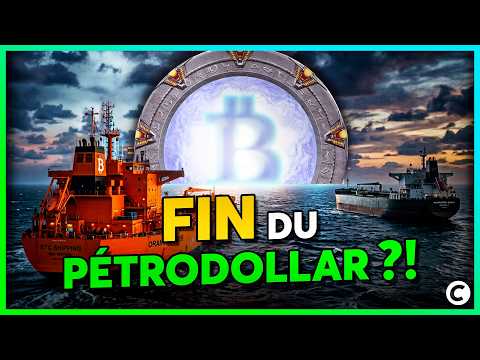
L'Iran fait payer le pétrole mondial en Bitcoin ?!
AI Summary
The video discusses a significant geopolitical and financial development: Iran's imposition of a passage fee for ships transiting the Strait of Hormuz, payable in Bitcoin. This situation is framed as a real-world test of Bitcoin's core principles and its potential role in international finance, particularly for nations under sanctions.
Normally, approximately 20 million barrels of oil pass through the Strait of Hormuz daily, representing about one-fifth of global oil supply. This includes a substantial portion of China's and Japan's oil imports. The strait is a critical chokepoint, and disruptions there have immediate and significant global economic consequences. In late February 2026, maritime traffic in the strait plummeted by 90%, leading to a surge in oil prices, exceeding $100 per barrel, and triggering the most severe oil crisis since the 1970s. This caused states of emergency in countries like the Philippines and encouraged teleworking in Thailand and Vietnam to conserve fuel.
On April 8th, an announcement of a two-week ceasefire between the United States and Iran signaled the potential reopening of the strait. However, Iran introduced an unprecedented condition: ships wishing to pass through Hormuz must first submit a detailed manifest to Iranian authorities. Iran would then assess the vessel, determine a toll, and require payment within minutes. The chosen payment method? Bitcoin.
The financial implications are substantial. A fully loaded supertanker carries approximately 2 million barrels of oil. At a $1 per barrel toll, this amounts to a $2 million Bitcoin fee per supertanker. Analysts suggest this system could generate up to $20 million daily for Iran, potentially reaching $600 to $800 million per month if liquefied natural gas carriers are included. This translates to roughly thirty Bitcoin transactions per day for each vessel.
The choice of Bitcoin is directly linked to Iran's long-standing international sanctions, imposed in 1979. These sanctions have effectively cut off most Iranian banks from the global financial system, making SWIFT inaccessible. Furthermore, Iran's national currency, the Rial, has been devalued by hyperinflation, rendering it nearly worthless. Bitcoin, therefore, emerges as a crucial, albeit unconventional, alternative for Iran to circumvent these financial restrictions.
Remarkably, even former U.S. President Trump's reaction to this development was described as considering a "joint venture," a stark contrast to previous threats. While the full implications of this statement remain unclear, it highlights a potential shift in approach.
This situation is not a sudden development for Iran. Data from Chainalysis indicates that Iran's regime has systematically built a sophisticated network of crypto wallets over several years to bypass sanctions. This includes facilitating transactions for oil, weapons, and raw materials through alternative channels. Iran has become a case study in cryptocurrency adoption driven by geopolitical pressure, with its crypto ecosystem reportedly exceeding $7 billion, fueled by internal instability and external military threats. The use of cryptocurrency by the Revolutionary Guard and even its central bank underscores its emergence as a significant financial pillar for both the regime and its population. The Hormuz toll is thus presented not as a gamble, but as the public emergence of an infrastructure that previously operated in the shadows.
The video then delves into game theory, explaining how Bitcoin's design inherently facilitates such scenarios. Game theory studies decision-making when outcomes depend on the choices of multiple actors. It explains phenomena ranging from nuclear deterrence to corporate pricing strategies and natural cooperation among competing species. The "Prisoner's Dilemma" is a classic example: individual rationality can lead to collective disaster if all actors choose the most self-interested option without considering the consequences for others. The "Nash Equilibrium," named after mathematician John Nash, describes a stable state where no player can improve their outcome by unilaterally changing their strategy.
Satoshi Nakamoto's genius, according to the video, was embedding these game theory concepts into Bitcoin's code. Bitcoin enables thousands of unknown, untrusting individuals to cooperate not out of altruism, but out of self-interest. The mining process, where computers solve complex mathematical puzzles, exemplifies this. Proof-of-work incentivizes miners to validate transactions honestly. If a miner attempts to cheat by including a fraudulent transaction, their block is rejected by the network, and all their expended energy is wasted. Conversely, playing by the rules guarantees payment. This creates a near-perfect Nash Equilibrium: cheating is prohibitively costly and unrewarding, while honest participation is the most profitable strategy. Bitcoin, therefore, doesn't require trust or morality; it makes cheating irrational. As Bitcoin's value increases, the rewards for honest miners grow, and the cost of attacking the network escalates, creating a self-reinforcing security loop.
The critical question then becomes: what happens when entire nations, not just individuals, engage with this system? Governments face a global Prisoner's Dilemma. Option A: adopt Bitcoin early, develop infrastructure, mine, and accumulate, gaining a technological, financial, and strategic advantage. Option B: ban or heavily regulate Bitcoin, maintaining short-term control but risking capital flight, loss of developers, and innovation to countries that embrace it. The tipping point occurs when a major player adopts Option A, drastically increasing the cost of resistance for others. The U.S. announcement of a strategic Bitcoin reserve is presented as such a tipping point, placing other nations at a disadvantage if they haven't already adopted it.
The concept of the "Schelling Point," developed by Nobel laureate Thomas Schelling, is introduced. It describes a solution that people tend to converge on when coordinating without explicit communication, often because it's the most obvious or natural choice. For instance, meeting at the Eiffel Tower in Paris without further instruction. Bitcoin, the video argues, is becoming the Schelling Point for global currency – a neutral asset that everyone converges upon in the absence of trust.
The Strait of Hormuz situation is presented as a prime example of this in action. Iran and the U.S. are adversaries with no trust, no shared banking system, and no mutually acceptable currency. Yet, they need a way to facilitate oil transit and a settlement tool that doesn't rely on the other. Bitcoin provides this solution. It's the only asset that works for both sides without intermediaries, permission, or the risk of seizure. The Iranian Rial is worthless, Chinese Yuan involves too much political dependency, and stablecoins like USDT and USDC have backdoors for government intervention.
The video acknowledges that Iran also uses Bitcoin for illicit activities like money laundering, emphasizing that the tool is neutral and serves both admirable and objectionable causes. Bitcoin operates with immutable rules, offering a level playing field.
The events at Hormuz are hailed as a significant milestone in Bitcoin's history. In an era of eroding international trust, the dollar's use as a geopolitical weapon, and the arbitrary cutting off of access to the global banking system, a neutral, open, permissionless, and verifiable protocol is gaining prominence. Satoshi Nakamoto's vision of an electronic payment system based on mathematical proof rather than trust is now being tested on the global stage, facilitating transactions between warring nations.
While the implementation of these tolls is still recent and its long-term effectiveness is yet to be seen, the video concludes that the protocol is functioning precisely as intended. The transcript ends with calls to action, encouraging viewers to join a Telegram channel for crypto news, check out partner offers from Bit Panda, explore Steady Lads for market analysis, and engage in the comment section to share their thoughts on the Iran-U.S. Bitcoin agreement and suggest future video topics.