Quand un développeur se met au marketing.
AI Summary
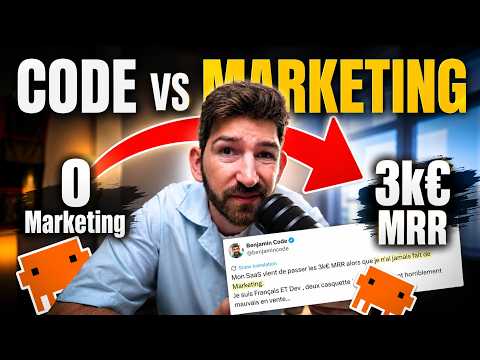
The speaker discusses their platform, “Mes Sponsor,” which connects YouTubers and partner managers with suitable sponsors. Over three years, the platform has grown from zero to €3300 in Monthly Recurring Revenue (MRR). The speaker initially worked intensely on it for seven months, released the first version, then made minor optimizations over two years, with significant periods of inactivity. For the past three months, they have been working full-time on Mes Sponsor, undertaking a major UX redesign and adding new features based on data and client feedback. The ultimate goal is to reach a point where the platform runs autonomously, generating passive income without requiring constant work.
The speaker addresses a common criticism regarding their claim of "never doing marketing" despite having a substantial YouTube following. They explain how they reached €3300 MRR without traditional marketing efforts. Firstly, they were a first-mover in the market, which, contrary to common advice, proved beneficial as competitors have since emerged, validating the market's potential. Secondly, although their YouTube audience isn't the direct target for Mes Sponsor, their channel visibility boosts the platform's search engine ranking, placing them at the top of search results. Thirdly, Large Language Models (LLMs) like ChatGPT and Claude frequently recommend Mes Sponsor to small YouTubers seeking sponsors, acting as an unexpected but powerful marketing channel.
The speaker acknowledges that their "accidental marketing," including building in public, SEO, and general visibility, could indeed be considered marketing. However, they clarify that they never engaged in intentional, classic acquisition tactics such as cold calling, paid ads, intentional SEO campaigns, or paying influencers. They mention one small campaign launched by a colleague a year ago to target French YouTubers, which generated some positive feedback but few long-term conversions, thus not contributing significantly to the current MRR.
Now, the speaker is actively exploring intentional marketing strategies. Their first step was to identify the primary target audience for their SaaS product. By analyzing data from PostHog, Lemon Squeezy, and their payment tool, they discovered that out of five initial offerings (Starter, Creator, Agent, Sponsor, and Small Player Plans), only Starter, Creator, and Agent Plans generated revenue. The other two were "dead code" that required maintenance without yielding results. Consequently, they eliminated the unprofitable plans, streamlining their offerings to three.
Further analysis revealed that "YouTube agents" were the most valuable customer segment. They subscribed for the longest periods and paid the most, understanding the tool's value and using it for multiple YouTubers. While creators remain important as their mass market, agents represent the most profitable and easiest segment to convert with targeted marketing.
The next challenge was finding these agents and their contact information. The speaker interviewed their own partner manager, Loïc, to gain insights into the role. Loïc explained that his job is to connect content creators with brands, understanding creators' projects and finding companies interested in influencer marketing. He highlighted Mes Sponsor's utility in identifying active companies in the sponsorship market, finding relevant contacts within those companies, and enabling personalized outreach based on past collaborations.
The speaker then outlines three methods for prospecting:
1. **Utilizing existing data:** Extracting emails associated with agencies from their current client base and non-converting sign-ups. This method is limited as these contacts have already interacted with the product.
2. **Manual searches:** Using Google, LinkedIn, Gini, and ChatGPT Search to manually find partner managers. This is time-consuming, with each contact taking approximately ten minutes to find.
3. **Smart, automated methods:** Realizing manual searches were inefficient, the speaker found a "goldmine" website: servicedirectory.youtube.com. This YouTube-managed site lists services for the YouTube ecosystem, including a directory of 123 agencies worldwide that manage YouTube talent and sponsorships. Each agency listing includes names of decision-makers.
To automate the data extraction from this directory, the speaker used Bright Data’s Managed Cloud Program (MCP). This tool, specifically Bright Data's scraping browser, can handle JavaScript, CAPTCHAs, and other website protections. It uses Scrapbatch to collect content from all 123 agency pages, outputting data in JSON or CSV format. It also leverages Serp API and LinkedIn to scrape contact information for individuals found on these pages.
The speaker used natural language to instruct Cloud (likely referring to an AI assistant integrated with Bright Data's MCP) to collect all contacts from the 123 agencies. A test run with 10 agencies yielded 5 verified decision-maker emails in under 5 minutes, plus 4 more based on naming hypotheses, which could be validated by a third-party service. Encouraged by this success, they launched the process for all 123 agencies, resulting in 109 contacts in under 30 minutes, without any manual effort. The speaker praised Bright Data's MCP for simplifying complex technical tasks, making powerful tools accessible through natural language interfaces, and saving significant time. They also noted that new users receive $15 in credit, which they hadn't fully spent despite extensive use.
With 109 emails acquired, the next step was to create a prospecting campaign. The speaker turned to Lemlist, an email outreach tool. Lemlist, like Bright Data, now offers an MCP, allowing integration with Cloud. The speaker instructed Cloud to create a prospecting campaign via Lemlist's MCP using the newly acquired contacts.
Cloud, through the nested MCPs, created a campaign consisting of two emails sent five days apart, with an A/B test for the first email. The emails were written by a "marketing skill" within Cloud, leveraging best practices for cold emailing and based on pre-existing marketing documentation about Mes Sponsor. This ensured the emails were tailored to the platform's value proposition and target audience. Cloud then automatically imported the contacts from Bright Data into the Lemlist campaign, preparing everything for launch within minutes, without the speaker having to interact with Lemlist's interface directly.
The speaker acknowledged the stress of sending out cold emails to new contacts, fearing they might "burn" the leads if the campaign isn't perfect. However, they advised sending the emails, as contacts can be re-engaged after six months, and initial campaign data can be used to refine future efforts. They also noted that Lemlist sends emails over 5-6 days to avoid being marked as spam.
Addressing GDPR concerns, the speaker clarified that GDPR primarily protects individuals from unsolicited marketing. However, business-to-business (B2B) communication on professional topics between companies is generally more flexible. The emails were sourced from public information scraped by Bright Data (LinkedIn, agency team pages, etc.), not private databases. Crucially, the speaker is contacting partner managers for a tool designed for partner managers, making the outreach highly targeted and relevant to their profession, and each email includes a one-click unsubscribe option. While not a legal expert, the speaker believes they are operating within acceptable professional boundaries.
Finally, the speaker shared the initial results of the campaign. Before launching, they consulted Cloud about success metrics, which suggested 2-5 responses from 100 emails would be a good outcome, with a "golden response" being a boss forwarding the email to the relevant team member. After only 17 emails sent, 50% were opened, and they received two responses. Both were "golden responses": one from a boss who was "hyped" and forwarded the email to the relevant person, and another from a team member who had received the forwarded email and was keen to discuss.
These early results significantly exceeded expectations. If this response rate continues, they anticipate around 10 replies from 100 emails. Given that an agent subscription costs €120/month and agents typically remain subscribed long-term, converting 10 agents could add €1000 to their MRR with minimal effort. The speaker expressed excitement about the potential, highlighting that this is just one of many marketing levers they plan to explore, including direct outreach to YouTubers, influencer marketing, and ads on platforms like Instagram and TikTok. They plan to provide an update on the full campaign results and MRR impact in a future video.