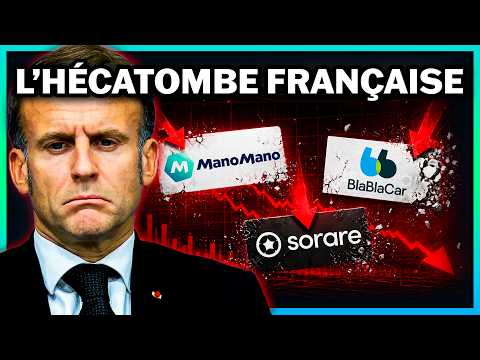
🔻 Le massacre silencieux des licornes françaises...
AI Summary
The number of French "unicorns" – startups valued at over a billion dollars – has significantly declined. Three years ago, France boasted 38 such companies, a figure proudly presented by President Macron. However, recent counts reveal only 23 remain, with many struggling. In the last five years, France has lost 39% of its unicorn population. Some have sought opportunities abroad, while others have seen their valuations plummet, pushing them out of the unicorn status and statistics.
Examples of this decline are stark. Sorare, a platform for fantasy football and NFT games on the blockchain, once valued at nearly 4 billion euros, is now worth around 240 million euros. Mano Mano, often called the "French Amazon" for DIY, experienced a 78% drop in value, falling from over 2 billion euros in 2021 to less than half a billion recently. Other companies like Jelly Mac and Payfit have seen similar significant losses of 78% and 65% respectively. This downturn affects the entire "startup nation," with even prominent French tech companies like Doctolib and Back Market, considered flagship examples of French innovation, experiencing substantial value erosion, though they still remain in the unicorn club.
A recent independent analysis by Mighty 9 examined 199 European unicorns across 25 countries. This "autopsy" compared their last valuation at funding rounds with their current market value, considering revenue, publicly traded competitors, and growth trajectory. Across Europe, 123 billion euros in value has evaporated, with France losing 11 billion euros. For every euro invested in European unicorns by recent investors, only 78 cents remain. Sixty unicorns out of 199 no longer meet the billion-euro threshold, with the UK showing a 37% loss in unicorn numbers and 28 billion euros in destroyed value, largely due to the struggles of blockchain companies like Blockchain.com and Immutable. Spain saw five of its unicorns fall, losing 63% of its capital, and Ukraine lost 80%.
Germany, however, fared better, with 33 unicorns and only a 24% loss in value. Notably, none of its unicorns critically distressed or relocated to the US. France, conversely, recorded the highest rate of relocation among major European nations, with one in four French unicorns moving to America. Even those that remain have suffered significant value drops, with Doctolib down 38%, CONT Square down 47%, and Back Market down 50%.
A common thread among these declining French unicorns is their peak funding rounds occurring between 2020 and 2022, a period characterized by historically low interest rates. During this "magic parenthesis" of zero-interest rates, money was cheap, and venture capital firms had ample funds to invest. Startups with promising ideas and well-crafted presentations could easily raise hundreds of millions. In fact, 60% of European unicorns were founded during this three-year window, and over half have struggled since interest rates began to rise.
However, the end of easy money isn't the sole explanation. European unicorns are also hampered by intense international competition, particularly from the United States. The US market offers a large consumer base, a single language, and a unified federal fiscal framework, leading to dominant players in most product segments. Europe, in contrast, often sees multiple competitors in the same segment, fragmented across different countries due to varying regulations, tax systems, languages, and accounting standards. For instance, a company like Payfit, which raised 434 million euros, operates in only three countries. This fragmentation prevents consolidation and traps startups within their domestic markets, hindering their growth potential. When a French startup realizes it cannot scale sufficiently at home, it often relocates. Hugging Face, Dataiku, and Algolia, all founded and developed in France with French engineers, are now based in the US. However, this expatriation has not necessarily salvaged their valuations; European unicorns that have relocated their headquarters to the US exhibit a valuation ratio of 0.71, even worse than the European average.
France faces several disadvantages against its American counterparts, with taxation being a significant hurdle. In the US, stock options are a crucial part of compensation for engineers and executives, attracting top talent. In France, these schemes are heavily regulated and taxed, diminishing their appeal. This leads to talent drain, and consequently, unicorns relocating to countries where capital and customers are more accessible.
The French government has invested heavily in the startup ecosystem. The Deeptech plan allocated 2.5 billion euros, and France 2030 has earmarked 54 billion euros over five years for innovation and emerging players. BPI France, the public investment bank, alone distributed 10 billion euros for innovation support in 2023. Public funds constitute 15% of the total capital raised by unicorns, yet a third of these publicly funded unicorns have either lost their valuation or left the country.
Despite the grim outlook, there are success stories. Mistral AI, founded in Paris in 2023, reached a valuation of 11.8 billion euros within two years, raising 2.7 billion euros. It's positioned as France's answer to OpenAI and is one of the few European unicorns competing with US AI giants. Exotec, a company developing robots for logistics automation, has doubled its valuation to 4 billion euros, with robotics being the best-performing sector in the Mighty 9 study, where invested capital is currently worth more than double. Penny Lane, a less glamorous but growing accounting software company for businesses, is also recognized among the top French companies in the study.
A reassuring signal is that all European unicorns founded after 2023 are reportedly in good health. Since 2023, a greater sense of discipline has returned, with more reasonable valuations and demanding investors. This post-bubble generation has learned lessons, and companies with genuine technology, physical products, and hard-to-replicate expertise are demonstrating resilience.
While Emmanuel Macron touted the number of unicorns as a measure of France's success, the speaker questions the utility of this metric. A unicorn is essentially a young company valued over a billion dollars, without necessarily proving profitability or true wealth creation. The current 23 French unicorns are still standing, but half have yet to demonstrate profitability. A unicorn valuation is the result of negotiation during funding rounds and represents expensive advertising rather than a true indicator of technological, industrial, or commercial sovereignty. The focus, the speaker argues, should be on fostering profitable, export-oriented companies that are durably rooted in French territory, even if they don't reach the billion-euro valuation.
The French tech scene is not dead but is undergoing a transformation. The era of champagne and inflated valuations is fading, replaced by a more sober, solid, and sustainable generation. This shift aligns with Schumpeter's concept of creative destruction. The challenge for France now is to retain and monetize its new unicorns, ensuring they contribute to the nation's long-term economic strength. A follow-up assessment in five years is suggested to gauge progress. The summary concludes with a promotional message for XTB's investment platform.