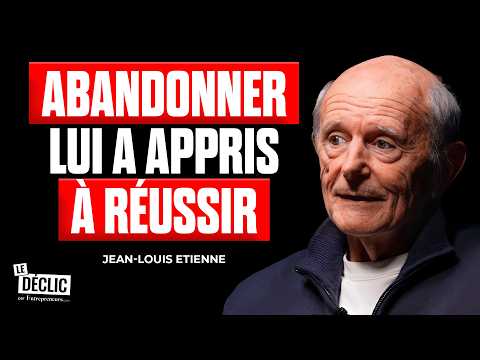
Comment provoquer le déclic psychologique pour accomplir l'impossible - Jean Louis Étienne
AI Summary
In this episode of the podcast *Le Déclic*, host Alec welcomes Jean-Louis Étienne, a legendary French explorer, doctor, and writer. Étienne is best known as the first man to reach the North Pole solo on foot, a feat he accomplished in 1986. Throughout the conversation, Étienne reflects on his unconventional path from a manual laborer to a surgeon, and finally to a "long-distance expedition entrepreneur." His story is a masterclass in resilience, the power of desire, and the art of turning dreams into scientific and pedagogical realities.
### The Shift from Surgeon to Explorer
Étienne’s journey did not follow a linear path. Growing up in a small village, he struggled with dyslexia and was initially steered toward technical training as a metalworker. However, a teacher recognized his mathematical talent, leading him toward a baccalaureate and eventually medical school. While he loved surgery, a deep-seated childhood desire for adventure remained. He realized he could use his medical skills as a "passport" to join expeditions.
His first major break came through a chance encounter with the legendary sailor Éric Tabarli at an airport in Rio. Étienne was prepared for the moment; he approached Tabarli, not as a fan, but as a doctor offering his services. This led to a year-long voyage that transformed him from a mountaineer into a sailor. This encounter illustrates one of Étienne’s core philosophies: "Luck is organized." He argues that opportunities appear to everyone, but they only yield results for those who have prepared themselves to seize them.
### The Solo Conquest of the North Pole
The defining moment of Étienne’s career was his 1986 solo trek to the North Pole. After a failed attempt in 1985 due to injury and equipment issues, he returned with a redesigned sled and a hardened resolve. For 63 days, he pulled a 100-kilogram sled through a chaotic landscape of ice in temperatures as low as -52°C.
To monitor his mental state and guard against hypothermia—what he calls "the white death"—he performed multiplication tables in his head. If he could still calculate, he knew he was conscious. Interestingly, Étienne credits his success to his solitude. He believes that if he had been with a partner, they likely would have collectively agreed to quit when things became unbearable. Alone, he bore the entire responsibility for the risk, which forced him to find internal resources he didn't know he possessed. He concludes that we do not "push" our limits; rather, we "discover" ourselves when confronted with the demands of reality.
### From Personal Achievement to Global Advocacy
Following the North Pole, Étienne shifted his focus toward international cooperation and environmental protection. During his solo trek, he crossed paths with American explorer Will Steger. This meeting birthed "TransAntarctica" (1989–1990), a seven-month international expedition involving members from the USA, USSR, China, Japan, the UK, and France.
The goal was more than physical; it was diplomatic. The expedition aimed to promote the protection of Antarctica. By leveraging their media presence, the team influenced world leaders to refrain from mineral exploitation on the continent. This effort contributed to the Wellington Convention’s moratorium, which protects Antarctica as a land of science and peace until 2048. For Étienne, this marked his transition into a "logistician for science," using adventure to fuel pedagogy and environmental awareness.
### The Entrepreneurship of Adventure
Étienne views himself as an entrepreneur. He notes that finding funding for an expedition often takes three years—longer than the expedition itself. He describes fundraising as a "vender’s job," requiring the ability to distill a complex vision into a few words that spark desire in a partner.
He manages two structures: a non-profit for scientific and pedagogical missions and a commercial side for visibility. He emphasizes that he doesn't sell technological solutions but rather an alignment of values—audacity, commitment, and the "culture of desire." He believes the greatest preparation for an expedition is the grueling process of financing it, as it forces the project to mature and ensures the explorer is truly ready.
### Audacity at Any Age: The Balloon and the Polarpod
Even in his sixties, Étienne’s thirst for discovery remained. At age 63, he flew solo across the Arctic in a balloon. This five-day ordeal was his most dangerous mission. Deprived of sleep and suffering from cerebral edema, he experienced auditory and visual hallucinations. When he finally landed in Russia, he was detained for four days by the FSB (formerly the KGB), who suspected him of spying because of a magnetometer he was carrying for scientific research.
Today, Étienne is focused on the "Polarpod," a revolutionary vertical floating station designed to drift around Antarctica for three years. This zero-emission "ship" will stay submerged 75 meters deep to remain stable in the "Furious Fifties" gales, allowing scientists to study CO2 capture and biodiversity in the Southern Ocean—the world’s most poorly understood sea. Though the project has faced administrative and construction delays, Étienne remains undeterred, supported by his new ship, *Persévérance*.
### Conclusion: The Philosophy of "Envie"
Jean-Louis Étienne’s final message is centered on the word *envie* (desire or drive). He believes that desire is the primary motor of any life or enterprise. He encourages everyone—especially those facing failure or doubt—to stay faithful to their original drive.
He closes with a quote from Jean Jaurès that serves as his life’s compass: "Go to the ideal while understanding the real." For Étienne, resilience is not about being "stainless" or without fear; it is about the "alternation" of highs and lows—the high tide and the low tide—and having the persistence to stay on the path until the tide turns back in your favor.