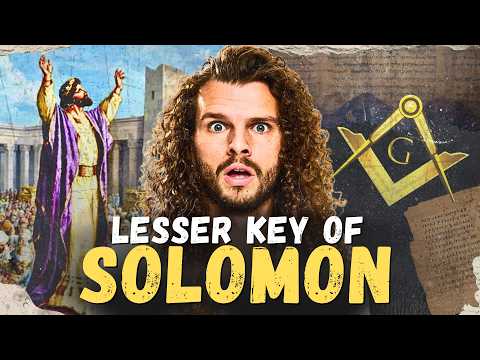
The Freemason Secrets of King Solomon’s Demon Book!
AI Summary
The figure of King Solomon, celebrated in biblical narratives for his wisdom, wealth, and role in building the first temple, also features prominently in other traditions as a master of spirits and demons. These alternative narratives, found in Jewish, Christian, and Islamic folklore, describe Solomon possessing a magical ring that allowed him to command an army of 72 spirits, sealing them into a brass vessel and using them to construct the Temple of God. This concept is explored in texts like "The Lesser Key of Solomon," a Renaissance-era grimoire, which details how a biblical king became intertwined with Western occultism, Freemasonry, and discussions about rebuilding the Third Temple.
In the Bible, Solomon is depicted as the son of David who inherited the throne and ushered in a golden age for Israel. His most famous story involves God offering him anything he desires in a dream, to which Solomon humbly requests wisdom to govern his people justly. Impressed, God grants him not only wisdom but also unmatched wealth and honor, making him the wisest and richest king of his era. His wisdom is exemplified in the famous story of settling a custody dispute by threatening to cut a baby in half, discerning the true mother by her compassionate response. Solomon's most significant achievement, according to the Bible, was the construction of the First Temple in Jerusalem, a magnificent dwelling for God designed to house the Ark of the Covenant. The biblical account emphasizes Solomon's exceptional organization, resources, and political reach, without mentioning any supernatural assistance.
However, the "Testament of Solomon," a pseudepigraphal text written centuries later, introduces a supernatural element to the temple's construction. In this account, a demon named Ornas torments one of Solomon's workers. Solomon prays for help, and the Archangel Michael appears, gifting him a ring engraved with a special seal—later known as the Seal of Solomon. Using this ring, Solomon forces Ornas into submission. Instead of merely banishing the demon, Solomon interrogates him, learning the names and weaknesses of other spirits. He then uses this information and his divine ring to bind more demons, compelling them to perform the arduous labor of cutting stones and hauling materials for the temple. This narrative presents a theological irony: unclean spirits, opposed to God, are forced to build the holiest place on earth for Him. Each demon in the "Testament" has a specific function, appearance, and method of attack, along with a corresponding angel or divine name that can defeat it, effectively creating a catalog of supernatural powers and their counters.
Centuries later, Islamic tradition, as found in the Quran, also portrays Solomon (Suliman) with extraordinary powers granted by Allah. He understands animal speech, controls the wind, and holds authority over jinn—unseen beings made of smokeless fire, some pious, some rebellious, possessing free will. Under Suliman, certain jinn are put to work, diving for treasure, forging metal, and constructing monumental structures. A poignant Quranic scene describes Suliman dying while leaning on his staff, overseeing the jinn. Unaware of his death, the jinn continue to work, fearing his authority, until a termite eats through his staff, causing his corpse to collapse and revealing the truth. The moral is that even jinn, with their hidden knowledge, can be deceived by appearances. Both the "Testament of Solomon" and the Quranic narratives depict Solomon as a central figure commanding unseen beings.
These stories eventually led to the question: if Solomon could command spirits, could others learn how? This led to the compilation of "The Lesser Key of Solomon," also known as the "Lemegeton," a grimoire from the mid-17th century that draws on older medieval and Renaissance sources. This textbook of ritual magic is divided into five parts. The most famous, "Ars Goetia," details 72 spirits allegedly bound by Solomon, providing their ranks (kings, dukes, etc.), appearances, abilities, and the seals or sigils needed to summon them. Other sections deal with spirits of the cardinal directions ("Ars Theurgia-Goetia"), angels associated with hours and zodiac signs ("Ars Paulina"), instructions for contacting beneficial angels via a wax tablet ("Ars Almadel"), and prayers for gaining knowledge and memory ("Ars Notoria"). The "Ars Goetia" provides precise, step-by-step instructions for summoning these entities, reflecting a belief that these spirits were real and capable of influencing reality. The number 72 is significant, mirroring the 72 hidden names of God in Jewish mysticism, suggesting a dark inversion where 72 demons correspond to 72 holy forces.
Solomon's name and temple also became central to Freemasonry, which emerged in the 17th and 18th centuries. Masonic rituals symbolically place members at the construction site of Solomon's First Temple, alongside Solomon, King Hiram of Tyre, and master builder Hiram Abiff. The temple serves as an allegory for building an inner temple of virtue. Masonic lodges often feature elements mimicking Solomon's temple, such as pillars labeled Yakin and Boaz, checkerboard floors, and starry ceilings, all presented as symbolic representations of moral growth and craftsmanship.
Outside of Masonic circles, particularly in some Christian and Islamic and conspiratorial groups, Freemasonry's use of Solomon's temple as a model is interpreted differently. Critics sometimes argue that this symbolizes a hidden agenda to physically rebuild a Third Temple as part of an apocalyptic end-times plan. When combined with the grimoires, some conspiratorial theories suggest that Freemasons are using Solomonic magic and that their "Great Architect of the Universe" is a demonic power. The pillars Yakin and Boaz, mentioned in 1 Kings 7, are seen not as structural supports but as symbolic thresholds of sacred space, representing duality like strength and stability, action and restraint, which Freemasons interpret as essential for moral development.
The concept of a Third Temple also resonates deeply within some apocalyptic Christian and Jewish circles, viewed as a prophetic trigger for the end times. Solomonic imagery is naturally drawn into these debates due to the imagined restoration of his original temple. While Solomon and his temple are indeed central to Masonic symbolism and some apocalyptic movements, and critics connect these to end-time plots and demonic control, these claims are often cinematic and theoretical.
Historically, the copying and study of Solomonic texts were not limited to "witches or outcasts" but were undertaken by priests, nobles, and scholars during the medieval and Renaissance periods. These educated individuals viewed grimoires as experimental tools for gaining knowledge, protection, healing, or worldly advantage. The logic was that if Solomon, a king favored by God, could command spirits without losing his divine favor, others might follow his blueprint, especially if they framed their rituals with psalms and invocations of the Trinity and angels. While the Catholic Church officially condemned such practices, demand for these hidden texts persisted, leading to their quiet circulation and study. By the 19th century, occult revival movements like the Hermetic Order of the Golden Dawn rediscovered and reinterpreted this Solomonic material, treating "The Lesser Key of Solomon" as a practical manual for manipulating reality.
Solomon's suitability for this mythology stems from several factors: his legendary wisdom, which made the mastery of spirits seem an extension of divine insight; the unimaginable scale and perfection of the First Temple, which led people to question if ordinary human labor alone could have built it; and the magical ring, the "Seal of Solomon," which provided a tangible explanation for how a human king could command demons or jinn. This hexagram or pentagram became a recognizable emblem in magical traditions. Solomon's personal complexity, as depicted in the Bible drifting into idolatry and facing divine judgment, also made him a believable figure to wield such power, as a flawless saint commanding demons might seem less plausible.
Ultimately, Solomon's story exists in two conflicting versions: the wise king blessed by God who built the magnificent temple, and the king who commanded forbidden powers and spirits. The latter, if true, raises questions about the line between divine wisdom and forbidden knowledge, especially if demons were involved in building God's house. This ongoing fascination with Solomon and his alleged command over the unseen reflects a human obsession with secret knowledge and power, evident in various esoteric traditions, modern gurus, and even conspiracy theories that suggest influential figures use such occult wisdom for personal gain. The enduring debate surrounding Solomon highlights the blurred boundaries between the sacred and the profane, and the human desire to tap into hidden realities.