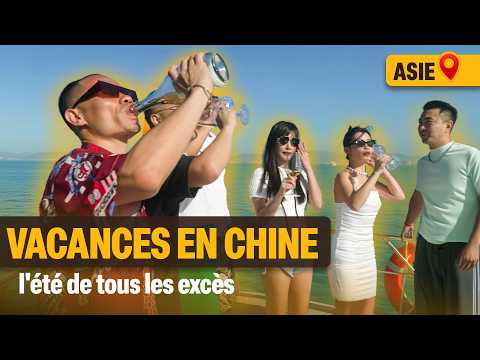
Plages, yachts, club Med : la jet-set chinoise s'offre des vacances d'été XXL
AI Summary
Sanya, often called the "Chinese Miami" or "Dubai," is a tropical paradise in China, resembling Hawaii. It’s a year-round summer destination, attracting wealthy Chinese from colder cities who rent luxury cars, host private parties with singers, and enjoy a bling-bling, Western-style resort lifestyle. The artificial islands in the South China Sea boast one of the world's highest concentrations of yachts. Despite this modern luxury, some vacationers still avoid the sun, covering themselves or burying themselves in sand.
Hainan, the island where Sanya is located, was once a place of exile but is rapidly transforming. Twenty-five years ago, its GDP was among the lowest in China; now, it's a testing ground for new concepts, like dining 50 meters in the sky. The government has ambitious plans to make Hainan an international economic and tourist hub.
Greg, a 28-year-old Franco-Swiss manager at a luxury Mandarin Oriental complex, has witnessed this transformation firsthand. The hotel, part of a Chinese group with 60 hotels worldwide, features five pools, two private beaches, and 300 employees. Villas, spanning 150 square meters, cost between 5,000 and 12,000 euros per night. Greg meticulously inspects every detail, from ocean views to heated pools (costing nearly 1,000 euros a day to reach 30°C). He dreads negative social media reviews, even offering free meals to appease dissatisfied guests. The hotel imports French oysters by plane and offers gourmet dishes, with visual appeal for social media being a key consideration. Greg also oversees numerous weddings, with receptions costing around 70,000 euros for 30 guests.
Hainan is also set to become the world's largest free trade port by 2025, with zero customs duties and 100% duty-free shops, attracting entrepreneurs like David Lou. Lou, born in Versailles, launched his fashion business in China in 2020, focusing on swimwear inspired by the French Riviera. He operates from the Atlantis hotel, a 52-story, 1,500-room complex inspired by Dubai, which cost over 1.5 billion euros to build. Lou targets high-spending clients who buy multiple items, with dresses starting at 500 euros. He plans to open six new boutiques this year, including in the world's largest duty-free shopping center in Tifri, a state-owned enterprise run by the Chinese Communist Party, which generates 4 billion euros in annual revenue. This massive mall, covering 280,000 square meters, houses 800 prestigious brands across six floors.
The island's transformation has also drawn people seeking a change of life. Chiaoso and his wife, with their 7-year-old daughter Emilie, left Beijing's pollution and 22 million inhabitants to open a cafe and surf shop in Hainan. They chose the island for its quality of life, a stark contrast to their previous lives selling ski equipment. Their move, initially met with incomprehension from their traditional parents, reflects a desire for less pressure and more freedom. Two years ago, their current location was a simple fishing village; now, it's a commercial hub with supermarkets and restaurants.
However, rapid development has its downsides. The island's original inhabitants, such as the Li ethnic group, are now often relegated to "Disneyland-like" attractions where they perform traditional dances and showcase crafts for tourists. Floating villages, once home to the Tanka minority (dubbed "sea gypsies"), have been largely replaced by hotels and skyscrapers. Sinzeng, a 56-year-old Tanka fisherman, laments the rising cost of living and the decline of their traditional way of life. His daughter prefers to work on land, reflecting a broader trend among younger generations to seek opportunities in tourism.
Despite these challenges, some locals are adapting. Boyugang, a fisherman's son, opened a luxury hotel in a floating village, converting old ritual boats into luxurious rooms. He leveraged political connections for a favorable loan, and his hotel's library displays works by President Xi Jinping. His venture represents a shift from fishing to leisure businesses, while aiming to preserve Tanka culture.
Hainan's appeal continues to grow, with 25 million tourists last year and double that expected this year. The rise of all-inclusive resorts, a concept pioneered in France in the 1950s, is a new trend in China, where paid holidays have only existed for eight years. The Wu family from Shanghai, urban planners, are pioneers in this new form of vacation, spending 10,000 euros (a third of Mr. Wu's monthly salary) for a three-night stay. They value the relaxed pace, a stark contrast to traditional Chinese group tours.
The Club Med resort in Hainan, the fourth in China, caters to 850 guests with international staff, though many don't speak Chinese. The mini-club for children, a staple of Club Med worldwide, faces unique challenges in China, where single children are often closely guarded by grandparents. Nicolas, the Belgian mini-club manager, struggles to communicate with children unaccustomed to playing independently.
For adults, the resort offers activities like "Crazy Sign" dances, where guests participate in choreographed routines, often fully clothed to avoid tanning, reflecting the Chinese preference for white skin. These activities provide a rare outlet for self-expression in a society that values discipline. The resort also caters to multi-generational families, offering activities for all ages. The all-you-can-eat buffet is a major draw, with over 25 dishes per meal, allowing guests to indulge in a way uncommon in China.
The resort's logistics are complex, managed by chef Uley, who daily sources 250 kg of fruits and vegetables and 90 kg of fish, prioritizing local Chinese ingredients. A French restaurant offers a touch of exoticism, with Uley, trained in European cuisine, creating dishes like beef bourguignon and duck a l'orange, as French cuisine is a prestigious reference in China. Customer satisfaction with food is crucial for recommendations.
The all-inclusive package also includes activities, some traditionally Chinese like Tai Chi, but many are new sports for Chinese guests, as water activities are not deeply ingrained in their culture. Many Chinese do not know how to swim, as seen with Mr. Soon, who struggles with a paddleboard lesson despite basic swimming skills.
Evenings at the resort are filled with karaoke in seven air-conditioned rooms and a grand spectacle directed by Mauritian choreographer Emilie. The shows, featuring elaborate costumes and lively dances, are adapted to Chinese tastes, avoiding overt sensuality while embracing "bling-bling" elements. The shows involve all staff, from cooks to lifeguards, who transform into performers. A highlight is a comedic act where guests, including Mr. Wu, are dressed in women's clothing, a surprising but well-received experience in a traditionally reserved country.
Beyond the resorts, China offers diverse travel experiences. Constantin de Sizevic, a French explorer dubbed "Tintin," leads luxury horseback expeditions on ancient tea routes in Tibet, a region he's explored for 20 years. His base is Shangri-La, a city dominated by a Buddhist monastery, where he and his English wife Phibi run a guesthouse and organize caravan treks for Chinese city dwellers seeking a different, less formatted tourism experience. These 5-day expeditions, costing 1,500 euros per person, include gourmet meals and antique furnishings, recreating the grand explorations of the past.
The expeditions involve a caravan of 45 horses, guided by local Tibetan muleteers. The treks are physically demanding, with participants climbing from 2,800 to 4,200 meters. For many, it's their first time camping and experiencing nature so intimately. The journey challenges preconceived notions about Tibetans and fosters a renewed connection with nature. Constantin pays his muleteers well, significantly supplementing their income in an economically underdeveloped region.
Qingdao, a city famous for its beer, is a popular budget-friendly beach destination. The Ma family, from a rural province, saved all year for their first beach vacation. Despite crowded beaches, cloudy skies, and green algae, they make the most of their limited budget (30 euros per day). Like many Chinese, Mrs. Ma, 26, cannot swim. Their vacation accommodation is a rented three-room apartment in a factory workers' complex, costing half the price of a beachfront apartment. They cook all their meals, carefully budgeting for food and essentials.
Qingdao's tourism history dates back to German colonization (1898-1922). Today, it's a bustling industrial city of nearly 10 million, with over 90 skyscrapers. It remains the country's top summer destination, attracting 45 million visitors in 2010. Day tours by bus are popular, offering an economical way to see the city's sights, including the opulent marina reserved for the wealthy. The city is also a popular spot for wedding photos, with couples paying for professional shoots on its scenic beaches months before their actual weddings.
Mount Huashan, a sacred mountain in central China, is a pilgrimage site known for its steep, dangerous paths. Taoist monk Master Chin has lived at the summit for 20 years, guarding a temple built in the 13th century. The 6-hour ascent is so challenging it has inspired a saying: "There is only one path to the summit of Mount Huashan," meaning one must suffer to achieve goals. Despite the difficulty, hundreds flock to witness the sunset from its peaks.
For thrill-seekers, the South Peak offers a terrifying wooden plank walk with a 500-meter drop. Safety measures were installed in 2003 after several fatal falls. While some visitors are deterred by the challenge, others find it exhilarating. Access to the summit has been made easier with two cable cars, built with the help of local porters who carried materials up the mountain. Rowentier, a 53-year-old porter, has worked on the mountain for over 20 years, carrying 60 kg loads of supplies up 600 meters for 10 cents per kilo, earning around 12 euros on a good day.
Mount Huashan is particularly busy during the May Day holiday, attracting over 45,000 visitors in a single day. The sacred mountain has become a commercialized tourist site, with vendors selling souvenirs and services, including ringing the monastery bell for a fee. The site attracts nearly 4 million visitors annually.