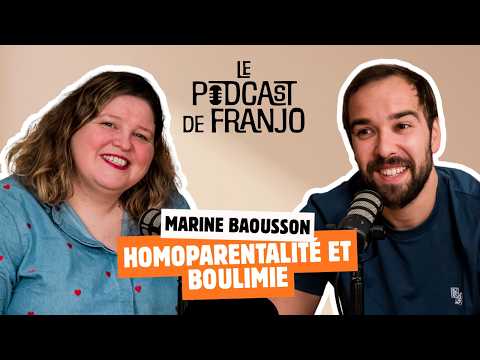
Marine Baousson - Homoparentalité et boulimie - Le podcast de Franjo
AI Summary
The podcast episode features Franjo, Riad, and guest Marine Baousson, an acclaimed French humorist, actress, author, and radio host from Brittany. Marine is best known for her podcast “Vulgaire,” which has garnered over 7.5 million listens since its launch in 2020. In “Vulgaire,” she humorously demystifies complex subjects. She also contributes regularly to France Inter. Her success extends to “Petit Vulgaire,” a children's adaptation of her podcast, which has made her a "Madonna for kids."
Marine recounts an experience at a "Petit Vulgaire" show where children excitedly recognized her, highlighting the unique joy of having young fans who are universally kind in their feedback, unlike some adult social media users. She notes that "Petit Vulgaire" has become an emotional support for some children, including those with autism, with parents reporting that the podcast helps their kids manage emotions or serves as a specific interest. This impact is profound for Marine, who anticipates being remembered by these children years later.
Regarding the adult version of “Vulgaire,” Marine explains that she started the podcast during the 2020 lockdown when she had no work and needed to fill her days. The initial idea was for Sophie Marie Laroui to host a show where scientists would explain concepts in two minutes, followed by Sophie Marie’s humorous re-explanation. When Sophie Marie didn't pursue it, Marine took the concept, naming it “Vulgaire.” She began by exploring everyday, often overlooked topics like a car’s cylinder head gasket or the spleen. She describes her process of choosing topics as intuitive, though finding new subjects has become harder over time. Science and American football are particularly challenging for her due to their complexity.
Marine admits that despite her extensive research for the podcast, she often forgets the information quickly. She now invites specialists to explain subjects, which has evolved the podcast’s format. This process has instilled in her a greater confidence to ask questions when she doesn't understand something, realizing that even experts sometimes struggle to simplify their knowledge. She believes that humorists, like herself, aim to provide all the keys to understanding a topic, making complex ideas accessible and entertaining.
She also discusses the adaptation of "Vulgaire" into a stage show, which allows the audience to choose topics from a predefined list, creating multiple possible versions of the performance. This "choose your own adventure" style is also applied to "Petit Vulgaire" for children.
Marine shares her current fascination with watching Pokémon card unboxing videos, despite never having been a fan of Pokémon herself. She finds the excitement of collectors captivating and is considering investing in Pokémon cards for her child's future, viewing it as a potential business opportunity, much like crypto investments for others her age.
She reveals subjects she avoids, like the Spice Girls, because she feels too much of an "expert" and struggles to find humor in them without disrespecting them. On the other hand, she found herself deeply engrossed in the history of cults, particularly the Heaven's Gate cult, after encountering the work of Quentin Bru-Féol. She recounts the chilling story of the cult's mass suicide, their early internet business, and the lone survivor who continues their mission. This interest in cults has led her to host specialists on “Vulgaire,” including a "zinzin des sectes" (cult fanatic) who owns a room full of cult artifacts.
The discussion touches on Raël, the leader of the Raëlian Movement, who claims to have met extraterrestrials. Marine finds it astonishing how individuals like Raël, despite their unconventional appearance, can amass thousands of followers based on extraordinary claims. She ponders whether cult members are "simple-minded" or if it's the charismatic leader and the sense of community that draws them in, referencing Scientology's origins in science fiction novels and its promise of immortality, which its founder failed to achieve.
Franjo and Marine debate the addictive nature of food, with Marine admitting to a lifelong struggle with weight and a perceived addiction to food. She describes a constant internal dialogue about eating and how it affects her daily life, comparing it to an eating disorder. She shares that she was told to lose weight for her PMA (Assisted Reproductive Technology) but gained more instead, attributing some of this to stress and a change in lifestyle after "Vulgaire" took off. She views the medical advice as potentially "medical grossophobia." She also mentions trying hypnosis to manage her eating habits, which surprisingly only worked for stopping her Coca-Cola consumption.
Marine opens up about her personal life, including her move back to Saint-Brieuc, Brittany, with her partner, Elisa. She initially found Saint-Brieuc boring as a teenager but now appreciates its beauty and amenities, including its proximity to the sea. She still visits Paris weekly for work, maintaining a balance between her rural and urban life. She describes her reluctance to perform in her hometown due to the pressure of being a "local child" and the fear of not living up to expectations.
She shares that she and Elisa recently had a baby boy through PMA in Belgium, as the process was not yet legal in France when they started. They chose a semi-anonymous sperm donor, meaning the child will have access to information about his genetic father later in life if he chooses. Marine, who has no genetic link to her son, expresses her initial desire for a daughter because she understood the experience of being a girl in the world, but is now curious to see how having two mothers will shape her son. She hopes to raise him as a feminist and is excited to witness the unique development of a child raised without traditional gender roles or authority figures in the household.
The conversation delves into the societal implications of same-sex parenting, with Marine emphasizing that the love and dedication of two parents are what truly matter for a child's well-being. She challenges the notion that children need a mother and a father, pointing out the diverse and often complex family structures already present in society. She stresses that since her son's birth, they have faced no discrimination and that their roles as parents are no different from those of a heterosexual couple.
Marine also discusses the challenges of being a visible lesbian woman and humorist in the public eye. She mentions being classified as an "LGBT lobbyist" by an extreme-right website, which she finds amusingly accurate despite its derogatory intent. She reflects on her past reluctance to incorporate her sexual orientation into her comedy due to shame but now embraces it to promote visibility and representation. She believes that seeing diverse representations, even in children's content like "Petit Vulgaire," can greatly benefit young people by normalizing different family structures and identities, making their lives more fluid and accepting.
Franjo questions the quality of representation in media, acknowledging the "quota" criticism for Netflix series but defending the importance of seeing oneself reflected, even if imperfectly. Marine asserts that if representation is flawed, the solution is better writing, not less representation.
The conversation touches on social media comments, with Marine admitting she largely ignores them due to their often negative and unconstructive nature. She recounts a particularly hateful experience after sharing a personal story on Topito, which led to a barrage of insults, including a deeply manipulative message. This experience reinforced her preference for podcasts, where interactions are less confrontational. She also notes the difference in online communities, finding YouTube comments generally more positive than Facebook, where she has encountered aggressive and irrational attacks, even over literary criticism.
Marine and Franjo discuss the evolving relationship between comedians and online criticism, with Franjo suggesting a growing distance and resilience among performers. They both acknowledge the difficulty of seeing oneself on screen and hearing one's voice, a challenge amplified by public commentary. Marine, being at the "intersection of all struggles" as a lesbian, heavy-set woman, and humorist, faces a disproportionate amount of online hate, but she maintains a philosophical distance, viewing many online trolls as disconnected from reality. She finds it particularly hurtful when negative comments come from other women, challenging the idea of "sorority."
Franjo concludes by thanking Marine for her open and insightful discussion, which moved from lighthearted topics to profound personal reflections. Marine encourages listeners to find her on Instagram and to attend her children's show "Pourquoi? Pourquoi?" at the Théâtre Michel in Paris and on tour, as well as to listen to her "Vulgaire" podcast.