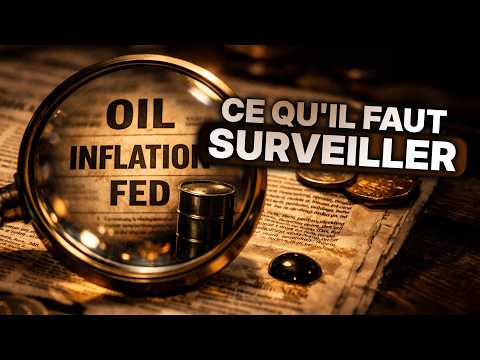
Pétrole, inflation, banques centrales : ce qu'il faut absolument surveiller
AI Summary
In this market update, the speaker addresses the current state of global finance, attempting to bring a bit of "lightness" to what he describes as a "brutal world." The primary drivers of the current market tension are skyrocketing oil prices, geopolitical instability involving Iran, and the looming decisions of major central banks. Amidst this chaos, corporate earnings are providing mixed signals, while cryptocurrencies continue to show surprising resilience compared to traditional assets.
The central theme of the current economic climate is the price of oil. As the essential fuel for the global economy, oil impacts everything from transportation and industry to food production and fertilizers. With Brent crude flirting with $100 a barrel—nearly doubling in just one month—inflationary pressures are mounting. This surge is largely attributed to developments in Iran, including the appointment of a new Supreme Leader and the closure of the Strait of Hormuz. Several ships have been struck, and major producers in the Gulf have drastically reduced production because their goods simply cannot reach their destinations. Despite a historic move by the International Energy Agency to release 400 million barrels from strategic reserves, the market remains unimpressed. The speaker describes this as a mere "bandage" that has failed to stop the bleeding, as gasoline prices at the pump have already surpassed €2 per liter.
This energy crisis complicates the inflation narrative. While recent inflation figures were roughly in line with expectations, providing a temporary sigh of relief, the speaker warns that these numbers reflect February data. They do not yet account for the massive spike in oil prices seen in early March. Consequently, the mid-April data is expected to be significantly worse. This puts indices under immense pressure. While US markets like the S&P 500 and Nasdaq haven't entered a full-blown panic, volatility is rising, as indicated by the VIX. The speaker notes that the longer the conflict lasts and oil stays near $100, the more "dramatic" the consequences will be.
Central banks, including the Federal Reserve and the European Central Bank (ECB), are now in a difficult position. The hope for interest rate cuts is fading; in fact, the ECB hasn't ruled out further hikes if inflation persists. This is a problem for stock valuations. Many companies are currently trading at 30 to 50 times their earnings, and the S&P 500 is sitting at 22 times earnings—well above its ten-year average of 18. Given this environment, the speaker maintains a "red cap" bearish stance on indices, preferring to sell on rebounds. While the S&P 500 and Nasdaq are holding within ranges, the Dow Jones is underperforming as the market begins to anticipate a hit to industrial sectors and consumer spending. In Europe, indices like the CAC 40 and DAX have already pulled back to key technical support levels, such as 7,900 points for the CAC.
The corporate landscape is a tale of two cities. Oracle reported exceptionally strong results, with cloud revenue growing by 50%. For the first time, they saw a simultaneous 20% increase in both revenue and earnings per share, setting a clear path toward $90 billion in revenue by 2027. On the other hand, Adobe faced a different reality. Despite beating consensus on revenue and earnings, their future outlook disappointed investors, leading to an 8% drop in after-hours trading. The company is facing a leadership transition with its long-time CEO departing, but more importantly, its core business is being "cannibalized" by generative AI. The market is currently unsure if Adobe is undergoing a healthy transition or if it is in serious trouble.
In terms of safe havens, gold has not yet fully played its traditional role. This is primarily due to the strength of the US Dollar, which investors are buying in anticipation of sustained high interest rates. Since gold is priced in dollars, the currency’s rise creates a mechanical drag on the metal’s price. The speaker attempted a long position on gold near 5,180 but exited flat, waiting for a clear break above 5,200 to re-enter the long-term uptrend. Meanwhile, the bearish view on the Euro/Dollar pair continues to pay off. The speaker has been shorting the pair, hitting targets at 1.1467, with a long-term goal of 1.1200.
Looking ahead to next week, the focus will be on Jerome Powell and the Fed. The speaker suggests that given the current uncertainty, Powell’s speech might be incredibly brief, as there is little the Fed can do until new data clarifies the impact of the oil shock. The ECB also remains a wildcard, with its policy heavily dependent on the duration of the geopolitical conflict.
Finally, the cryptocurrency market provides a rare "green cap" moment of optimism. Bitcoin has shown remarkable strength, surging past $70,000, $72,000, and even $73,000 during the recording. Short-term trends are turning positive, though the speaker advises against FOMO (fear of missing out). The strategy remains to buy pullbacks rather than chasing vertical moves, with a critical long-term support zone identified between $55,000 and $60,000. While the "glass ceiling" of market psychology takes time to break, the current performance is a welcome boost for portfolios.
The speaker concludes by advising traders to watch oil prices on short timeframes, reduce position sizes to manage volatility, and only increase exposure when the market confirms their directional bias. He emphasizes that it is impossible to catch every move, and trying to be everywhere at once usually leads to poor results.