Ma stratégie patrimoniale après 9 ans d’investissement (je révèle TOUT)
AI Summary
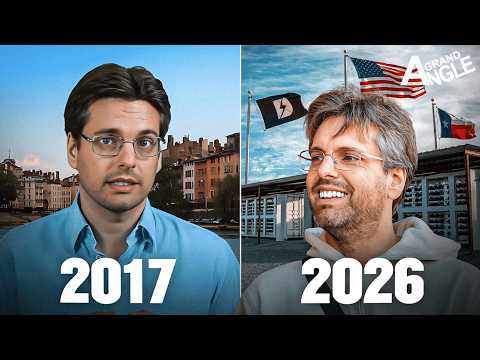
The speaker begins by reflecting on the nine-year anniversary of their YouTube channel, Grand Angleto. They recall starting with basic videos on inflation and the utility of money, filming in their living room on a green screen while their wife took their children to the park, and editing late at night. After five months of intense effort and little sleep, they earned only 37 cents in ad revenue, but were driven by the growth in views, comments, and engagement, believing they were building something significant.
Their efforts intensified, juggling a part-time job, two young children, the channel, and family life for two years. In February 2018, they interviewed Charles Gave, a pivotal moment, followed by other notable figures. In October 2018, they launched an investment newsletter with Charles Gave and Guillaume Rouvier. Eventually, they left their part-time job to focus entirely on real estate and Grand Angle.
They then ventured into business projects, including real estate in Turkey, specifically Antalya, where property values significantly increased. However, they faced challenges in structuring a scalable investment platform for the community. Despite interest from investors for approximately 10 million euros, they did not proceed due to an insufficient local team and a lack of deep understanding of the legal framework, incurring substantial legal fees without closing any deals. They personally profited from real estate and learned valuable lessons about structuring international investment companies and avoiding pitfalls.
Next, they co-founded Cleanset Mining with Guillaume, aiming to leverage low energy costs for Bitcoin mining. This venture encountered significant difficulties, including operating in war-torn Congo, machine confiscation by the government in Paraguay, and higher-than-expected electricity prices in Finland. They concluded that the core business was in electrical infrastructure, not mining machines, leading to the creation of Data Factory with Richard and Philippe.
Their move to the USA, particularly Texas, was a revelation due to its well-structured energy market and effective demand response programs, an area they had prior experience in from a private equity firm. This led Guillaume to join them in Austin to manage the farms. They emphasize that no one was left behind from Cleanset Mining; all investors who voted yes were converted into Data Factory shares, a decision they took pride in despite the cost, acknowledging Guillaume's loyalty and talent.
They also invested in Cross the, a video game project aiming to engage non-investors, losing over 1.5 million. Not being in control of the strategy or on the board, they sold their stake when the project shifted purely to video games. This experience taught them to only invest in projects where they control the strategy, now serving as president for all their commitments.
They highlight that their success, including raising nearly 100 million euros for Data Factory, is thanks to their community's trust. Data Factory is now a successful industrial company in the US, on track to become a unicorn. Their investment track record includes anticipating the rise of gold since 2018, outperforming Chinese bonds, and Bitcoin since 2021. They admit to missing the market rebound after the COVID-19 crisis but sustained no losses. This period strengthened their collaboration with Didier Arc, a macroeconomics expert. The investment newsletter, which they have since stopped due to time constraints, achieved significant returns for both conservative and tactical portfolios. They express gratitude to Didier, a loyal and talented partner and friend.
The speaker emphasizes their dual role as a theorist through media and a practitioner in industrial operations, finding immense satisfaction in building tangible infrastructure. They acknowledge the challenges and solitude of decision-making, citing their decision to forego a NASDAQ IPO for Data Factory in favor of a merger to integrate AI, a complex move made against initial board advice. These nine years have been tumultuous but also deeply fulfilling, attributing this sense of accomplishment to their audience's trust.
They then reveal their personal investment strategy, a distillation of their nine years of learning. Having grown up in a small village, they've always been unconventional. Their investment philosophy is guided by four cardinal points: Value, Risk, Anti-fragility, and Decorrelation.
**Value:** They argue that only work that creates wealth, or is useful to others, has value. Simply working without producing something useful, like digging and refilling a hole, creates no value. Creating value means transferring the power to act to others, such as providing water access, which is the essence of wealth and freedom through property.
**Risk:** All capital storage is inherently risky. The perceived difference between "saving" and "investing" is an illusion. Saving, traditionally seen as risk-free, merely entrusts money to institutional structures backed by the state, which, like private ventures, can fail, albeit on a longer timescale. They cite Ray Dalio's work on economic cycles, suggesting that Europe and the USA are at the end of a cycle, characterized by monetary printing, conflicts, and political instability, leading to either a national recovery or state bankruptcy. They believe Western countries will devalue their currencies, leading to an "euthanasia of the rentier." Traditional savings mechanisms tied to the state will become vulnerable.
**Anti-fragility:** Investors must choose between fragile assets, which perform well in stable times but lose value in chaos, and anti-fragile assets, which thrive in chaotic periods. They, like Didier d'Arcy, believe in identifying and investing in anti-fragile assets, such as specific Google Alphabet stocks, rather than fragile ones like the MSCI World index. Given their conviction that the USA and European countries are entering a period of significant crisis and transition, they advocate for a portfolio of 100% anti-fragile assets, accepting high volatility and potential drawdowns of 50% or more for several years, in exchange for potential 5x or 10x returns over a decade. They use gold and Bitcoin as examples, noting the mental and emotional resilience required to hold such assets through significant downturns. They stress the importance of knowing oneself and avoiding panic selling or clinging to losing positions.
**Decorrelation:** This is presented as the "free lunch" in investing. Decorrelating a portfolio—investing in assets whose movements are largely independent—reduces overall risk and volatility without sacrificing performance. This means combining assets that are weakly correlated results in a portfolio with lower overall risk than any individual asset.
Based on these principles, their strategy includes:
1. **Private Equity (Unlisted Shares):** They focus on entering the board and capital of early-stage companies, not yet known or funded, to achieve substantial multiples. This involves personally guiding 2-3 companies annually, a qualitative approach rather than a broad "shotgun" strategy. They plan to make this a public show, demonstrating the investment process from fundraising to execution. This ambition will be pursued once their involvement with Data Factory is less demanding. Their media channels, Grand Angle, no longer generate income but serve for visibility and credibility. They refuse sponsorships, valuing community trust over commercial endorsements, preferring to lead by example and invest their own money first.
2. **Off-market, Off-plan Luxury Real Estate:** This strategy, similar to private equity, targets specific segments of the luxury market (not mass market) in geopolitically strategic locations like Dubai, Switzerland, and potentially the US and Asia. The idea is to buy off-plan at a discount, paying only a fraction of the cost upfront, and resell before completion as the market value appreciates, generating significant returns on invested capital due to leverage without traditional credit. They prioritize locations with strong property rights and a mobile, capitalized clientele.
3. **Decentralized Refuge Currency:** They believe major currencies like the Euro, Dollar, and Swiss Franc will devalue due to monetary printing, eroding savings. They seek a currency to store value created by their other two pillars, one with strong appreciation potential. Bitcoin, with its high volatility, offers the best Sharpe ratio over a 10-year period and superior returns. While gold is also valued for its completed adoption and lower risk, Bitcoin offers additional remuneration during its adoption phase. Their portfolio allocates one-third to each pillar, with the refuge asset naturally growing in volume as it stores value from the other two.
Finally, they discuss enhancing returns by "shorting" the old system. This involves using debt, or leverage, to position against assets expected to decline. While generally wary of leverage, they identify two methods:
* **Borrowing in USD:** They suggest borrowing dollars to buy their preferred assets (gold, Bitcoin, etc.), betting on the dollar's long-term depreciation. For gold, borrowing up to 20% against it as collateral is deemed safe.
* **Mortgage Loans:** Unlike margin loans on financial assets, real estate loans offer a "free lunch." Property values are not instantly quoted, and liquidation criteria are less stringent, meaning one is unlikely to be forced to sell simply because the property's market value drops below the loan amount, as long as interest payments are met. This allows them to borrow dollars against real estate to invest in their preferred assets, essentially shorting the dollar with reduced risk of margin calls.
A third, more advanced method for corporations, involves issuing shares for dollars to buy more of their preferred assets. This leverages the company's ability to create future value, allowing it to attract investors at a valuation higher than its current asset base. They note this is a future possibility for their ventures.
The speaker concludes by reflecting on the human element of investment, emphasizing that trust and the ability to execute are paramount. They have personally connected with many of their investors, finding that human relationships and shared experiences are often more valued than detailed financial data. They express gratitude to their community for their trust and support, which has enabled their journey and achievements.