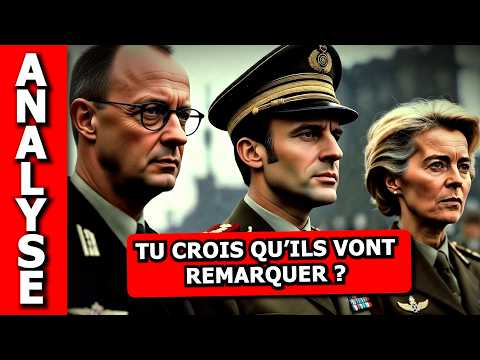
Vers une guerre Germano-mondialiste en Ukraine ! Plus que quelques années pour réagir !
AI Summary
This analysis explores the evolving political landscape surrounding the war in Ukraine as it reaches its four-year mark. The current situation is characterized by deep confusion regarding peace negotiations and a disconnect between official rhetoric and reality. While European leaders like Emmanuel Macron and various German officials push for escalation, the underlying motives appear less about defending Ukrainian sovereignty and more about preserving a specific globalist economic order and advancing European federalism.
**The Fabrication of the Enemy**
A primary insight is the deliberate "fabrication" of a Russian threat to galvanize public support for war. Military experts and politicians, particularly in Germany, have popularized the Orwellian notion that "peace is war," suggesting that any negotiated settlement would merely lead to a Russian invasion of NATO members like Lithuania. This narrative is supported by what the transcript describes as "fake news" and propaganda regarding Russian drones and GPS jamming. During the fall of 2025, media reports hinted at Russian aggression against NATO airspace, yet no official charges were ever filed, and the incidents often involved civilian drones. This climate of fear is used to justify the shift from a "Europe of peace" to a "Europe of war," where generals now openly tell the public they must be prepared to sacrifice their children.
**The Shift to a "German-Globalist" War**
The transcript introduces the concept of a "German-globalist" war. The European Union’s new defense strategy notably lacks any diplomatic or diplomatic component. Instead, it focuses on infrastructure and military mobility—reinforcing roads, bridges, and tunnels to support 60-ton tanks. This strategy serves two purposes: it advances federalism by centralizing defense under the EU, and it provides a "disguised stimulus plan" for the German economy. Having crippled its own industrial base through failed energy policies and the transition to electric vehicles, Germany is now pivoting toward the defense industry. By labeling these expenditures as "war preparation," Germany can bypass EU debt and stability rules, funding a massive industrial transition under the guise of security. Furthermore, there is a push for a "European nuclear deterrent," which essentially means Germany gaining access to or control over French nuclear assets.
**Globalism vs. National Sovereignty**
At its core, the conflict is framed as a struggle between "market democracy" (globalism) and national autocracy. Globalism, in this context, refers to a system where multinational corporations dictate policy and national borders are erased to facilitate unregulated trade. In the West, politicians have become "spectacle" figures, while real power resides with supranational bodies and lobbyists. In contrast, the Russian model, despite its flaws, maintains a hierarchy where the state dominates the wealthy elite (the "oligarchs"). The transcript argues that the "international order" the EU seeks to defend is actually the hegemony of this globalist system. If Russia "wins" or even "doesn't lose," the credibility of this entire neoliberal framework collapses.
**The Role of Donald Trump and the "Ceasefire Trap"**
Donald Trump represents a significant threat to European globalists because he seeks to withdraw the United States from this globalist project. His "America First" approach prioritizes American resources over the ideological war in Ukraine. This has led to panic within the EU, as leaders realize they lack the military and economic means to defeat Russia alone.
Consequently, the EU is not seeking a final peace treaty, which would require acknowledging Russian territorial gains and the failure of Western sanctions. Instead, they are pushing for a "ceasefire." The goal of a ceasefire would be to freeze the conflict, station NATO troops on the border to prevent Russian movement, and use the time to rearm Ukraine and rebuild the European defense industry. They hope that a future, more "cooperative" (globalist) U.S. administration will eventually return to the fray.
**Conclusion: A Disconnect from the People**
The transcript concludes that the European elite is engaged in a "flight forward." They are willing to risk a direct conflict to save face and protect an economic system that the majority of the population—both on the left and the right—already rejects. While the public is told they are defending "values" and "democracy," the reality is a struggle to maintain a failing neoliberal order. The transcript warns that as the EU moves closer to a "German-globalist" war, the lack of a peace project and the prioritization of multinational interests over national stability could lead to a catastrophic outcome. The upcoming years will likely see a confrontation between those who wish to maintain this globalist status quo and those who seek a return to national sovereignty and realistic diplomacy. For now, the prospect of peace remains sidelined by the egos and financial interests of a leadership class that refuses to admit the failure of its policies.