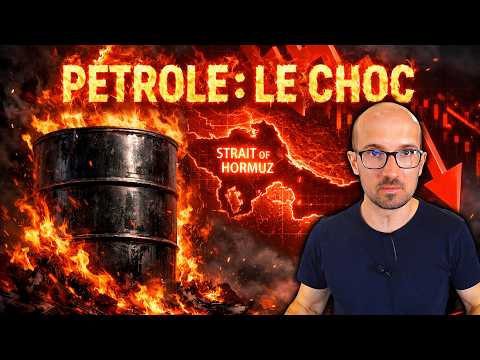
L'IRAN BLOQUE LE PÉTROLE : Le scénario catastrophe ? (Stagflation)
AI Summary
The following summary provides a comprehensive overview of the current geopolitical and economic crisis based on the latest market developments and the escalating conflict involving Iran, Israel, and the United States.
### **Market Turmoil and Geopolitical Escalation**
The financial landscape has shifted dramatically following a weekend of intensifying conflict in the Middle East. While cryptocurrency markets showed some resilience, traditional markets opened with significant losses. In Europe, indices like the CAC 40 and the DAX plummeted by nearly 3%, while U.S. futures dropped by 2%. The primary catalyst for this instability is the direct military confrontation between Iran, Israel, and the U.S., which has moved beyond mere threats into historic disruptions of global trade.
The conflict reached a boiling point approximately ten days ago when the U.S. and Israel launched strikes against Iran with the specific objective of eliminating the Supreme Leader. Iran’s retaliation was swift and multi-faceted, involving missile and drone strikes on American bases and neighboring states. Most significantly, Iran took the unprecedented step of completely closing the Strait of Hormuz. While Iran has frequently threatened to close this passage in the past, this marks the first time in history they have followed through, halting all maritime traffic.
### **The Strategic Importance of the Strait of Hormuz**
The closure of the Strait of Hormuz is a "never-before-seen" event with catastrophic implications for the global economy. This narrow waterway, roughly 34 kilometers wide, serves as the transit point for one-fifth of the world’s oil. Under normal conditions, approximately 100 cargo ships pass through daily, with 70% of them carrying oil or liquefied natural gas (LNG).
The dependency on this route is staggering. Major exporters rely on it for their survival: Saudi Arabia sends 37% of its production through the Strait, Iraq sends 27%, and the UAE sends 13%. Combined with Kuwait and Iran, these five countries account for over 93% of the flow through this chokepoint. On the buying side, Asia is the most vulnerable, receiving 89% of the oil that transits the Strait. China alone accounts for 38% of those imports, followed by India at 15% and Japan at 11%. Currently, the flow of oil through the Strait has dropped to zero. Over 150 tankers are currently anchored, awaiting orders, while Iran has warned that any Western vessels attempting to pass will be attacked. Reports have already emerged of drones hitting a Bahraini tanker and incidents resulting in the deaths of Indian sailors.
### **The Oil Price Shock**
The immediate result of this maritime blockade is a vertical surge in oil prices. After ending last week at $90 per barrel, prices gapped up to $115 at the start of the week. This follows Israeli attacks on Iranian refineries and statements from Donald Trump suggesting that high oil prices are a "small price to pay" to eliminate Iran’s nuclear threat. Trump also indicated that the U.S. would not yet release its strategic oil reserves, signaling that no immediate relief is coming.
The speed of this price increase is historic. Last week saw the largest one-week percentage gain for WTI (West Texas Intermediate) since futures contracts began in 1983, rising over 35%. This was followed by a 23% single-day jump, the highest since 1988. Analysts from Goldman Sachs suggest prices could easily sustain levels above $120, while the Qatar Energy Minister warned that if the Strait remains closed, oil could reach $150 per barrel, a level he claims could "topple the world's economies."
### **Inflation, Stagflation, and Central Bank Dilemmas**
This oil shock is colliding with already fragile economic data. In the U.S., recent employment figures showed stronger-than-expected wage growth, which is inflationary. All eyes are now on the upcoming inflation report this Wednesday. If inflation exceeds the 2.5% target, the specter of "stagflation"—the combination of stagnant economic growth and high inflation—becomes a primary concern.
Stagflation is the "worst of all worlds" for central banks. If they raise interest rates to fight inflation, they risk further crushing an already slowing economy. If they lower rates to stimulate growth, they risk letting inflation spiral out of control. Consequently, market expectations for interest rate cuts have been pushed back. While investors previously expected a cut in June, 81% of the market now believes a cut won't occur until at least September. In the Eurozone, the sentiment has shifted even more drastically; the market is now pricing in an 80% chance of a rate *increase* in September, a total reversal of previous expectations.
### **Sectoral Impacts and Market Volatility**
The crisis is creating clear winners and losers across various industries:
* **Airlines:** This is the hardest-hit sector. Kerosene accounts for 25-30% of airline operating costs. With over 20,000 flights canceled and companies like Delta and American Airlines facing costs of $40–50 million for every cent increase in fuel, the sector is in freefall.
* **Luxury and Consumer Goods:** As energy and food costs rise (driven by fertilizer prices), consumers are pivoting toward essential goods, hurting the luxury, automotive, and high-end electronics sectors.
* **Gold and Safe Havens:** Surprisingly, gold has not acted as a safe haven. This is largely due to investors selling gold to raise cash to cover margin calls or losses in their equity portfolios.
* **Maritime Transport:** Some shipping companies may benefit as diverted routes allow them to increase freight rates.
* **Defense:** Despite the conflict, the defense sector has not been immune to the general market sell-off.
### **Strategic Advice for Investors**
In this high-volatility environment, the key is to avoid emotional, "hot-headed" decisions. Panicking and liquidating everything or aggressively buying the dip without a plan is often counterproductive. The recommended approach is "Investing By Level" (IBL)—identifying long-term technical levels for gradual entry.
For example, while the CAC 40 was unattractive at 8,200 points, it is nearing a more interesting intervention zone around 7,600 points. Investors are advised to maintain a healthy cash reserve, monitor sectoral exposure (avoiding over-concentration in airlines or discretionary spending), and watch the U.S. dollar, which continues to strengthen. Above all, objectivity is required: investors must face the reality of the geopolitical shift rather than ignoring their screens. The goal for the coming weeks is to remain disciplined, wait for the inflation data, and act only when prices hit predetermined levels of significance.