Bubbles Pop When Earnings Can’t Keep Up
AI Summary
The markets are currently experiencing an "ugly" day, with the Nasdaq down two percent and Bitcoin also down almost two percent. A concerning development is the rising 10-year yield, which is approaching a level that previously prompted significant political intervention. The question arises whether this signals a market top or a correction leading into midterm elections, a period often associated with average 10% market corrections when a new Fed chair takes office.
The discussion delves into potential scenarios, including the possibility of Iran collecting tolls on all goods and information passing through the Strait, a move that could drastically impact oil prices. There's speculation that oil might break out, with some observing an inverse head and shoulders pattern. The critical factor, regardless of pattern, is whether the trend line breaks. A measured move to the upside, if the trend line breaks, could see oil prices return to and exceed 2008 highs, potentially reaching $250 a barrel, which would be "bad news bears" for the economy.
Such an oil price surge would likely cause yields to break out "high and hard." The speaker speculates that if yields break to the upside, the move would be significant and could eventually mark a long-term top for yields, but not before causing substantial damage to current market momentum. The price of yields is closely linked to oil prices, with both tracking each other closely.
Today's CPI report came in "very, very hot," driven not only by energy but also memory prices, suggesting a supply shortage potentially linked to the AI build-out. The dollar is strengthening on this news, indicating increased odds of rate hikes, which is ironic given past criticisms of the Federal Reserve's rate policies. A developing wedge pattern in the dollar's chart suggests a potential breakout that could lead to a sharp appreciation, putting a major drag on global liquidity.
Despite the current "ugly" market conditions, the speaker emphasizes that this is a long-anticipated pullback, and the technical picture remains relatively strong. The first line of defense for the market is identified, with a break below 28,570 potentially leading to a further, yet still healthy, correction. An "unhealthy" market signal would be a daily or weekly engulfing candle.
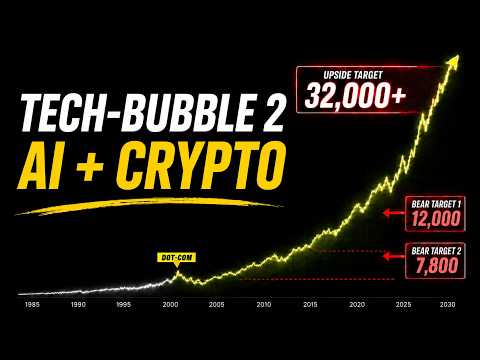
Comparing the current market to the 1999-2000 tech bubble, the RSI on SOX shows similar readings, raising questions about whether this signals an impending market top. However, the speaker dismisses this as a "nothing burger" for now.
Regarding Bitcoin, the current day is deemed "ugly" but technically unchanged. The next moves are seen as dependent on the geopolitical "line in the sand," particularly concerning oil, crude, the dollar, and the 10-year yield. The speaker doubts that significant outcomes will arise from upcoming political meetings without major concessions.
Current market positions include well-held profits in FNGU (12%), Bitcoin spot ETFs (break-even), Tesla (up 8.5%), and NVIDIA (up 19%). A short trade is being held on Ethereum.
Analyzing Bitcoin's past cycle behavior, if October marked the all-time high, there's potential for a significant leg down, aligning with midterm seasonalities where markets typically face pressure through September and October, potentially marking a four-year cycle bottom for Bitcoin. This could entail a 40-50% drawdown from current levels. Alternatively, if the low occurred in February, the market could see sideways to slightly upward price action into the midterm elections. Bitcoin is currently trading around $80,000.
The speaker highlights the fragility of the current market despite its recent loft, acknowledging the possibility of a much deeper correction, aligning with the "Tom Lee awareness" of midterm year and new Fed chair dynamics.
A key question arises: if the February low is indeed the bottom for Bitcoin, what does it mean for the macro structure? The speaker believes it is the bottom. From a macro standpoint, the Fed has just begun raising its balance sheet and stopping quantitative tightening. Bitcoin's bull market, which began in January 2023, has seen a massive run despite tight monetary policy. Now, monetary policy is shifting towards easing, but sustained high oil prices could still lead to recession and force the Fed to raise rates, drastically altering the macro landscape. However, currently, rates are paused, and the Fed is easing policy and increasing its balance sheet, indicating fiscal dominance and continued money printing.
The current market is in a different cycle than six years ago, with institutional forces and spot ETFs at play. Despite a 55% drawdown, ETF holders did not exit, suggesting they are "battle-tested." Bitcoin is now in the "early majority" stage of adoption.
The possibility of an oil breakout leading to vertical price movement and a global recession is acknowledged, but the speaker notes that many such predictions were made before the Iran conflict and are now contending with significant opposing forces. The AI build-out is seen not as a bubble but a massive force, though it could eventually lead to one. The speaker's outlook has been towards re-acceleration, though the Iran conflict presents a major challenge. The power of the AI build-out continues, but the speaker expresses worry about potential stagnation, slowing growth, and higher inflation beyond 2027.
Easy monetary policy, fiscal dominance, and ISM PMIs consistently above 50 are seen as indicators that the market is not yet at a critical turning point. The NASDAQ 100's price increase of 25 times since 2009 is justified by its earnings, which are up 45 times, driven by tech and AI. Bubbles pop when earnings don't justify price, and currently, they do. NVIDIA's upcoming earnings report on the 20th is identified as a major market catalyst to watch.
The speaker also outlines intentions to identify potential long-term investment targets and early warning signs by comparing current infrastructure build-outs to the 1999-2000 period. The confidence is expressed that if a bubble situation and subsequent crash occur, the audience will be on the right side of the market. The speaker also mentioned buying MAG7 stocks during a recent low and selling them near the all-time high recovery, emphasizing the difference between discretionary and mechanical trading.