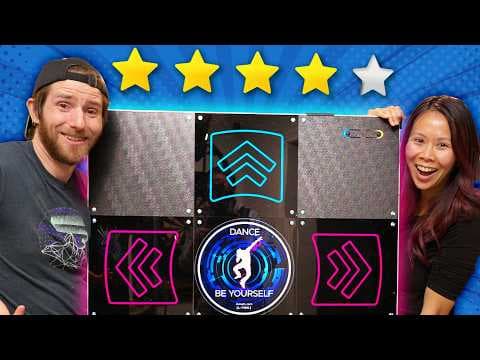
My Wife Wanted a DDR Pad...
Audio Summary
AI Summary
The speaker's wife has long wanted a DDR dance pad, but the speaker has resisted due to a lack of clear recommendations for quality products and the hassle of finding good ones. Many recommendations focus on what to avoid, and the universally praised "goatated" pad is extremely rare. However, Eltech, a Polish company, has developed a reputation for producing acceptable, reasonably priced, and in-stock DDR pads. The speaker recently acquired one, noting its cost but anticipating it will pay for itself given modern arcade prices. He hopes it will see extensive use, unlike some past exercise equipment.
The video briefly introduces Cape, a cell phone carrier focused on privacy and security, as a sponsor. Cape aims to combat phone number takeovers and two-factor authentication theft through features like network lock and identifier rotation. Another sponsor, Shipstorm, offers free shipping on ltstore.com for orders over $150 in the US and Canada or $225 worldwide from April 24th to May 7th.
The speaker admits to not doing extensive research on the Eltech pad, choosing it because it seemed to be the only viable option that wasn't a floppy vinyl pad or a decommissioned arcade cabinet. A significant obstacle to previous purchases was storage space, as exercise equipment often goes unused after initial enthusiasm. The Eltech pad's thin design when not in use was a key selling point, making it easier to stash away.
The unboxing reveals minimal contents: the pad, a USB cable, and a user manual. The cable is relatively short, suggesting it's designed for use in a living room near a computer or console. The pad is compatible with PlayStation, laptops, PCs, and Xbox. The speaker notes the durability of the pad.
The discussion moves to software, with StepMania being the recommended choice for playing DDR tracks. The pad itself features illuminated buttons for start and select, and different modes: dance pad, joypad, keyboard (Wazda or jilk layouts), and programming mode. The "programming mode" is clarified to likely mean programming which operational mode the device is in, rather than coding. A "penny mod" is mentioned as a potential fix for pads that don't always register steps, involving placing copper pennies under the contact points.
The speaker and a colleague attempt to play, struggling significantly and finding it much harder than expected. Their scores are very low, with many misses. The lack of music during their initial attempts is highlighted as a potential issue. A cameraman, Shawn, who competes internationally in dance, easily outperforms them, although the scoring system seems inconsistent, sometimes registering non-hits or failing to register actual hits.
Ivon, the speaker's wife, also tries the pad. Despite her initial desire for it, she finds it very challenging and fast, quickly giving up. The speaker's daughter had believed Ivon would be good at it.
A quick look at the pad's internal construction reveals hot glue and contact plates, with a warning about sharp edges. Ivon explains her desire for the pad stemmed from seeing it at Castle Fun Park and wanting something for her kids to do with friends, not necessarily for herself.
The video concludes with a renewed plug for Cape, emphasizing its privacy features like network lock (which verifies physical location against network connection requests to prevent signaling attacks) and identifier rotation (changing IMSI daily to prevent tracking). Users can save 33% on their first six months with code LTT at cape.co/linustechtips.