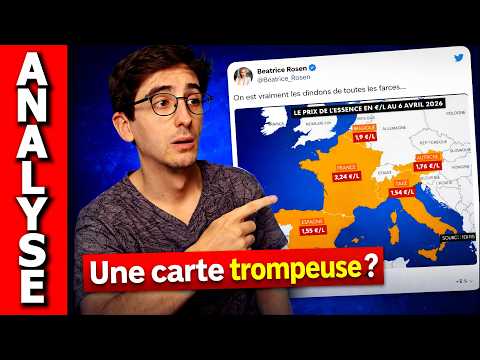
Scoop : L’essence est à 0€/L en France et je vous le prouve !
AI Summary
This analysis addresses the public outrage over high fuel prices in France, often compared unfavorably to other European countries, as depicted in viral social media posts. The speaker challenges this simplistic view, arguing that such comparisons are misleading without considering the full economic context, particularly France's structural deficit and public spending.
The discussion begins by referencing a widely shared image showing French fuel prices at €2.24 per liter, significantly higher than countries like Austria (€1.80), Italy (€1.76), and Spain (€1.55). This disparity fuels public anger, with many accusing the government of excessive taxation and exploitation. However, the speaker contends that a more comprehensive analysis reveals a different picture, suggesting that once negative factors are integrated, the price gap with Spain, for example, disappears, and French fuel prices could even be considered "negative" at -€2 per liter due to the level of public support.
To explain this counterintuitive conclusion, the speaker revisits the breakdown of fuel prices, highlighting that a large portion of taxes, such as the TICPE (domestic consumption tax on energy products) and its associated VAT, are fixed. These fixed taxes amount to €0.73 per liter, regardless of the base fuel price. Additionally, new energy certificates, implemented at the beginning of the year, add another fixed €0.16 per liter. These certificates, though not technically a tax, function similarly by raising consumer costs to fund initiatives like social leasing for electric cars, electric vehicle bonuses, and building thermal renovation, effectively subsidizing industries. The variable component of the price is the fuel cost itself, distribution, and the VAT applied to all these elements. Because most taxes are fixed, the fuel component's price increases much faster than the tax portion. Previously, it was estimated that the additional VAT generated a fiscal gain of €270 million for the state, which, if removed, would only lower fuel prices by about €0.06 per liter—a marginal impact.
The speaker notes that high fuel prices negatively affect the economy by reducing consumption, leading to lower tax revenues (including VAT and corporate taxes) and increased unemployment. This explains why other European countries have implemented measures to lower taxes or cap prices. Spain, for instance, reduced VAT on fuel from 21% to 10% as part of a €5 billion emergency plan for four months, resulting in a €0.30 reduction at the pump. Italy lowered excise duties by approximately €0.25 for a limited period. Germany temporarily reduced its TICPE by €0.17 per liter for two months.
A crucial distinction is made between lowering VAT and lowering excise duties. Reducing VAT primarily benefits individuals, as businesses typically deduct VAT. Conversely, reducing excise duties benefits both individuals and businesses. The speaker points out that Spain and Poland's VAT reductions (Spain from 21% to 10%, Poland from 23% to 8%) violate EU rules that set a minimum VAT rate of 15% on fuel. While the EU has sometimes "closed its eyes" to such infringements in exceptional circumstances (like Poland in 2022), these actions carry legal risks. The speaker questions whether French citizens would agree to higher VAT rates in normal times to benefit from temporary reductions during crises, as seen in Poland.
The core argument against immediate and significant tax cuts in France is the country's dire budgetary situation. Unlike many other European nations, France has limited fiscal leeway. In 2024, France's public deficit was -5.8% of GDP, placing it among the worst in the Eurozone, trailing only Poland and Romania. While Poland and Romania also have high deficits, their significantly lower public debt (below 60% of GDP in 2025) gives them more room to maneuver. France, however, is among the top three most indebted countries in the Eurozone, facing an excessive deficit procedure from Brussels, which mandates that public spending increases must remain below 1.9% in 2026. This means spending cannot even keep pace with inflation, forcing a gradual reduction of the deficit.
Implementing a €5 billion support plan for four months, similar to Spain's, would represent an additional 5% increase in France's state budget, pushing it off its required fiscal trajectory and risking sanctions from Brussels. The speaker illustrates France's worsening deficit compared to other EU countries: in 2022, France and Spain had similar deficits (5.6% of GDP), but by the third quarter of 2025, Spain's deficit is projected to be 2.2% while France's remains at 5.4%. This 3.2% gap represents a structural difference.
The French public deficit in 2025 is estimated at €152 billion. The 3.4 percentage point difference in deficit between France and Spain for 2025 translates to France having injected an additional €101 billion into its economy that year alone, compared to if it had followed Spain's trajectory. Cumulatively over three years, France injected an additional €190 billion through deficit spending compared to Spain. Therefore, while people might envy Spain's €5 billion short-term fuel price reduction, France has provided a much larger, albeit less visible, level of economic support over a longer period. This effectively means that, compared to Spain, French citizens have not only had their fuel paid for in 2025 but have effectively received an additional €2 per liter.
The speaker acknowledges that this deficit spending is not evenly distributed but broadly benefits the French population, with 56% receiving more than they contribute through public redistribution. This continuous deficit is attributed to three core ideologies: asymmetrical globalization (leading to unfair competition and deindustrialization), the Euro (which enables fiscal dumping by other countries and forces internal devaluation in France to maintain competitiveness), and the ecological transition (which is criticized for creating artificial markets and excessive taxation).
The speaker then critiques two common proposals for addressing fuel prices. First, the CGT (General Confederation of Labour) calls for a general strike to demand fuel at €1.50 per liter and immediate wage increases, accusing oil companies of profiteering. The speaker dismisses the €1.50 price target as unrealistic, explaining that given fixed taxes, it would require crude oil prices to drop below $40 per barrel, far below current market rates. He argues that the CGT uses fuel prices as a pretext to push for wage increases.
Second, Jordan Bardella of the RN (National Rally) proposes lowering VAT on fuel from 20% to 5.5% and reducing the TICPE by €0.16, claiming this would save €0.25 per liter. The speaker points out that such a drastic measure, costing an estimated €12-19 billion annually, is financially unfeasible for France, given its high deficit and debt. He also highlights Bardella's inconsistency in proposing cuts to EU-mandated policies (like immigration and renewables) while simultaneously advocating for France to remain in the EU. These proposed savings are long-term structural changes that cannot fund immediate tax cuts.
In conclusion, the speaker warns against being misled by simplistic comparisons of fuel prices. He argues that France's high deficit and debt, accumulated over 50 years, represent a continuous subsidy to its citizens' living standards, making it appear as if fuel is cheaper in other countries when a broader economic view is taken. The current high interest rates and the need to reduce the deficit will exacerbate France's economic challenges, leading to a "Potemkin economy" built on excessive financing. The speaker advocates for a shift in focus from short-term fuel price adjustments to addressing fundamental structural issues, including energy independence. He emphasizes that reducing fuel taxes at a time of supply pressure would only worsen potential shortages.