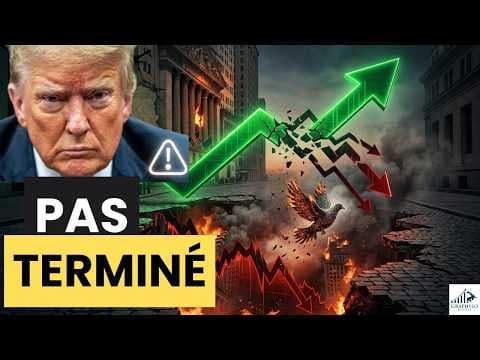
PAIX IRAN : Trump annule le krach boursier (Faux)
AI Summary
This video discusses macroeconomic trends and market indices, analyzing potential impacts and offering investment strategies.
Historically, oil shocks have led to market corrections, followed by about a year of stagnant market activity. A 10% market correction, as recently experienced, is considered normal and occurs annually. More substantial corrections of 10-20% happen every one to two years, 30% every four to five years, and crashes exceeding 40% every seven to eight years. This pattern suggests a strategy of dollar-cost averaging (DCA) should prioritize larger investments during 10-20% market dips, as these are the most frequent. A smaller portion of funds should be reserved for rarer, larger declines exceeding 30%. The current market situation, post-correction, suggests a likely period of sideways trading within a defined range, rather than an immediate straight-line recovery or a crash.
Geopolitical tensions, particularly involving Iran, introduce significant uncertainty. While there's a possibility of de-escalation, the lasting impact of such conflicts, even if the war ceases, remains. The risk of stagflation persists, where inflation continues while growth slows. Long-term interest rates are a critical factor, with significant corporate debt needing refinancing around 2027-2028. Elevated rates during this period could pose substantial challenges. Despite some minor credit market strains, the overall system is deemed resilient.
The notion of an "AI bubble" is overly simplistic. The AI market is segmented: software stocks are struggling, AI-specific stocks are largely flat, and semi-conductors, while generally bullish, have been lagging recently. The primary driver has been memory for data centers. True market concern regarding AI would emerge if major tech companies (GAFAM, hyperscalers) reduce their investments due to lower-than-expected growth, productivity returns, or tightening credit markets. Political and regulatory concerns, including cybersecurity and job displacement, could also impact AI's future development.
Oil prices are central to the economic outlook. Even if the conflict in Iran subsides, the question remains whether oil will quickly drop below $80 a barrel. Rapidly falling oil prices could destabilize Middle Eastern economies that rely heavily on oil revenues. Sustained oil prices above $90 would contribute to a stagflationary scenario, dampening economic activity.
Long-term interest rates remain a key concern, with rates in the UK, US, and France all elevated. There's potential for European countries to harmonize rates and push for investments in infrastructure and defense, possibly through European convertible bonds, to boost sovereignty. Central banks may eventually need to intervene to prevent long-term rates from rising too high, which could stifle economies and increase debt burdens. While households and businesses are currently less indebted than in the past, this trend is reversing, and excessive rate hikes could choke off credit.
Bank of America suggests that a weakening dollar could benefit European and international equities. The European market has shown resilience, outperforming the US recently. The US consumer market is also a focus, especially with upcoming mid-term elections. To boost consumption, which currently relies heavily on wealthier segments, tax cuts and other measures may be implemented to support the average consumer. Unlike Europe, the US has depleted its post-COVID savings, whereas European countries still have high savings rates. A moderate level of inflation in Europe, coupled with wage growth, could encourage consumption and help manage debt.
Consumer-related stocks are seen as a promising area for investment, given their low valuations (comparable to COVID or subprime crisis levels) and the potential for government stimulus to boost consumer spending. Trump's current unpopularity suggests he will need to deliver on promises to the average consumer to regain support before the mid-terms.
In Europe, there's a growing awareness regarding energy policy. While the Middle East conflict impacts LNG and other energy sources, North America's shale oil production is peaking, meaning future energy demand will increasingly turn to natural gas (LNG) as a transition fuel. North American LNG capacity is projected to double in the next two to three years, serving both domestic needs (data centers, electricity) and exports to Europe, which will continue to require significant energy imports. This positions the US to maintain its economic and military power, suggesting that while the dollar may weaken, a complete collapse of American influence is unlikely. A dollar index between 100-125 and oil prices in the $70-80 range are seen as beneficial for global stability.
Looking at market indices, the "Magnificent Seven" (now dubbed "hateful") tech stocks are crucial for any market rebound. Their heavy weighting in indices means their recovery is essential for overall market growth. The market is currently undergoing a relief rally, but significant impacts still need to be digested. While investment in CAPEX is projected to slow its growth rate, the absolute volume of investment remains massive through 2027-2028, signaling continued funding for the AI sector.
Looking further ahead to 2027, deflation or disinflation, rather than inflation, could become the primary concern. This could prompt central banks to lower rates, which would be crucial as significant government and corporate debt walls approach. Lower valuations and abundant corporate cash could also drive mergers and acquisitions, further stimulating markets. Insider buying in tech stocks, particularly during recent market dips, indicates confidence.
Technical analysis of the US 10-year and 20-year yields shows a return to previous levels despite the Iran crisis, indicating a potential range-bound scenario. Extreme movements (too high or too low) in these yields would signal significant economic stress, leading to either strong inflation and recession or a credit crisis. A stable range is deemed the most favorable for equities. Copper prices, a recession indicator, also suggest a period of range-bound trading, with no immediate recession.
Oil prices, even if they drop below $100 to $85, are expected to remain elevated for months, continuing to impact demand above $90. This reinforces the long-term trends of investing in energy infrastructure, national energy sovereignty, and transition energies like natural gas, as well as renewables (solar, batteries). The Iran situation is seen as an accelerator of existing trends rather than a new paradigm.
The CAC 40 index has shown a rebound, breaking above the 20-day moving average, but is now in a resistance zone, suggesting potential for zigzagging or range trading. For the Nasdaq, a true recovery would involve breaking above resistance levels with sustained momentum, rather than just technical bounces. The current market environment encourages taking profits on poorly positioned trades, raising cash levels (25-30%), and adopting a cautious approach. The speaker plans to provide further updates next week and encourages engagement through likes and comments. A list of favored stocks for the coming year is available in the description.