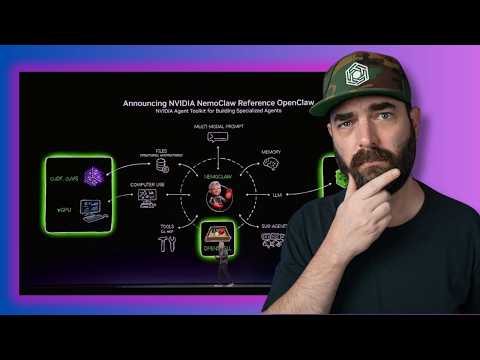
NVIDIA Is Everywhere Right Now
AI Summary
The Nvidia GTC conference in San Jose, California, often described as the "Super Bowl" or "Burning Man" of artificial intelligence, serves as a massive showcase for the company’s latest innovations. While much of the event is tailored toward enterprise-level data centers, several key announcements from the Day 1 keynote and surrounding events are particularly relevant to the general public and AI enthusiasts.
A primary focus of the conference was OpenClaw, an open-source project that has gained significant traction in the AI community over the last few months. OpenClaw is designed to transform standard AI models into autonomous agents equipped with memory and the ability to use various tools, essentially allowing them to act as human workers. To support this ecosystem, Nvidia announced "Nemo Claw," a tool that simplifies the installation of OpenClaw to a single line of code.
A major barrier for many potential users has been security, as giving an AI agent access to a system raises concerns about the safety of API keys, passwords, and sensitive financial data. Nemo Claw addresses this by including a dedicated security layer intended to protect this information. The speaker demonstrated the efficiency of this setup at a "Build-A-Claw" event, where professionals installed OpenClaw on a DGX Spark Box in just two minutes. Along with the agent framework, they installed the Neotron 3 Super, a 120-billion parameter model. This model is significant because it allows state-of-the-art AI performance to run entirely on-device, meaning users no longer have to send their data to cloud providers like OpenAI or Anthropic to achieve high-level results.
For the gaming community, Nvidia introduced DLSS5. Unlike previous versions like DLSS 3.5, which focused on frame generation—sometimes leading to visual "hallucinations" or artifacts—DLSS5 appears to function as a real-time AI upscaler. This technology is designed to take existing game graphics and polish them into higher-resolution, more realistic visuals instantaneously. While the live audience at GTC responded enthusiastically to the demonstrations, the speaker noted that some hardcore gamers online remain skeptical. The concern is that the AI might "hallucinate" details into the graphics that were not part of the original game design. The true impact of DLSS5 will likely only be clear once it reaches wider production.
Looking further into the future, Nvidia unveiled the "Space 1 Vera Rubin" module, a conceptual plan for data centers located in space. While the idea of extraterrestrial data centers sounds like science fiction, Nvidia is actively working on the engineering challenges involved. The primary obstacle currently is heat dissipation; GPUs generate immense heat, and in the vacuum of space, cooling them is incredibly difficult—especially when factoring in heat from the sun. While this technology is likely not arriving before 2030, it represents the company's long-term vision for infrastructure.
The conference also highlighted two overarching themes regarding Nvidia’s current position in the world. The first is the company's near-total integration into the global tech landscape. Nvidia works with every major cloud provider, including AWS, Google, Microsoft, and Oracle. Their technology is now a foundational element in almost every industry vertical, including automotive, healthcare, financial services, robotics, and telecommunications. If a company uses AI, it is almost certainly utilizing Nvidia hardware or software in some capacity.
The second theme is the staggering rate of acceleration in the field. Keynote presentations featured charts showing a rapid increase in tokens per second and the expansion of token context windows. Simultaneously, the energy usage and overall costs associated with these advancements are dropping. This rapid scaling suggests that the AI field is moving faster than ever before.
In summary, Day 1 of GTC emphasized making AI more accessible and secure through Nemo Claw, enhancing consumer experiences through DLSS5, and laying the groundwork for future infrastructure in space. Despite the "mad house" atmosphere of the crowded expo hall, the event made it clear that Nvidia remains the dominant force driving the rapid evolution of artificial intelligence across all sectors of society.