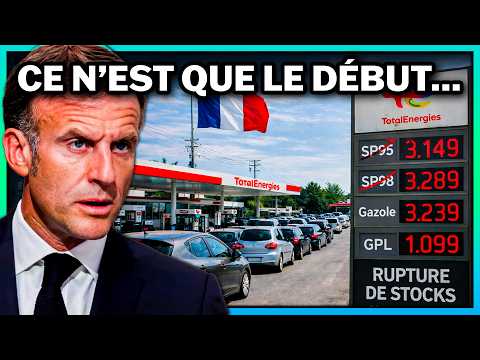
🚨 ALERTE PENURIES : La vérité que les médias vous cachent...
AI Summary
Less than a month ago, the Strait of Hormuz was an obscure location to most, but today, it commands global attention. It's widely known as the transit point for a significant portion of the world's oil and gas, and its closure by Iran has led to an explosion in gasoline prices. However, oil is just one aspect of the crisis. Hormuz is also the mandatory passage for one-third of global fertilizers, 9% of all aluminum produced, and one-third of the world's helium – a critical component for manufacturing electronic chips by companies like Samsung and TSMC. In the past three weeks, traffic through the strait has plummeted by 80%. While the immediate impact has been felt at the gas pump, this is merely the beginning, with further shortages anticipated that will drive up prices for staples like bread, rice, and smartphones, and extend delivery times across various sectors, including hospitals. France, which relies on imports for its fertilizers, chips, and aluminum, is particularly vulnerable.
The speaker investigated the potential consequences, drawing parallels from previous crises and performing calculations to forecast future impacts. Before delving into the predictions, the speaker introduces Cyberghost VPN as a partner. Cyberghost VPN, with over 38 million users, encrypts internet connections, preventing internet service providers and other entities from tracking online activities. It also allows users to bypass geographical restrictions by changing their virtual location, providing access to an additional 39-50% of content on streaming platforms like Netflix, Amazon Prime, and Disney Plus. Users can also secure better online deals by altering their virtual location. The service supports up to seven devices simultaneously and offers an exclusive deal for listeners: 2.3 cents per month, four months free, and a 45-day money-back guarantee.
The Strait of Hormuz is a 34-kilometer-wide maritime corridor between Iran and Oman, through which about a hundred ships pass daily. It serves as the sole exit point from the Persian Gulf, making it a highly strategic "choke point." Since February 28, following American-Israeli strikes on Iran, the Revolutionary Guards declared the strait closed to Iran's enemies, leading to attacks on merchant vessels. Consequently, shipowners are turning back, with over 150 vessels currently waiting outside the strait, unwilling to pass, and their insurers refusing coverage. The 80% drop in traffic primarily affects oil and gas, which constitute 85% of the goods passing through Hormuz. The remaining 15%, often overlooked, includes critical items like fertilizers, helium, and aluminum.
Fertilizers are crucial for modern agriculture, which heavily relies on nitrogen. The production of urea, essential for crops like wheat, corn, and rapeseed, requires ammonia, which in turn necessitates natural gas burned at high pressure. The largest fertilizer plants are located in the Persian Gulf due to the low cost of gas. Thirty percent of global urea trade and 20% of ammonia transit through the Strait of Hormuz. The blockade means millions of tons of fertilizers are stuck at sea or on docks, unable to be applied during the critical planting season in March. Farmers who didn't stock up on fertilizers in the autumn now face exorbitant prices. While France produces a significant portion of its nitrogen fertilizers and had covered 85% of its needs before the crisis, the remaining 15% now costs double. The price of Egyptian urea for Europe surged by 47% in three weeks, from $487 to $715 per ton. This demonstrates the silent expansion of the conflict, as Egypt, which supplies a quarter of Europe's nitrogen fertilizers, uses Israeli gas via a pipeline that has been shut down since early March for security reasons. Additionally, the EU's new carbon border adjustment mechanism adds €100-130 per ton of imported fertilizer. Fertilizers account for up to 30% of production costs for French cereal farmers, meaning consumers will bear some of the burden. During the 2022 Ukraine war, urea prices exceeded $1000 per ton; while not yet there, $715 is approaching that level. The World Food Programme warns that if the Hormuz blockade continues until June, an additional 45 million people could face food insecurity.
Helium is another critical commodity stuck in Hormuz. While often associated with balloons and entertainment, its industrial applications are vital. As the coldest gas on Earth, helium is indispensable for semiconductors and medical imaging. In chip manufacturing, helium cools silicon wafers during the engraving of atomic-scale circuits, preventing deformation. Without it, chips cannot be produced, impacting smartphones, cars, servers, and AI. In medical imaging, MRI machines rely on helium to cool superconducting magnets. Qatar produces nearly a third of the world's helium as a byproduct of natural gas extraction at the Ras Laffan complex, the planet's largest LNG plant. However, Ras Laffan has been shut down since March 2 following Iranian strikes, and further missile attacks on March 18 caused damage that will take years to repair, reducing exports. Spot prices for helium have jumped 70-100% in a week. South Korea, which imports 65% of its helium from Qatar, is particularly concerned. While Samsung and SK Hynix have several months of stock, prolonged crisis will slow memory production. Experts estimate at least five weeks are needed to restart Qatari production, even with a ceasefire, during which the world will lack a major supplier. A longer disruption could lead to chip foundries rationing and extended delivery times for all products containing semiconductors.
The 15% of miscellaneous goods passing through Hormuz also include aluminum. The Persian Gulf is a major aluminum production hub, with the UAE, Bahrain, Qatar, Saudi Arabia, and Oman collectively producing about 7 million tons annually, or 9% of global output, 80% of which is exported. Aluminum is ubiquitous, found in cans, window frames, car bodies, aircraft fuselages, electrical cables, and food packaging, making it the second most used metal after steel. The Hormuz crisis prevents foundries from shipping finished products and receiving raw materials like alumina, which the region mostly imports through Hormuz. Consequently, stocks are dwindling. Qatar's Qatalum has halted production, and Bahrain's Alba reduced capacity by 19%, declaring force majeure. Europe is especially vulnerable, having already lost Russian supplies after the invasion of Ukraine. Thirty percent of Europe's aluminum imports come from the Middle East, primarily the UAE. Prices on the London Metal Exchange surged 12% in days, reaching a four-year high of $3545 per ton. Observers predict prices could exceed $4000 per ton by autumn if the blockade persists, impacting industries like automotive, aerospace, and construction, with the increased costs passed on to consumers.
In response to these shortages, countries are taking various measures. The Philippines declared a national emergency due to a doubling of gasoline prices in Manila, importing 98% of its oil from the Gulf. Bangladesh closed universities to save electricity, Pakistan reduced its work week and closed schools, and Sri Lanka rationed fuel. Vietnam cut domestic flights, and Thailand encouraged remote work. South Korea urged citizens to take shorter showers and charge phones during the day to ease grid strain. Slovenia became the first EU country to ration fuel. France saw some stations limit deliveries, mainly due to panic. China banned refined product and fertilizer exports to protect its own supply, reducing global availability. Unlike oil, there are no global strategic reserves for these materials. Saudi Arabia can reroute some oil exports via Yanbu port on the Red Sea, but this covers only a fifth of the deficit. China and Russia maintain their own restrictions.
Semiconductor giants are actively addressing the helium shortage. Samsung implemented recycling systems recovering up to 90% of used gas, and TSMC claims diversified suppliers and sufficient stock. However, smaller foundries in Southeast Asia, like those in Malaysia and Singapore, recycle only half their helium and would be the first to halt operations if the crisis continues. For aluminum, Bahrain and Qatar have cut or reduced production. The UAE is attempting to reroute cargo by truck through Omani ports, but this is costly and cannot replace usual volumes.
The economic impact is significant. European gas prices nearly doubled in three weeks, from €32 to over €52 per MWh, and Brent crude rose 40% since February 28. As European electricity prices are linked to gas prices, utility bills will increase. The IMF estimates that a sustained 10% rise in oil prices adds 0.4 percentage points to inflation and costs 0.2 percentage points of growth. Oil prices have quadrupled this impact at the pump, with diesel potentially exceeding €2.50 if crude stays above $100 a barrel. The aluminum shortage will affect the automotive, aerospace, construction, and packaging industries, with increased costs eventually passed to consumers. Fertilizer costs will impact food prices, taking 4-6 months to ripple through the supply chain. If urea remains above $600 per ton until June, food price increases will hit shelves by early 2026 and intensify after the 2027 season. After the Ukraine war, French food prices rose by 16%; this time, a 12% increase is expected, which would undermine the ECB's 2.4% inflation target for the Eurozone. The helium shortage will be slower to manifest but potentially more destructive. Chip foundries have a few months of stock, but Qatari production must restart before summer. Otherwise, delivery times for all semiconductor-containing products—phones, cars, computers, medical equipment—will lengthen by autumn.
To illustrate the scale of the Hormuz crisis, recall the 2021 Suez Canal blockage: one container ship, six days of blockage, $9 billion in goods immobilized daily, 2-3 months of delivery delays, and over 250% increase in freight costs on Asia-Europe routes. Hormuz is four times the volume of Suez, and the current blockade has lasted three weeks. The overall impact depends on the conflict's duration. If the strait reopens quickly, the current shockwave might be manageable. However, if the blockage persists until next June, Eurozone growth could drop to 0.5%, and China's growth could fall below 3%, making the summer more expensive than last year. The speaker encourages viewers to check out Cyberghost VPN for privacy protection, exclusive content, and savings, offering a risk-free trial.