Electric ships are slowly starting to make sense
Audio Summary
AI Summary
The Touanor, the first solar-electric ship to circumnavigate the globe in 2012, still appears futuristic, with mass-market adoption of electric ships lagging behind electric vehicles. However, momentum is building. Recent announcements include China's first 10,000-ton fully electric container ship, Norway's order of 20 electric Candela P12 ferries, and BYD, the world's largest battery maker, launching a new business unit for marine batteries and electrical systems. Earlier, Incat Hull 96 became the largest electric ferry, and the Silent Yacht 62 was the first production yacht to cross the Atlantic primarily on solar power.
Electrifying ships faces two primary challenges: charging and energy consumption. Charging is straightforward for small boats at marinas but difficult for large ships needing specialized ports and unable to refuel at sea, limiting range. The second challenge is the immense energy required to move ships through dense water, especially at higher speeds. Water's density necessitates significant power, and as ships accelerate, they create increasingly larger waves. Reaching "hull speed" drastically increases energy consumption, and exceeding it requires hulls designed to lift out of the water (planing), which is also energy-intensive. Hydrofoils offer a solution by lifting the hull out of the water, reducing energy consumption by up to 80% at high speeds, but they add significant cost and complexity. Consequently, electric ocean liners or very fast ships are not feasible in the near future.
Despite these limitations, electrification is proving highly effective for certain ship types. **Ferries** are an ideal fit. Many operate on short, fixed routes, easily covered by current battery technology. They also spend considerable time docked, allowing for charging. Municipalities often own port infrastructure, facilitating charger installation. While upfront costs are higher, operational costs are lower due to cheaper electricity and reduced maintenance. Furthermore, ferries are significant polluters, with environmental and economic incentives strongly favoring electrification. Examples include the Incat Hull 96, numerous ferries in Norway (which mandates zero-emission passenger ships in fjords starting this year), and Candela's hydrofoil ferries.
**Luxury yachts and houseboats** are another promising category, benefiting from quiet and clean operation. These vessels often rely on solar panels for power and can use backup diesel generators if needed. Their leisurely pace between destinations and anchoring allows for solar recharging, potentially offering infinite range. The Silent Yacht 62, for instance, utilizes solar panels to power onboard appliances and charge its battery, enabling slow cruising or fallback to battery power. While expensive, these vessels offer reduced refueling and maintenance costs for users who prioritize a serene, environmentally friendly experience.
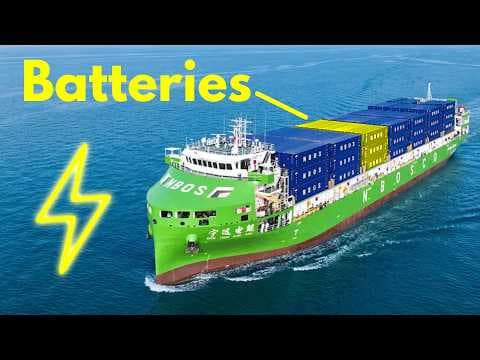
**Container ships** present a more complex scenario. China's Ningbo Dianyun, a smaller container ship, carries 740 TEUs, with 10% of its capacity dedicated to batteries. Its estimated range is 90 nautical miles, suitable for specific short routes but not long-haul voyages. Batteries are integrated into standard shipping containers, allowing for easy charging and swapping at ports. Longer voyages are unlikely to be electrified soon, potentially relying on hydrogen or nuclear power.
**Smaller pleasure boats**, such as fishing boats and sailboats, are also viable for electrification. Electric outboards offer direct replacements for combustion engines, though with higher upfront costs and limited range. Sailboats can benefit from electric engines for harbor maneuvering. For recreational boats, electric options exist but involve significant trade-offs. High-end speedboats like those from Arc are expensive and generate large waves due to their heavy batteries, ironically making them suitable for wake surfing. Electrified versions of these boats can be 38% more expensive than their gas-powered counterparts, with range significantly decreasing at higher speeds.
A notable geographical split exists in electrified shipping, with Europe leading in non-commercial sectors due to its shipbuilding industry, component suppliers, and stringent emission regulations. The US is catching up, while China, a dominant force in battery production and commercial shipbuilding, is increasingly playing a role.
The sponsor, Anti-gravity, offers the A1 drone, featuring a 360° camera and VR headset for an immersive flying experience. Its ease of use, advanced sensors, and lightweight design make it a futuristic option for aerial photography and videography.