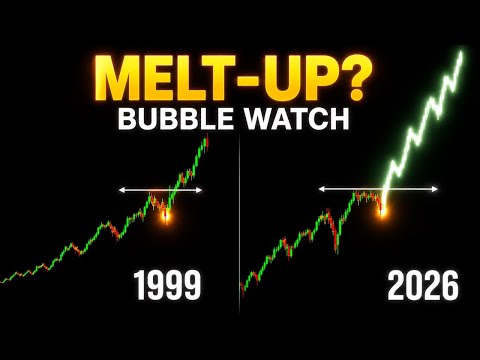
Melt-Up or Bubble? The Market Is Flashing 1999
AI Summary
The current market is experiencing a "melt-up" phase, reminiscent of 2019 when the Fed expanded its balance sheet. This time, the focus is on Bitcoin, which is expected to stabilize over several weeks, potentially seeing one or two lower lows, though the latter seems less likely. Both bullish and bearish outlooks for Bitcoin suggest an exceptionally bullish future, differing only in the timing of the upward surge.
Some predict a significant 50% correction in Bitcoin, possibly reaching $40,000 between September and November. This scenario would mirror Bitcoin's 2008 flatline followed by a sharp drop, triggered by Fed policy. However, the current market differs significantly from 2008, which was retail-driven. Today, institutional flows, particularly from spot ETFs, are holding up Bitcoin, resulting in a much smaller drawdown compared to previous cycles. Retail investors are currently irrelevant, a trend observed over the last three years.
From April until its peak, spot ETFs added over $20 billion in inflows, indicating a fundamentally different market than past cycles. Even during recent drawdowns, these ETFs have continued stacking, suggesting a strong underlying demand. While a prolonged period of sideways movement or minor drawdowns for Bitcoin, especially during a midterm election year (May through September), is plausible, it's not the most probable outcome. Historical seasonality, particularly from October into year-end, typically supports an ascent out of a bottom, even for bearish scenarios.
The Fed's playbook, involving liquidity and balance sheet expansion, is seen as a key driver. Similar to past instances, tech is leading this melt-up. In 2019, tech led an S&P 500 rise of 14% in months before the global lockdown. The current situation is strikingly similar, with tech once again melting up over the past five to six weeks, albeit with a slight delay this time.
The global lockdown is viewed as an anomaly. The need for liquidity injections, as seen in September 2019 when the Fed stopped quantitative tightening (QT), is a recurring theme. Currently, there's a need for $40 billion a month in organic balance sheet expansion, dubbed "reserve management purchases," where the Fed buys treasuries. This, along with yield curve control, is highly conducive to liquidity. The monetary base total is now rising, which historically correlates with Bitcoin's ascent.
The current market trajectory for Bitcoin is expected to be an upward-sloping channel, leading to a significant bull run. However, several factors could derail this. A return to tight monetary policy by the Fed, a breakout in the 10-year Treasury yield above its upside resistance, or a significant surge in oil prices above $120-$140 per barrel (which would cause yields to blow out) could all lead to market corrections. Additionally, a pullback in CapEx spending, which continues to show robust growth, would be a concern.
The "Buffett indicator," which compares total U.S. stock market value to U.S. GDP, is often cited as a sign of overvaluation. However, this indicator is skewed because a large portion of revenue for major U.S. companies (e.g., Apple, Microsoft, NVIDIA) comes from outside the U.S. For S&P 500 companies, 28% of revenue is foreign, rising to over 56% for information technology and 67% for semiconductors. This means the numerator (global revenue) grows while the denominator (U.S. GDP) does not, leading to an inflated ratio. Furthermore, the digital economy (Google, YouTube, Instagram, WhatsApp) generates immense economic value but contributes little directly to GDP.
The current AI CapEx boom is a real and significant driver of economic growth. Software and IT contributed 134 basis points to GDP growth, accounting for 60% of all economic growth in the last quarter, surpassing the 1999 dot-com record. Without AI-driven tech investment, GDP would be flat. The AI build-out is substantial, with companies spending and earning staggering amounts. This period is akin to the dot-com bubble but with a more tangible foundation, presenting significant opportunities.
The exponential growth in AI is difficult to comprehend. While there's a monopoly in the semiconductor market (e.g., NVIDIA, Taiwan Semiconductors), the demand for chips is immense. Elon Musk's efforts to build semi-fabs are driven by the need for chips for robots, indicating that current chip supply cannot meet demand. Therefore, despite high valuations, these companies may not be overvalued given the current chip and energy constraints. As production increases, costs may come down, but that's not imminent. The build-out is real, and the market is entering the next phase with the advent of robots.