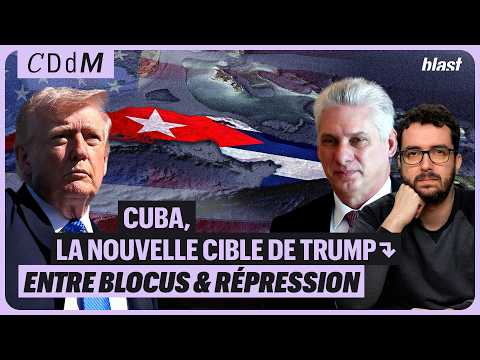
CUBA, LA NOUVELLE CIBLE DE TRUMP : ENTRE BLOCUS ET RÉPRESSION
AI Summary
The political landscape of the Western Hemisphere is shifting rapidly as Donald Trump turns his sights toward Cuba. Following recent actions involving the removal of Maduro in Venezuela and ongoing tensions with Iran, Trump has declared that the Cuba we have known for decades is reaching its final moments. This aggressive stance was solidified during the "Shield of the Americas" summit held on March 7 at Trump’s Florida golf club. This event brought together several prominent right-wing Latin American leaders, including Argentina’s Javier Milei and El Salvador’s Nayib Bukele. While the official objective of this "Shield" initiative is to coordinate the fight against drug cartels, the underlying motivation is a geopolitical struggle to reassert American influence and block Chinese expansion in the region.
The consequences of this "maximum pressure" strategy are already visible on the ground in Cuba. The island is currently gripped by a severe energy and economic crisis. In the city of Moron, frustrated citizens recently set fire to the local Communist Party headquarters, a stark symbol of the growing anger over constant electricity blackouts and fuel shortages. The situation has become unsustainable because Cuba is no longer receiving the oil it once relied on from Venezuela. Following the removal of Maduro, the new Venezuelan leadership under Delcy Rodriguez has aligned itself with Washington. This shift was highlighted by a friendly exchange between Trump and Rodriguez on social media, signaling a new era of cooperation that pointedly excludes Cuba.
Without oil, the Cuban economy has effectively ground to a halt. Kerosene shortages mean that international flights can no longer land, which has decimated the tourism industry—the country’s primary source of foreign currency. Public services are being drastically reorganized; hospitals are paralyzed, and the government has been forced to implement a four-day work week. The desperation is so extreme that even Mexico, which previously provided oil to the island, has had to stop doing so to avoid American sanctions. Instead, the Mexican government has transitioned to providing emergency humanitarian aid, a role that would have been unthinkable for Cuba just a few years ago.
The human cost of this collapse is profound. The transcript highlights the story of Robertico, a 29-year-old who works as a doctor but is forced to drive a taxi and manage a cafeteria just to survive. Despite his medical degree, he earns less than $20 a month, a wage that makes basic existence a struggle. While the majority of the population faces this "misery," a small elite has emerged, benefiting from a limited private sector allowed since 2014. This elite lives in a "parallel dollarized society," frequenting luxury jazz clubs and eating sushi in Havana, while 90% of the purchasing power of average retirees has been wiped out since a failed currency reform in 2021.
This economic decay is coupled with a climate of intense political repression. There are currently between 760 and 1,200 political prisoners in Cuba. In 2024 alone, over a hundred people were arrested for participating in protests, with some facing charges of sedition for peaceful demonstrations. The traditional pillars of the Cuban Revolution—free healthcare and education—are no longer enough to compensate for the lack of political freedom and the crumbling infrastructure. Consequently, the island is facing a demographic crisis; it is estimated that 20% of the population has emigrated since 2020. This exodus is driven by a deep generational divide: while older citizens may still cling to the revolutionary ideology of the past, those under 30 have largely abandoned the regime’s rhetoric.
In a surprising turn of events, President Miguel Diaz-Canel recently admitted that his government has been engaging in secret negotiations with the United States, mediated by the Vatican. These talks have already resulted in the release of 14 political prisoners. However, the ultimate goal of the U.S. remains clear: they want the current regime to step down.
The transcript suggests several reasons for this renewed American aggression. Beyond the desire to curb Russian and Chinese influence—a policy known as "continentalism"—there are significant domestic political factors at play. Republican strategists are concerned about losing the Latino vote in Florida, where the anti-communist Cuban diaspora holds immense influence. Hardliners like Secretary of State Marco Rubio, the son of Cuban immigrants, are driving this confrontational policy. As Trump yields to these radical pressure groups, the future of Cuba remains more uncertain than ever, with a moribund regime struggling to maintain its grip on a disillusioned population.