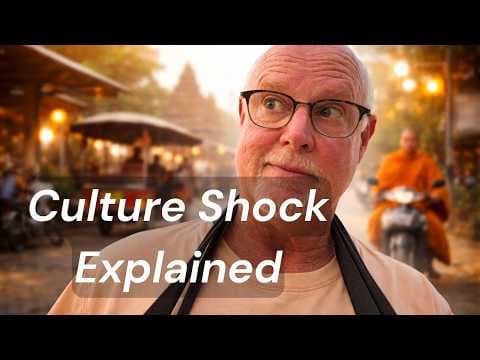
First Time in a Cambodian ? Here's What to Expect About Culture Shock!
AI Summary
When arriving in Cambodia, foreigners often experience a realization that the culture operates on a completely different set of social assumptions than in the West. What initially seems chaotic often follows its own logic, and understanding these patterns deepens with time. Here are some significant cultural adjustments people encounter when moving to places like Siem Reap or Phnom Penh.
Firstly, the perception of time differs considerably. In many Western countries, time is a resource to be managed and optimized. In Cambodia, it's more situational and flexible. A repair that might take 30 minutes elsewhere could take half a day here, not due to carelessness, but because relationships and circumstances often take precedence. This system, while different, works effectively on its own rhythm.
Secondly, a smile in Cambodia doesn't always signify happiness. Visitors frequently observe Cambodians smiling in situations where Westerners might not, even when things go wrong. Smiles can convey politeness, embarrassment, uncertainty, or an effort to maintain comfortable interaction, especially in negative situations where directly saying "no" might be avoided. This reflects a cultural tendency towards preserving social harmony.
Thirdly, the informal economy is pervasive. Unlike the highly formalized systems in many Western nations, daily life in Cambodia often relies on informal networks. Whether finding a mechanic or an apartment, personal connections frequently outweigh official channels, highlighting the power of community networks over institutions.
Fourthly, hierarchy and respect are deeply ingrained. Cambodian society strongly emphasizes respect and hierarchical structures, with age and titles holding significant weight. Deference to elders and authority figures is evident in subtle cues like body language, tone of voice, and greetings. The Khmer language itself has formal words used when addressing monks or teachers, further illustrating these distinctions, all of which contribute to maintaining social balance.
Fifthly, removing shoes is a constant adjustment. In many homes, businesses, and even places like dentist offices, taking off shoes is expected. This practice is partly about cleanliness but also signifies respect for the living or business space. Over time, it becomes second nature, leading to practical changes like opting for flip-flops over lace-up boots.
Sixthly, much of life happens outdoors. In contrast to Western habits, daily life in Cambodia frequently unfolds in open or semi-outdoor spaces, such as parks or along rivers. Families cook, eat, repair items, or relax outside, even just beyond their homes. Streets become extensions of living spaces, partly due to the tropical climate where shaded outdoor areas can be cooler. This also explains why houses are often on stilts—not just for flooding, but because the cooler downstairs area serves as a living space.
Seventhly, the sounds of the city are distinct. Depending on one's location, the soundscape includes motorbikes, street vendors, construction, karaoke, and notably, loud music and chanting from weddings and funerals, which can last for about three days, starting early in the morning. While initially overwhelming, these sounds eventually become part of the ambient atmosphere.
Privacy is also viewed differently. While strongly emphasized in many Western cultures, Cambodian communities often operate with greater social visibility. Neighbors notice things, and people may ask personal questions, driven more by curiosity than nosiness. Family networks are also incredibly close-knit, reflecting a culture where community awareness is normal, shaped by historical context.
Ninthly, street food is an integral part of daily life. Unlike in the West where eating out is often a treat, in Cambodia, street food is a common daily meal. Small food stalls, often mobile, neighborhood vendors, and various restaurants create a decentralized, fresh, and affordable food system that is widely accessible.
Finally, history is ever-present. Cambodian culture cannot be separated from its past, particularly the profound impact of the Cambodian genocide during the Khmer Rouge era. The legacy of this period continues to shape society, affecting many families and their descendants across generations. Understanding this history reveals the resilience and perspective inherent in Cambodian culture and communities.
Culture shock in Cambodia is not just about learning that the world works in multiple ways; it actively challenges Western assumptions about time, community, people, and daily life. For those who stay long enough, these initial shocks transform into an understanding of a truly different way of living.