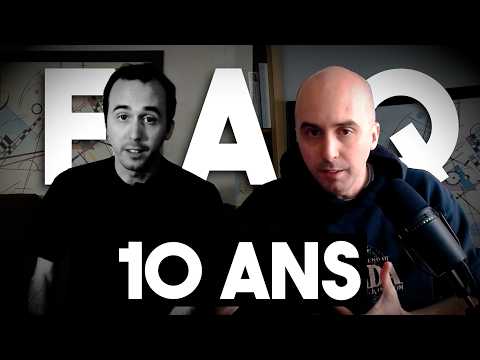
Je n'arrête pas YouTube
AI Summary
The speaker begins by reminding listeners about the crowdfunding campaign for "The Late Show of the Century," an ambitious project aiming for hour-long, anachronistic late-night shows featuring philosophers like Hobbes and Descartes. The campaign is nearing its second tier, which would enable an episode with Hobbes. Contributors gain access to a blooper reel featuring Thomas in the role of Sextus Empiricus.
The speaker then addresses a series of frequently asked questions. Regarding his educational background, he explains that he pursued a science baccalaureate remotely and chose university philosophy studies because he found the traditional school system, including preparatory courses, unappealing. His initial interest in philosophy was sparked by a scientific aspect in a baccalaureate essay question and a broader search for knowledge.
A pivotal moment in his philosophical journey was discovering formal logic during his first year at Nanterre, attending two different lectures on the subject. He found the depth of Jerome Scure's class particularly impactful. Another significant early reading was Peter Singer's "Animal Liberation." He attributes his discovery of analytical philosophy to the "Key Text Collection" by Vrin, which compiles foundational articles in various fields, particularly philosophy of mind. Later in his research, Edward Zalta's "Abstract Objects" greatly influenced him, fascinating him with its expressive logical system. Beyond philosophy, Greg Egan's science fiction novels, discovered relatively late, significantly deepened his appreciation for the genre. He plans to create a video comparing Egan's and Ted Chiang's short stories as thought experiments on determinism, potentially making it accessible to "Late Show" contributors.
Addressing his professional situation, the speaker confirms he has been a full-time YouTube content creator for nearly a decade, having stopped teaching after his first year on the platform. His income primarily comes from regular donations, supplemented by partnerships and, to a much lesser extent, YouTube ad revenue. He notes that living solely off YouTube revenue typically requires millions of regular views, which he doesn't achieve. He also mentions past support from the CNC for "Philosopher View" and hopes for similar funding for "The Late Show." While he handles all regular video production himself, "Philosopher View" involves a team for filming, preparation, and some editing.
On the topic of motivation, he states he genuinely enjoys making videos, including writing and editing, and has no shortage of ideas. Despite this, he has experienced periods of low motivation, mainly due to videos performing below expectations and the channel's audience stagnating for years. He feels he constantly battles to maintain his current audience level. He attributes this stagnation partly to the heterogeneous nature of his content, which covers diverse subjects from AI to the history of philosophy, making it difficult for YouTube's algorithm, which favors niche content, to recommend his videos effectively, even to subscribers. This leads to self-imposed pressure, guilt over not releasing enough videos, and a tendency to over-perfect details in writing and editing. He acknowledges this isn't ideal for work-life balance but notes he hasn't experienced burnout in 10 years.
He expresses a long-standing desire to create shorter formats but finds it challenging, as his natural inclination is towards in-depth, structured discussions that inevitably lead to longer videos. He explains that current algorithm behavior makes multi-part video series, which he used to produce, risky for visibility. Consequently, he now creates fewer, but very long and elaborate, standalone videos. Despite the unpredictable nature of YouTube and fluctuating motivation, ambitious projects like "The Late Show" re-energize him.
Regarding public appearances, he attends festivals infrequently, about once a year, and rarely accepts conference invitations. He believes his time is better spent on video production, as a video allows for more refinement and engagement than a live talk. He tries to present fresh content at conferences, which demands more preparation. He announces his participation in the Toulouse Rec festival, where he will discuss AI and the media reception of his video on Luc Julia.
Responding to questions about recurring elements from older videos, such as his "evil twin" and the "green monster," he explains that the "evil twin" was a pedagogical device for asking naive questions, a role now partially filled by the "Philosopher View" interviewer and by rhetorical questions within his current scripts. The "green monster," once a channel mascot, is now his daughter's plush toy, having been "swiped" by him for the channel's early set.
When asked about his viewing habits, he mentions watching a lot of popular science. He also highlights his recent discovery of Chris and Jack's YouTube channel, which produces well-written, philosophically inclined humorous short films. His favorite videos on his own channel are the "Philosopher View" series, of which he is most proud. He also particularly likes his experimental philosophy video on belief and knowledge, praising its accessible epistemology and original research.
His views on AI, particularly LLMs, have evolved rapidly. He clarifies that his initial "AI skeptic" stance in early 2023, where he noted GPT-Chat's inaccuracies, was accurate for GPT 3.5 at the time, not a definitive judgment on AI's future. He had been impressed by LLMs for years and his early video emphasized their nature as "text fillers" that "bullshit" in Frankfurt's philosophical sense, which he clarified is not inherently negative and can require intelligence. He admits he didn't anticipate the rapid improvement seen with GPT-4, which quickly rendered his early hallucination examples obsolete. He notes that many people's perceptions of LLMs remain skewed by their initial experience with GPT 3.5. A second significant shift in his perception occurred with the advent of reasoning models (e.g., chain of thought) around late 2024, which greatly enhanced LLMs' potential without increasing model size.
He confirms his continued interest in LLMs and generative AI, planning future videos on topics like self-representation in LLMs. However, he clarifies that LLMs will not be the *sole* focus of his channel; he will continue to produce diverse content, including "Philosopher Views" and experimental philosophy.
Regarding a past idea to write science fiction short stories, he expresses a desire to do so but lacks the time due to his current workload. He also plans to revisit poll-format videos, an enjoyable format where he analyzes audience responses. Videos on logic are challenging due to YouTube's visibility demands, as highly specialized topics may not attract sufficient viewership to justify the extensive production effort.
He describes his relationship with academic research as minimal, primarily through friendships with researchers, and he holds no academic ambitions himself. He views his role as most useful behind a screen preparing videos. When discussing the history of philosophy, he notes that his analytical approach emphasizes arguments, premises, and conclusions. He also addresses authors like Foucault, Deleuze, Sartre, and Camus, explaining that while they are significant in philosophy courses, they don't feature prominently on his channel because his focus is on specific arguments rather than authors whose work is less amenable to isolating famous arguments.
Finally, he recommends using LLMs as personalized tutors for those wanting to delve deeper into philosophy, emphasizing their potential for education and research when approached with a curious mindset. He debunks the common criticism about the immense ecological footprint of LLMs, stating that text queries consume negligible energy and water compared to many daily activities. He also expresses skepticism about the general usefulness of AI video generation, deeming it impractical for precise scripts and far more resource-intensive than text generation, which he sees as having clearer applications of general interest in research and education. He concludes by reiterating that "The Late Show of the Century" will feature human talent and urges continued support for the crowdfunding campaign.