C’est Officiel, l’Ordre Mondial s’est EFFONDRÉ | Ray Dalio
AI Summary
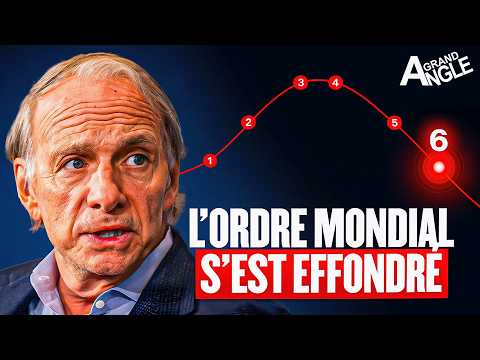
Current global events indicate that we have reached a critical decision-making point, signaling the collapse of the post-1945 world order. World leaders recently gathered at the Munich Security Conference to acknowledge that the era of established international rules has ended, replaced by a period of "great power politics." In this new phase, described as "Phase 6" of a recurring historical cycle, the rule of law is superseded by raw power. As the previous structures of security and commerce dissolve, the risk of a profound recession—or something even more transformative to the monetary order—becomes imminent.
The fundamental difference between internal national order and external international order is the presence of enforcement. While nations have police and courts to resolve disputes, international relations operate under the "law of the jungle." Because international organizations like the United Nations lack more wealth and power than the strongest individual countries, those powerful nations ultimately dictate the rules. Conflict arises when a dominant power begins to weaken while a rising power approaches its strength. In these moments, disagreements are rarely settled by lawyers; instead, they are resolved through threats and, eventually, five distinct types of warfare: trade, technology, capital, geopolitics, and military combat.
History shows that these cycles of peace and disorder repeat approximately every 150 years. Periods of prosperity eventually sow the seeds of their own destruction by creating massive wealth gaps and overextension. A nation’s long-term success depends on its ability to maintain "guns and butter"—the financial strength to provide a high standard of living for its people while simultaneously funding a military capable of protecting its interests. When a country can no longer afford both, it becomes vulnerable to domestic unrest and foreign opposition.
The 1930s provide a stark parallel to our current era. Following the 1929 stock market crash, the world entered a period of extreme internal conflict over wealth. This desperation led to the rise of populist, autocratic leaders across the globe. In Germany and Japan, where democratic traditions were weak, the population turned toward fascism—an ideology that is autocratic, capitalist, and collectivist. Fascist leaders argued that top-down government direction of private production was the most efficient way to restore national power. Conversely, the United States and the United Kingdom, possessing stronger democratic roots, moved toward populism but maintained their core systems, though they significantly increased taxes on the wealthy and expanded government spending.
The economic recovery of the 1930s illustrates the power of debt monetization. In Germany, the government funded massive public works and military expansion by forcing banks to buy state bonds and having the central bank monetize the debt. This eliminated unemployment but necessitated the seizure of foreign resources to sustain the machine. In the United States, President Roosevelt’s New Deal utilized similar deficit spending and debt monetization, alongside raising the top marginal tax rate from 25% to over 80%. These examples demonstrate that borrowing in one’s own currency to fund productive investments can be highly effective, but it also increases the stakes of the global competition for resources.
Before "hot" military wars begin, there is typically a decade of intense economic and capital warfare. These tactics include freezing assets, blocking access to capital markets, and imposing embargos. The path to World War II was paved by such measures. The United States used the Export Control Act and the Lend-Lease Act to support allies while economically strangling adversaries. The most pivotal moment occurred when the U.S. froze Japanese assets and imposed an oil embargo in 1941. This forced Japan into a "fight or retreat" dilemma; they calculated they would run out of fuel within two years, leading directly to the attack on Pearl Harbor.
In a state of total war, economic principles shift entirely. Governments take absolute control over production, wages, prices, and capital flows. Because credit and paper currency are often mistrusted during such existential conflicts, gold becomes the primary medium for international exchange. Wealth protection for individuals becomes a secondary priority to national survival, often leading to massive redistributions of wealth through taxation or asset seizure. Markets during these times are driven not by traditional earnings, but by the shifting probabilities of victory or defeat.
The final lesson of these cycles is that power always prevails over agreements and laws. Therefore, it is essential to have power, respect the power of others, and use it wisely. Wisdom in power involves seeking "win-win" negotiations whenever possible, as "lose-lose" wars are often the result of "stupid" escalations driven by ego or misunderstanding. However, if a nation’s relative power is declining, it may be incentivized to fight sooner rather than later. To avoid the most catastrophic phases of this cycle, a dominant power must remain productive, ensure the system benefits the majority of its population, and maintain stable relationships with its rivals. While every empire eventually declines, those that manage their wealth and power with discipline can endure for centuries.