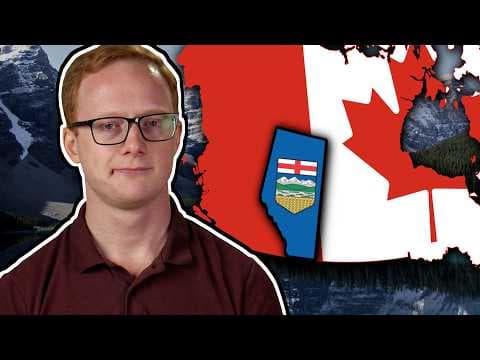
The Cost of Alberta Separatism
AI Summary
In this transcript, Richard from *The Plain Bagel* examines the rising sentiment of Alberta separatism, a movement that has shifted from the fringes to a significant point of national debate. While currently supported by a minority of Albertans—between 19% and 29%—the movement has gained momentum due to provincial legislative changes making referendums easier and the vocal efforts of the Alberta Prosperity Project. This non-profit group is actively collecting signatures for an independence vote, framing the move as a rescue from what they describe as a "downhill spiral" caused by international agendas. The tension is further heightened by external pressures, including comments from U.S. officials regarding a potential $500 billion transition loan and threats from the Trump administration to exert economic pressure on Canada.
To understand the roots of this movement, one must look at Alberta’s unique position within Canada. Known for its agriculture and the Calgary Stampede, Alberta is the nation’s energy powerhouse, producing over 80% of Canada's oil. Despite representing only 15% of the national GDP, its natural resources allow it to maintain the highest GDP per capita in the country. This economic strength, however, has led to "western alienation." Many Albertans feel that federal environmental policies, such as the carbon tax and pipeline delays, stifle their primary industry. Unlike Quebec’s separatist movements, which are rooted in language and culture, Alberta’s grievances are almost entirely fiscal and political, driven by a right-leaning population at odds with the federal Liberal government.
The core argument for independence rests on the belief that Alberta is subsidizing the rest of Canada. Proponents point to the equalization system, where wealthy provinces redistribute revenue to ensure comparable public services across the country. As a net contributor, Alberta sends billions more to Ottawa than it receives in direct benefits—roughly $4,000 per capita annually. Furthermore, there is a heated debate over the Canada Pension Plan (CPP). Because Alberta has a younger, higher-earning population, some estimates suggest the province’s share of the national pension pot is as high as $334 billion, or half of the entire plan. The Alberta Prosperity Project claims that by reclaiming these funds and ending federal transfers, the province could eliminate income and sales taxes while turning multi-billion dollar deficits into massive surpluses.
However, Richard highlights that these promises of a "fiscal utopia" are largely unfounded and built on questionable data. Economics experts, such as Dr. Trevor Tombe, have identified glaring omissions in the separatists' calculations. For instance, the Alberta Prosperity Project’s budget fails to account for $10 billion needed to fund Old Age Security and the Canada Child Benefit. Their military spending estimates are also unrealistic; while the group suggests a defense budget of a few billion dollars, meeting NATO targets would actually cost between $10 billion and $25 billion annually. Additionally, their revenue projections rely on outdated oil prices, assuming $85 per barrel when current benchmarks are significantly lower. The claim to 50% of the CPP is also viewed as an aggressive oversimplification that ignores worker mobility—many people work in Alberta's oil fields in their youth but retire in other provinces, skewing the contribution data.
Beyond the immediate fiscal errors, the risks of secession are profound. As a landlocked nation, an independent Alberta would be in a weak position to negotiate trade. It would lose access to the Canadian Free Trade Agreement and the CUSMA (the successor to NAFTA), potentially facing a 5% increase in trade costs that could wipe out $20 billion in annual economic activity. History suggests that political instability leads to "capital flight." When Quebec flirted with independence in the 1970s, hundreds of businesses, including the Bank of Montreal, moved their headquarters to Toronto. Alberta could face a similar exodus of companies and skilled labor.
The logistical hurdles are equally daunting. Alberta would need to establish its own currency—with suggestions ranging from a gold-backed "Alberta dollar" to Bitcoin—and build entirely new systems for healthcare, education, border patrol, and the judiciary. It would lose access to federally managed lands, such as Banff National Park, and would have to navigate complex new negotiations regarding Indigenous rights and federal debt. Furthermore, basing an entire economy on the volatile oil and gas industry is risky. Oil revenues have fluctuated from 6% to 33% of provincial income in a single decade; staying within Canada provides a level of industrial diversification that protects the province during market downturns.
Ultimately, while Albertans have valid criticisms of federal overreach, the transcript suggests that the current push for independence is fueled by misinformation. Richard concludes that the costs of secession would likely far outweigh any perceived savings, potentially leaving the province in a precarious economic position.