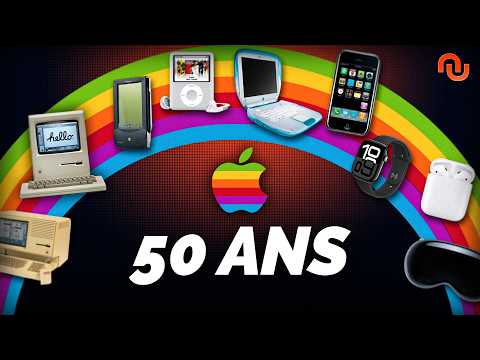
APPLE a 50 ans : l’histoire de la marque qui a CHANGÉ le monde
AI Summary
In 1996, Apple was 90 days from bankruptcy, facing widespread predictions of its demise due to what was seen as poor management. Yet, 30 years later, Apple has become one of the most influential companies globally, illustrating perhaps the greatest comeback in modern capitalism. At 50, Apple is a veteran in the tech industry, significantly older than many of its GAFAM counterparts, except Microsoft. While many are familiar with modern Apple, this video delves into the strategic missteps that nearly destroyed the company multiple times, alongside the pivotal innovations that cemented its DNA.
The story of Apple can be divided into three distinct phases. The first phase began in 1971 with the meeting of Steve Jobs and Steve Wozniak. Jobs, the visionary and shrewd strategist, and Wozniak, the pure tech genius, were an unlikely but essential duo. Their initial venture was the "Blue Box," a device invented by Wozniak to make free long-distance calls, which Jobs recognized the commercial potential of, selling it for $150. This initial capital funded Apple's genesis.
Their first computer, the uninspiredly named Apple I, was a technological feat for its time: one of the first personal computers with integrated video output and a keyboard. Priced at $666.66, it found modest success. On April 1, 1976, Apple Computer Company was founded with a third co-founder, Ronald Wayne, who famously sold his 10% stake for $800 just 11 days later—a stake that would be worth $350 billion today. Early Apple also saw internal struggles, such as Jobs's insistence on being employee "zero" rather than "two," highlighting his burgeoning ego. The name "Apple" itself was chosen simply to appear before Atari in the phone directory.
The second generation, the Apple II, launched in 1977, marked a significant step forward. This beige computer with the iconic rainbow Apple logo became a huge success in professional and educational sectors, partly due to Wozniak's ingenuity in enabling color display and its utility for spreadsheet management, a new concept at the time. Apple went public in 1980, creating many millionaires. However, the same year saw the failure of the Apple III, which overheated due to Jobs's insistence on not including a fan.
A pivotal moment occurred in 1980 when Apple encountered Xerox, who presented their groundbreaking mouse technology and graphical user interface. Jobs immediately recognized its potential, effectively "borrowing" the concept. This led to the 1983 launch of the Lisa, named after Jobs's daughter. While revolutionary as the first computer with a mouse and GUI, its $10,000 price tag led to a massive commercial flop. This failure caused Jobs to be removed from the Lisa project and reassigned to the Macintosh team, which he fiercely adopted.
In 1984, Apple unveiled the Macintosh with a legendary Super Bowl commercial. Despite its iconic status, the Macintosh's launch was a failure due to insufficient RAM, frustrating users and leading to a major dispute within Apple. Jobs blamed CEO John Sculley, whom he had recruited from Pepsi, and attempted a coup in 1985. Sculley, however, outmaneuvered Jobs, convincing the board that Jobs's ego and vision were detrimental. Jobs was stripped of all executive responsibilities and resigned in September 1985, going on to found NeXT and Pixar, gaining invaluable experience during his exile.
The second phase of Apple, without Steve Jobs, from 1985 to 1997, is often considered less exciting and marked by strategic drift. While the Macintosh improved and found success among graphic designers and printers with the LaserWriter, Apple suffered from product proliferation and a lack of clear design direction. In a surprising move, Apple even allowed macOS to run on competitor PCs, leading to cheaper, better-specced alternatives that undermined the Mac. This era also saw several major product failures: the Newton (1993), an oversized PDA with flawed handwriting recognition; the Macintosh TV (1993), a computer-television hybrid; and the Apple Pippin (1995), a gaming console that lacked games and struggled with its macOS architecture. By 1996, Apple was on the brink of collapse, with many, including Dell CEO Michael Dell, suggesting it should shut down.
In this desperate situation, CEO Gil Amelio made a "poker move": he decided to acquire NeXT for $429 million, primarily to bring Steve Jobs back as an advisor and integrate NeXT's advanced operating system into the Mac. This marked the beginning of Apple's third and most successful phase.
Jobs, initially returning as interim CEO (iCEO), quickly asserted control, eventually dropping the "i" and becoming the permanent CEO. His return marked the start of "Steve Jobs Prime," a period of unparalleled innovation and reinvention. In 1997, a critical alliance was forged with Microsoft, which invested $150 million in Apple and agreed to cease legal battles. In return, Apple committed to developing Microsoft Office for Mac and making Internet Explorer the default browser. This humiliating moment, with Bill Gates projected as "Big Brother" on screen, taught Apple the importance of controlling its image.
Jobs immediately simplified Apple's product lines into a clear 2x2 grid: consumer/pro, portable/desktop. In 1998, Apple launched the iMac, a transparent, colorful computer that revolutionized design in a market dominated by drab beige boxes. This product, the first fruit of collaboration between Jobs and designer Jony Ive, sold 800,000 units in five months, signaling Apple's triumphant return. Apple also reinvented its brand image with the "Think Different" campaign, positioning itself as a company for creators and unconventional thinkers. The opening of Apple Stores in 2001, initially seen as a risky niche, became a highly profitable business model, offering a unique retail experience.
The year 2001 also brought the iPod, a revolutionary portable music player that promised "1000 songs in your pocket." The iPod, along with iTunes (launched on Windows in 2003), popularized Apple beyond its core user base and marked Apple's first significant foray into services, selling individual songs for $1. This established Apple as a cultural powerhouse and a leader in personal, pocketable devices. Other innovations included the iPod Nano, iPod Shuffle, and the iBook, the first Wi-Fi-enabled portable computer. In 2005, Apple transitioned to Intel processors, boosting Mac performance.
The biggest revolution came on January 9, 2007, with the iPhone. Steve Jobs's legendary presentation unveiled a device that combined an iPod, a phone, and an internet communicator into one. Despite initial skepticism from competitors like Microsoft's Steve Ballmer, the iPhone became the greatest success in tech history, generating the vast majority of Apple's revenue. A year later, the App Store launched, creating an entirely new global economy around mobile applications, a concept Jobs initially resisted but embraced after seeing the demand created by "jailbroken" iPhones. Under Jobs, four generations of iPhones were released, alongside the iPad in 2010, an early version of which matured into a highly successful product. Jobs also foresaw the potential of AI, as evidenced by his reaction to Siri's capabilities.
In August 2011, Jobs, battling cancer, appointed Tim Cook as CEO, instructing him not to question what Jobs would have done, but to lead Apple as his own. Jobs passed away on October 5, 2011, at 56, never seeing Apple become the world's most valuable company. However, Jobs had meticulously prepared Apple for this transition, establishing a strong leadership team and a consistent communication style that endured.
Tim Cook has become Apple's longest-serving CEO, leading the company to unprecedented heights. While some critics argue Apple became "boring" under Cook, the company's stock performance and continued innovation tell a different story. Cook's tenure has seen the launch of major new product categories like the Apple Watch (now the world's best-selling watch) and AirPods (which created a new industry for wireless earbuds). He also spearheaded a significant shift towards services, with offerings like Apple Music, Apple TV+, Apple Arcade, and Apple Fitness+, diversifying Apple's revenue streams beyond the iPhone.
Under Cook, Apple has also strongly emphasized user privacy, famously clashing with the FBI over data access. This focus, while sometimes complicating product development (e.g., in AI, where data scarcity forces partnerships), reinforces Apple's premium brand image. Perhaps Cook's most significant revolution is Apple Silicon. Building on early work under Jobs (iPhone 4's custom chip), Cook accelerated Apple's independence, developing its own GPUs, Neural Engines, and eventually entire system-on-a-chip designs like the M1 in 2020. This allows Apple to control hardware and software from end-to-end, delivering powerful, cost-effective products like the MacBook Neo.
As Apple celebrates its 50th anniversary on April 1, 2026, it stands as an undisputed tech giant, a block that has remained remarkably consistent since Jobs's return. While questions remain about future strategies, such as its conservative approach to AI or the market positioning of products like the Apple Vision Pro, Apple continues to sell more products than any other company. With rumors of Tim Cook's imminent retirement and the potential succession of hardware chief John Ternus, Apple is on the cusp of a new era. Cook has actively prepared for this by promoting younger leaders, ensuring the company's long-term stability. The next 50 years promise to be just as transformative for Apple.