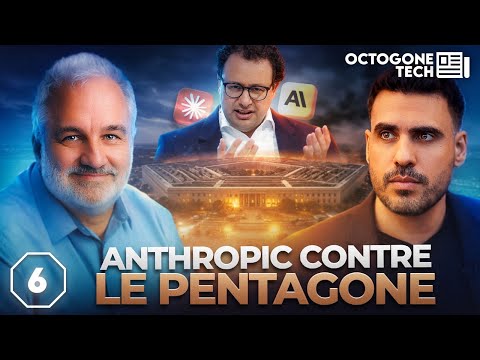
Anthropic affronte le Pentagone et Apple explose le game du PC portable
AI Summary
This summary details the latest technological shifts, geopolitical tensions, and hardware breakthroughs discussed in the recent "Octogone Tech" analysis by Idriss Aberkane and Philippe Anel. Based strictly on the provided transcript, the discussion centers on the growing friction between AI developers and military institutions, the revolution in biological computing, and the shifting hardware landscape.
### The Ethical Standoff: Anthropic vs. The Pentagon
The most significant geopolitical development involves Anthropic and its CEO, Dario Amodei, entering a direct confrontation with the U.S. Pentagon. Under the influence of the Trump administration’s Secretary of Defense (referred to as the "Secretary of War"), the Department of Defense (DOD) demanded that AI companies remove restrictions on their models, allowing for "any legal use" under American law. This essentially meant removing ethical safeguards.
Anthropic, which holds a $200 million contract with the DOD for intelligence analysis and cybersecurity, refused to comply. Amodei established two non-negotiable red lines: Anthropic will not participate in the mass surveillance of American citizens, and it will not allow its AI to power fully autonomous weapons. In retaliation, the Pentagon issued an ultimatum on February 27, followed by a presidential order banning all federal agencies from using Anthropic’s "Claude" model.
The administration labeled Anthropic a "supply chain risk," a designation usually reserved for foreign adversaries like Huawei. Anthropic has countersued, arguing this label is illegal for a domestic company. The legal battle has escalated rapidly, with 149 federal judges and companies like Microsoft filing "amicus briefs" to join the case. Interestingly, while the U.S. government restricts Claude, the model remains the most used AI per capita in Israel and is reportedly utilized via Palantir for targeting operations in international conflicts, highlighting a deep hypocrisy in AI deployment.
### The RAM Crisis and Apple’s Strategic Disruption
The hardware market is currently reeling from a "RAM-ageddon." AI now consumes 70% of global memory production, leading manufacturers like Micron to abandon consumer-grade products to prioritize AI servers. This has caused a 15% to 50% price surge for traditional PC manufacturers like Asus, Dell, and Lenovo.
In this chaotic market, Apple has launched the "MacBook Neo," a fanless laptop priced at $499 (with student discounts). Despite having only 8GB of RAM, Apple’s vertical integration—combining high-speed SSDs, optimized buses, and efficient "swap" memory—allows it to outperform Windows PCs with double the specifications. Benchmarks show the Neo running *Cyberpunk 2077* via emulation at performance levels comparable to a PS5. This move is seen as a "logistical revolution" rather than a purely technical one, designed to lock a new generation of students into the Apple ecosystem while competitors struggle with rising component costs.
### Biological Computing: "Wetware" Playing Doom
A breakthrough in "wetware" or biological computing was highlighted through the work of Cortical Labs. They successfully trained a system called CL One, consisting of 200,000 live human neurons grown on a chip, to play the video game *Doom*. This follows a 2022 milestone where a similar "brain in a dish" played *Pong*.
The revolutionary aspect is not just the biological interface but the accessibility; a developer used a standard Python API to train the neurons without needing a neuroscience background. These biological servers are vastly more energy-efficient than silicon chips. While silicon AI requires massive power—prompting calls for new nuclear plants in the U.S.—biological neurons perform complex tasks with negligible energy consumption. This points toward a future of "cyborg servers" that combine organic efficiency with digital control.
### Cybersecurity Failures and the European "Sieve"
The transcript paints a grim picture of European cybersecurity, particularly in France, which is described as a digital "passoire" (sieve). Recent hacks have exposed the data of 15 million health patients, 1.5 million photos of minors, and 12 million employee records from URSSAF. These breaches, often carried out by independent groups rather than state actors, cost the French economy an estimated €100 billion annually.
This crisis underscores the necessity of moving toward "Local AI." The discussion emphasizes that centralized, cloud-based AI is a privacy nightmare. The proposed solution is the deployment of local AI agents—autonomous "teams" of AI that reside on a user's machine (like a Mac Studio) rather than a remote server. This allows businesses to automate roles like CFO, Strategy Director, or COO without exposing sensitive data to external hacks or corporate surveillance.
### SpaceX and the Future of Global Connectivity
Finally, the discussion touched on SpaceX’s ambition to launch a constellation of one million satellites. This has sparked a "space squatting" dispute with Amazon’s Project Kuiper. More importantly, rumors suggest Apple may integrate SpaceX connectivity directly into future iPhones, potentially rendering traditional SIM cards and telecommunications providers obsolete.
### Conclusion
The tech industry is at a crossroads where ethical stands by companies like Anthropic meet the raw demands of military power. Simultaneously, the physical limits of silicon are being challenged by biological computing, while the economic reality of the RAM shortage is allowing Apple to consolidate market power. The overarching conclusion is that users must adapt to local, agent-based AI to maintain productivity and security in an increasingly volatile digital world.