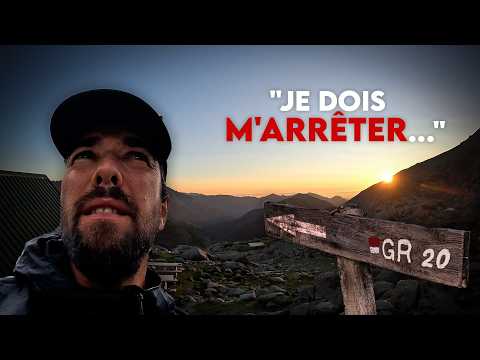
Le gr 20 : une épopée
AI Summary
The following summary documents the experience of hiking the northern section of the GR20 in Corsica, often cited as the most difficult trekking route in Europe. This account is based strictly on the provided transcript, detailing the physical challenges, logistical hurdles, and personal reflections of the narrator and his companions.
**Preparation and Initial Logistics**
The journey begins with a candid admission: despite the GR20's reputation for extreme difficulty, the narrator did not train for the expedition. He starts his trek at Vizzavona, opting to tackle the northern half of the trail heading toward Calenzana. This section is widely recognized as the most technical and mountainous part of the entire route. The narrator is joined by friends, including Clem and Tarek, the latter of whom is nicknamed the "Ninja Turtle" due to his unique breathing strip and gear.
Early in the trip, the narrator realizes several logistical errors. He chose a specialized mountaineering backpack for the journey, which, while high-quality, lacks the external pockets necessary for easy access to water and snacks. This creates immediate frustration. Before even starting the first ascent, the group notes the high cost of supplies in the region and the steep learning curve regarding the terrain. They briefly consider the southern route, which is rumored to be easier and sunnier, but they ultimately commit to the technical challenges of the north.
**The Brutal Reality of the First Stages**
The first day sets a grueling tone for the rest of the trip. The group encounters the Cascade des Anglais, a stunning natural landmark, but the beauty of the landscape is quickly overshadowed by the physical toll of the climb. The narrator highlights a crucial piece of advice for any prospective hiker: the use of hiking poles. He describes them as a "game changer" that provides necessary stability on slippery surfaces and significantly reduces the impact on the knees.
In an ambitious move, the group decides to double their stages on the first day, attempting to complete two days' worth of hiking in one. This decision proves nearly catastrophic. By the end of the day, the narrator experiences near-total physical failure. His legs refuse to move, and he is forced to stop just 200 meters from the refuge to eat and recover his strength. They arrive late, exhausted, and feeling as though they have emerged from a "war zone." The narrator’s health suffers almost immediately; he ends the first night sick and struggling with the cold, realizing that doubling stages without proper conditioning is a high-risk strategy.
**Navigating the Middle Terrain and Cultural Observations**
As the trek continues toward Petra Piana and Manganu, the narrator observes the extreme volatility of mountain weather. Temperatures can plummet from 20°C to a perceived 5°C in a matter of minutes, a factor that contributes to his ongoing illness. Despite the hardship, the trail offers unique sights, such as supply convoys being transported by horses, which are the only viable means of locomotion in these remote areas.
The narrator also reflects on the social and cultural aspects of the GR20. He notes the high percentage of international hikers, particularly from Germany and the Netherlands, and describes the communal atmosphere of the refuges. Because hikers are often served meals at shared tables, the environment is naturally social, though the lack of privacy and basic facilities can be a psychological drain. A significant feature of the experience is the total digital disconnection. Mobile signal is rare, forcing a break from work and social media that the narrator finds both difficult and ultimately refreshing. However, the trail's difficulty leads to the group’s first casualty: Tarek, the "Ninja Turtle," decides to abandon the hike, a common occurrence given the trail's estimated 50% abandonment rate.
**The Ascent of Monte Cinto and Technical Hazards**
The fourth day presents the most formidable challenge: the ascent of Monte Cinto, the highest point of the trek. This stage involves a massive elevation gain of 1,200 meters and a descent of 1,400 meters over treacherous, loose rock. The narrator describes the terrain as "con-like," involving dangerous crags where one wrong step could lead to a serious fall. He admits to a fear of heights and struggles with the thinning air at 2,500 meters. To manage the steep descents, he often resorts to sliding down rocks on his rear to prioritize safety over speed.
Throughout this difficult period, the narrator is honest about his mental state. He confesses that there were many moments where he stopped enjoying the hike and felt a strong urge to quit. He explains that the only thing keeping him on the trail was the responsibility of completing the video project for his viewers. This psychological battle is a recurring theme, as he balances the desire to finish with the genuine physical danger of the technical "chains" and steep ridges.
**Final Reflections and Practical Conclusions**
The final push involves a 5:30 AM start to witness the sunrise from the crags. The terrain remains technical, requiring semi-climbing and scrambling through the "maquis," the dense shrubland where French resistance fighters hid during World War II. The trek concludes with a final, four-kilometer run down to Calenzana, driven by the pure desire to return to civilization and comfort.
In his final summary, the narrator offers several key insights for those considering the GR20:
1. **Do Not Underestimate the Difficulty:** The trail is a genuine athletic challenge that requires physical preparation, particularly knee-strengthening exercises.
2. **Essential Gear:** Hiking poles are mandatory to save one's joints, and high-quality footwear is non-negotiable.
3. **Strategic Planning:** For most, completing just the northern or southern half is a more realistic and enjoyable goal than attempting the full 16-day trek.
4. **Mental Fortitude:** The "mental" aspect is just as important as physical fitness. The urge to quit is common, especially at the end of a long day, but it often passes after a night's rest.
5. **Weather Awareness:** The difficulty of the technical sections increases exponentially in poor weather; hikers must be prepared to stop if conditions become unsafe.
Ultimately, the narrator expresses a newfound respect for the sport of hiking. While he admits he might not have enjoyed every moment of the pain and exhaustion, he concludes that finishing the northern section was one of the most rewarding experiences of his life.