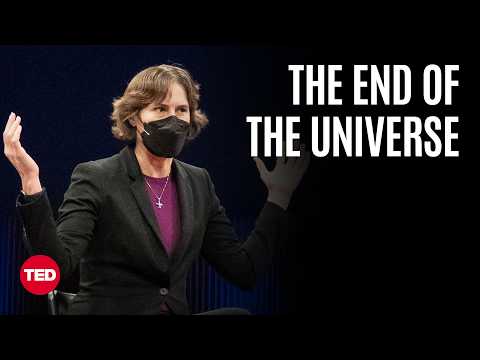
A Cosmologist’s Guide to the End of the Universe | Katie Mack and Debbie Millman | TED
Audio Summary
AI Summary
Katie Mack, a cosmologist, discusses her journey into science, including earning her private pilot license during the pandemic and pursuing aerobatic training. She describes aerobatics as flying an airplane in unusual ways like loops and spins, emphasizing it's a way to learn the airplane's full capabilities and become a safer pilot, not an adrenaline-fueled activity. Flying provides a mental escape from her work, allowing her to be fully present and focused.
Mack’s grandfather, a Navy meteorologist, played a crucial role in the Apollo 11 mission. He was tasked with assessing weather conditions at the splashdown site. Using a secret weather satellite, he discovered a severe storm, "screaming eagle thunderclouds," predicted to hit the designated landing zone. Despite being unable to reveal the source of his information, he convinced NASA to move the splashdown site 72 hours prior, saving the astronauts from a potentially catastrophic event.
Her grandfather's scientific curiosity and passion for various fields, from weather to marine life, influenced Mack from a young age. Although his Apollo 11 work was classified, his general scientific enthusiasm and his connection to Caltech, where he studied meteorology, sparked her interest in science. She recalls being a curious child, taking things apart, and being exposed to science through magazines and public talks, particularly influenced by her mother's love for science fiction.
At ten years old, Mack read Stephen Hawking's "A Brief History of Time." While she didn't understand much of it then, the book ignited her desire to learn and introduced her to the concept of cosmology. She realized that cosmology, the study of the universe, the Big Bang, black holes, and spacetime, was a field she wanted to pursue.
She pursued physics at Caltech, where she learned that theoretical physics is not just about equations but also about imagination and creativity. Theoretical physicists build mathematical models to understand observations and data, requiring them to think creatively, identify symmetries, and draw connections between different phenomena. The field is highly collaborative, involving discussions and debates around chalkboards and at conferences.
Her doctoral research at Princeton focused on early universe cosmology, cosmic inflation, and dark matter. She explains that much of cosmology involves deciphering information from faint traces of light, particularly the cosmic microwave background (CMB). The CMB is a glow of light permeating space, originating from the Big Bang. Its spectrum matches that of a hot object, indicating it's residual heat from the early universe. By observing the CMB, cosmologists can look billions of years into the past, directly witnessing the universe when it was a hot, dense state. This light is continuously diffusing through space, with the portion traveling towards us being what we observe as background radiation.
Mack acknowledges the difficulty of conceptualizing the vast scales of cosmology, such as billions of light-years. She relies on numerical representations and the understanding that these are the scales she works with, rather than having an intuitive grasp of them. While individual galaxies and humans are insignificant on these cosmic scales, she finds the work itself to be deeply human due to the collaborative nature of scientific inquiry and the imaginative aspect of building mathematical models.
Her interest in the "end" of the universe stems from a holistic curiosity about its entire story, from beginning to evolution to its ultimate fate. She explores five potential endings in her book, "The End of Everything": the Big Crunch, Heat Death, The Big Rip, Vacuum Decay, and Bounce. She notes that these represent categories of endings discussed in physics literature, with variations possible within each.
Writing about the distant future of the universe has profoundly changed her relationship with time. She emphasizes the concept of "deep time," highlighting how small our own lifespans and even humanity's existence are in comparison. This perspective has led her to seek meaning and purpose in the present moment, recognizing that everything will eventually end and that significance must be self-contained and not dependent on a tidy, future resolution. She believes it's important to focus on what truly matters in our temporary existence and to do our best while we are here.
Beyond her scientific pursuits, Mack is also a poet. She shares a poem titled "Constructs," written for a graphic design company's demo reel. The poem reflects on how we perceive the world and the uniqueness of individuals and objects. It suggests that while we are composed of the same fundamental elements, our true essence lies in the knowledge that unites these parts, rather than just the constituent components themselves.