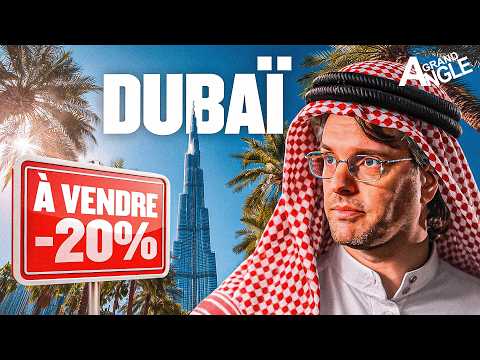
J’investis dans l’immobilier à Dubaï en 2026 !
AI Summary
This video discusses Dubai's business model and the speaker's personal investment strategy, which he calls the "three burrows strategy." This strategy involves taking maximum risk across three uncorrelated investment pillars: private equity (investing in unlisted companies), anti-fragile refuge assets (specifically Bitcoin), and high-risk, high-potential luxury real estate, particularly in Dubai.
The speaker emphasizes that Dubai's success is not based on oil. While Abu Dhabi, a neighboring Emirate, possesses 95% of the UAE's oil reserves and financially supported Dubai during the 2008 crisis, oil and gas now account for only about 2% of Dubai's GDP, down from nearly 50% in the 1970s. The strong political and financial ties between Abu Dhabi and Dubai are crucial, as is their shared federal budget for common expenses, alongside individual emirate budgets.
Dubai's strategy and success are rooted in overcoming extremely hostile starting conditions: minimal oil, scarce freshwater, no arable land, poor quality sand for construction, and uninhabitable summer temperatures. The royal family, particularly Sheikh Rashid bin Saeed Al Maktoum and later Sheikh Mohammed bin Rashid Al Maktoum (often called "Chequmo"), recognized the need to diversify beyond finite oil resources. Sheikh Rashid initiated major infrastructure projects like Port Rashid and the Dubai World Trade Center. Sheikh Mohammed, seen as a brilliant businessman akin to Elon Musk, positioned Dubai as a "startup" with a clear development strategy. Current plans, like the D33 agenda and the Dubai 2040 Urban Master Plan, aim to double Dubai's economy by 2033 and make it one of the top three global economic hubs, alongside cities like New York, London, or Hong Kong. JP Morgan's decision to remove the UAE from its emerging market bond indices due to its wealth underscores this success.
A key element of Dubai's strategy is "organized grand replacement" through massive immigration of wealthy foreigners. As early as 1975, nationals were already a minority, comprising only 28% of the population, a figure that has dropped to less than 10% today. Despite this, Emiratis retain political power and cultural elements. Dubai has fostered a unique "culture of compromise"; while officially an Islamic monarchy with Sharia law, non-Muslims can marry, divorce, and handle succession under civil laws. Business law is a mix, with civil law for local companies and common law (inspired by English law) for companies in free zones, where most foreigners operate. Judges are international, and English is the official language in these zones.
The speaker addresses the misconception that Dubai primarily attracts reality TV influencers. He clarifies that Dubai is a hub for entrepreneurs, financiers, international executives, and wealthy families, with 258,000 active companies in 2024 and 53,000 new companies joining in 2025. Dubai's "product" is offering rich foreigners a country where they are free and secure to deploy their talents, providing a competitive environment against other global cities. Talented and wealthy individuals seek peace, freedom to conduct their business, and access to services that enhance their quality of life. The "Golden Visa," requiring a $500,000 investment, exemplifies Dubai's desire to attract individuals who will anchor themselves and reinvest capital locally, becoming "free men" who create wealth.
Dubai's tax system is unique, described as "degressive" rather than progressive. While richer individuals pay more in absolute terms, their overall tax rate decreases as their wealth increases. This incentivizes wealth creation. Dubai's budget revenues are primarily derived from fees and fines (56%), such as visa fees, DLD (Dubai Land Department) fees (4% of property transaction value), administrative fees (e.g., commercial licenses), and utility taxes. Fines, a marginal part of revenue, are seen as a "cultural learning cost" due to different customs. State-owned company participation accounts for 17% of revenues, and fiscal revenues (VAT, corporate tax, customs duties) make up 23%. A small portion (4%) still comes from oil. Essentially, three-quarters of Dubai's revenue comes from a "toll system" where users pay for services, complemented by state-owned enterprises.
The speaker discusses the impact of the Iran crisis on Dubai, noting that the UAE's stance is hardening to protect economic interests. He believes their priority is regional stability, not military power. He addresses concerns about the Dubai real estate market, particularly the DFM Real Estate Index, clarifying that it measures listed property developers' valuations, not direct apartment prices, especially not the luxury segment he invests in. While transaction volumes have slightly decreased, prices per square meter remain high, and a "catastrophe" is not evident. Panic selling exists, with some properties seeing 15-20% drops, but this is against a backdrop of 80-100% price increases in high-end real estate between 2020 and early 2024. Short-term, volumes are down by about 40%, and overall market prices are down 3-15%, mainly in high-rise towers.
The speaker's personal investment strategy involves buying off-market, pre-construction luxury family homes in green, garden-rich areas away from the city center, catering to wealthy immigrant families seeking a secure, green environment. He cites investments in Al Barari and Lunaya, which offer lush landscapes in the desert through advanced techniques. These projects are sold through private networks, not public agencies, reflecting how luxury real estate often operates. Despite the crisis, no reservations in these developments have been canceled, and some properties are even being offered at higher prices than before the crisis. A well-known high-end real estate agent, Dom Chabo, confirmed a 7% price increase in the ultra-prime segment, despite lower transaction volumes, due to long-term, unindebted investors. He anticipates a modest 3-8% price increase for 2026.
The speaker recently acquired an additional pre-construction home in Lunaya at its pre-crisis price. He sees this as a long-term bet on Dubai's visionary "startup" model. He also highlights the recent scaling back of Saudi Arabia's Neom project, suggesting that replicating Dubai's success is challenging, which reduces regional competition for business hubs. The crisis has also suspended many new real estate projects in Dubai, potentially leading to a future supply shortage against demand.
Dubai has a history of overcoming major crises (e.g., 2008, COVID-19). Development plans are accelerating, with projects like the Dubai Loop (tunnels to ease traffic) and The Loop (a climate-controlled cycling highway). Significant investments, such as 30 billion dollars in the Lunaya area, are ongoing. The Lunaya project, though currently amidst desert, is strategically located to be 15 minutes from Dubai's future second airport, 30 minutes from a future Disneyland in Abu Dhabi, and 20 minutes from Dubai's center, with plans for new schools and hospitals.
The speaker believes that if Dubai successfully navigates the current crisis, it could strengthen investor confidence and boost demand further, especially if regional stability improves. While long-term investors temporarily leave during tangible risks, they return when calm is restored, as evidenced by minimal panic selling and a recent record-breaking apartment sale. He suggests that a common identity might be forming among Dubai's foreign residents through these crises.
He also notes that if the UAE's vast wealth (over $1 trillion in central bank reserves, plus sovereign wealth funds like ADIA and ICD totaling over $1.6 trillion) is mobilized to maintain attractiveness, it might reduce their significant investments abroad (45-60% in the US, 15-30% in Europe), potentially impacting European countries more than the UAE itself. The US, being energy independent, is less reliant on the Strait of Hormuz and has benefited from rising oil prices during the crisis. The speaker concludes that his bet on Dubai is not on the absence of risk, but on the Emirate's capacity to absorb risk without breaking its model, reaffirming his view of Dubai as a resilient startup.