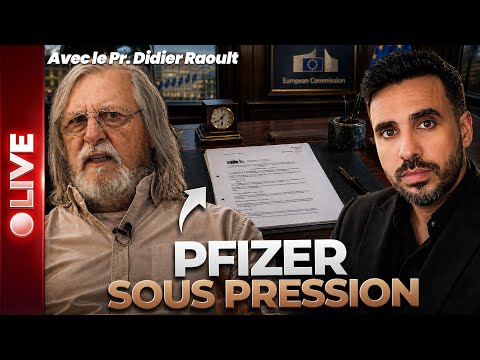
Bras droit de Fauci inculpé, contrats Pfizer publiés : Didier Raoult avait encore raison!
AI Summary
The discussion opens with the host and Professor Raoult, located by Lake Maggiore in Italy, noting that Professor Raoult's predictions have once again proven correct, five years later. They highlight the indictment of Fauci's right-hand man, an event that, while not directly implicating Fauci, signals a significant shift. Robert Francis Kennedy Jr. and Rand Paul are leading this offensive. A major topic is the side effects of vaccines, with a senator claiming Pfizer's inoculations were 55 times more dangerous than flu vaccines, citing the McClor Foundation. Recent publications also support these claims, which Professor Raoult will comment on.
Professor Raoult begins by reflecting on the "society of fakery," a concept from his recent book. He suggests that society has become so artificial that people question if they are living in a Matrix-like reality, where information is often false or unreasonable. He cites the example of life expectancy, which he argues is a statistical construct rather than a true measure of longevity. He explains that official figures, like the CDC's claim of a 2.5-year drop in US life expectancy during COVID-19, then a swift recovery, are misleading. He points out that the average age of death in France is 81-82, with half of deaths occurring over 85. It’s impossible for a sporadic event like COVID-19, primarily affecting the elderly, to significantly alter the overall life expectancy, which includes babies and young people.
He delved into the methodology of calculating life expectancy, revealing that it's a mathematical fantasy designed for cross-country comparison, rather than an accurate reflection of individual longevity. He found that in France, the average lifespan actually increased from 74 to 76 years during the epidemic, due to a higher mortality rate among the very elderly. This real data contradicts governmental narratives, which are often inaccessible or manipulated. He presents graphs showing no visible impact on France's overall population size during the pandemic, unlike the clear demographic "holes" caused by world wars, suggesting COVID-19 was a marginal event in this context.
Professor Raoult links this "fakery" to political and financial interests, echoing Robert Kennedy Jr.'s assertion that the reason hydroxychloroquine and ivermectin were dismissed was to clear the path for $200 billion in vaccine sales. He notes Rand Paul's efforts to repeal the 1986 law that shields vaccine manufacturers from liability, placing the burden on the state. This, he argues, is another "Matrix" element: even when the truth is evident, it's ignored or suppressed. He gives examples like the persecution of hydroxychloroquine and the FDA's campaign against ivermectin, highlighting how practical demonstrations of truth are no longer enough to convince people.
The discussion then turns to the lack of safety testing for the 72 mandatory childhood vaccines in the US, a claim made by Robert Kennedy Jr. that Anthony Fauci publicly denied. However, when Kennedy sued Fauci, Fauci's lawyers admitted Kennedy was correct to avoid trial, confirming that these vaccines lack front-end safety testing and downstream liability. This creates a "gold rush" for pharmaceutical companies, as the federal government mandates these vaccines for millions of children annually without marketing costs or liability. The conversation touches on the rise of vaccine-derived polio cases, now outnumbering wild polio cases in the Western world, and the increase in conditions like narcolepsy, sleep disorders, language disorders, autism, and Tourette's syndrome since 1989, coinciding with the increase in mandatory vaccinations. Autism, for instance, has risen from 1 in 10,000 in Kennedy's generation to 1 in 34 today, even with improved diagnostics.
Professor Raoult emphasizes the danger of administrative authority masquerading as scientific authority, citing instances where scientific discourse is suppressed for political reasons, such as the ARCOM imposing fines for questioning CO2's sole role in climate change. He draws parallels to historical examples like Lysenkoism in the Soviet Union, where political ideology dictated scientific truth, leading to devastating famines. He also reflects on the intellectual battle between "nature" (innate) and "nurture" (acquired), arguing that denying the innate is a dangerous path.
He criticizes the peer-review system, particularly for controversial topics. He presents a preprint on SARS-CoV-2 RNA polymerase errors explaining vaccine heterogeneity, which was later published in *Nature Microbiology* but with all sections on vaccines removed—a clear instance of censorship driven by political consequences. He highlights how scientific papers are often manipulated to satisfy reviewers, with abstracts contradicting data, or statistically insignificant differences being presented as non-existent, even when visually apparent. This, he argues, is the "parachute paradigm," where obvious truths are ignored if they don't fit statistical models.
The discussion moves to the lack of accountability for pharmaceutical companies. Professor Raoult points out that Purdue Pharma, responsible for hundreds of thousands of opioid deaths, paid billions in fines but saw no one jailed. He argues that this impunity, where the law isn't proportional to the crime, undermines democracy. He believes public perception of the pharmaceutical industry is shifting from one of occasional missteps to systemic corruption, comparable to the mafia.
The host then presents revelations about Fauci: his instruction to destroy emails, a federal crime, and his alleged lying to Congress about funding gain-of-function research, while simultaneously boasting about creating ancestral SARS strains. The statute of limitations for perjury before Congress is approaching, raising concerns that Fauci might evade indictment, with only his subordinate facing charges. This, Professor Raoult states, is a legislative problem, a disconnect between the law and public morality. He criticizes the proliferation of unnecessary laws and the growing discord between the state and the people, warning of potential revolutionary situations if this gap isn't addressed. He stresses that the pharmaceutical industry, unlike a century ago, now poses a significant threat to global health, demanding legal adaptation.
The publication of Pfizer's contracts, thanks to Frédéric Beltrra and Marc Doyer (whose wife died from Creutzfeldt-Jakob disease linked to vaccines), reveals that Pfizer explicitly stated in Article 4 that it did not know the vaccine's real efficacy or its short- and long-term side effects, even as the press proclaimed 95% efficacy and safety. Moderna's IPO documents similarly described its product as "gene therapy" for shareholders, while public messaging presented it as a vaccine. This contractual reality, hidden from the public, is another example of the "Matrix" effect.
Professor Raoult explains that pharmaceutical companies avoid testing in children and pregnant women because they bear the liability during clinical trials. Once approved and recommended by the state, the state assumes liability, even if no tests were conducted. He connects this to the 2017 Davos summit, where Bill Gates, a major WHO funder, predicted an epidemic and called for 3-6 month vaccine development, investing heavily in BioNTech. This narrative, he argues, bypassed standard safety protocols, creating a "terrible scam."
The late Rabbi Zev Zelenko, who treated COVID patients with Professor Raoult's protocol, accused Bill Gates of seeking to reduce the global population, citing Gates's support for the Malthusian "Limits to Growth" report and the existence of immunosterilization technologies. Zelenko also revealed that Fauci and Ralph Baric patented a chimeric coronavirus spike protein as a bioweapon in 2002, and that Fauci's NIAID funded gain-of-function research at the Wuhan Institute of Virology, violating US laws, effectively using Wuhan as a "Guantanamo" to conduct prohibited research. Professor Raoult praises Zelenko as a hero who dedicated his final days to saving lives. He dismisses Fauci as an opportunist, not a great doctor, who has been involved in political maneuvering and financial schemes since the AIDS era.
Further contract revelations include Pfizer's total exemption from liability, with the European Commission agreeing to indemnify them for all side effects, deaths, and damages. The EU was aware of high clinical trial failure rates but still mandated promotion. Massive, non-refundable orders were placed, and strict confidentiality clauses were imposed, all while the vaccines were still experimental.
Professor Raoult reiterates that these revelations, though politically charged, gradually awaken the public. He critiques the term "populism" as a derogatory label for democracy, revealing a disconnect between political elites and the people. He observes a similar pattern to the decline of the Roman Republic and the French monarchy: phenomenal debt, inability to govern, and a growing rejection of the "nomenclatura."
He highlights the Telegraph's report on a woman paralyzed by COVID injectables, and Senator Ron Johnson's statements that the FDA admitted COVID-19 vaccines killed American children and actively concealed myocarditis signals from the public. Johnson also asserted that these injectables are not vaccines but products that turn the body into a spike protein factory, with the McClor Foundation demonstrating that spike proteins persist for years and are toxic. He points out the FDA and CDC ignored 58,000 severe adverse event reports in VAERS.
Professor Raoult shares his own early observations: the first severe adverse event he saw from the AstraZeneca vaccine (which comprised half of French vaccinations initially) was a young woman who suffered a cerebral vein thrombosis, losing an eye. He mentions other high-profile cases like BBC's Lisa Shaw and British rocker Lord Z, whose deaths were officially linked to AstraZeneca vaccine side effects, despite official assurances of safety. He notes that authorities like Rousseau continued to claim safety even after Denmark halted the vaccine and AstraZeneca stopped production due to dangers.
He also observed an increase in COVID cases in the 15 days following vaccination, hypothesizing that this was due to facilitating antibodies, a phenomenon known in dengue fever. He explains that studies often started counting COVID cases more than 15 days post-vaccination to conceal this initial increase, knowing that vaccinees were still testing positive and that the vaccines wouldn't eradicate the virus.
In conclusion, Professor Raoult expresses his belief that the solution lies with the people, who are increasingly realizing they are being deceived. He highlights France's unprecedented agricultural deficit and the general decline in production, questioning the sustainability of this "folly." He believes that while there's no single solution, public awareness and demand for accountability are crucial. He emphasizes the need for adaptation of laws and penalties to reflect the gravity of the pharmaceutical industry's actions.