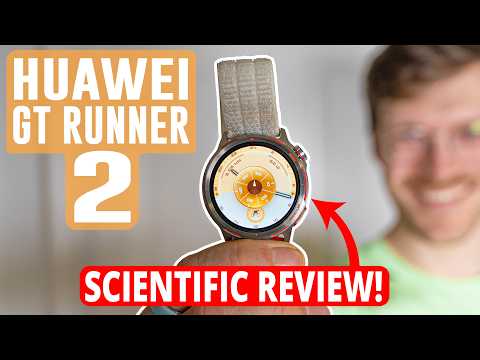
Huawei Watch GT Runner 2 - Scientific Review
AI Summary
The Huawei GT Runner 2 represents a significant evolution in Huawei's sports-focused wearable lineup, aiming to capture the market currently dominated by established brands like Garmin and Coros. Tested by postdoctoral scientist Rob, the device was put through a rigorous series of benchmarks focusing on heart rate accuracy, GPS precision, and sleep stage tracking. Despite some initial data synchronization issues caused by pre-release beta firmware, the results provide a clear picture of where this watch excels and where it falls short.
### Heart Rate Tracking Performance
The standout feature of the GT Runner 2 is its exceptional heart rate (HR) tracking. In tests against a Polar H10 ECG chest strap—the gold standard for exercise monitoring—the watch performed at a near-perfect level. For indoor cycling, which is the easiest activity to track, the device achieved a correlation value of 1.00, meaning its readings were virtually identical to the chest strap.
Outdoor cycling, which introduces more vibration and movement, saw a slight but expected dip in performance. However, the correlation remained very high at 0.96. While there were isolated moments where the watch briefly deviated by showing a heart rate that was slightly too high or too low, it remained one of the top-performing devices in its class, rivaling high-end offerings from Apple and Google.
Perhaps the most impressive result came from weightlifting. This activity is notoriously difficult for wrist-based optical sensors because the tension in the arm muscles often restricts blood flow, leading many watches to "flatline" at a lower heart rate. The GT Runner 2 defied this trend, maintaining a 0.94 correlation. It successfully captured the peaks of intensity during sets, performing significantly better than most competitors and matching the high standards set by Huawei’s more expensive Watch Fit and GT Pro series.
Regarding running, the specific activity the watch is named for, the host encountered software bugs that prevented raw data export. However, visual overlays of the watch's internal heart rate graphs against reference data showed that the device tracks general patterns accurately. There were minor signs of signal smoothing and one potential instance of "cadence lock"—where the watch mistakenly tracks the rhythm of the runner's steps instead of their heart—but overall, the HR performance is solid enough that most runners would not need to wear an additional chest strap.
### Sleep and Recovery Tracking
While the GT Runner 2 excels during exercise, its performance in sleep stage tracking is less impressive. Huawei’s sleep algorithms struggle to accurately differentiate between deep, light, and REM sleep when compared to the Zmax EEG headband, a scientific-grade sleep monitor.
The data showed that only 56% of deep sleep and 36% of REM sleep stages were correctly identified. These figures place the GT Runner 2 at the bottom tier of sleep trackers, performing similarly to other Huawei and Coros models. In contrast, devices from Apple, Pixel, and specialized trackers like the Oura Ring or Whoop strap provide much higher accuracy. While the GT Runner 2 is sufficient for tracking total time in bed and basic metrics like heart rate variability (HRV), it is not a reliable tool for those who require detailed analysis of their sleep architecture.
### GPS Accuracy and Signal Acquisition
The GPS performance of the GT Runner 2 is described as "second-tier" or "the edge of first-tier." One of its primary strengths is the speed of signal acquisition; the watch locks onto satellites almost instantly, which is a major convenience for athletes who want to start their workouts without waiting.
During cycling tests, the GPS tracks were generally consistent but showed some deviations during sharp turns and roundabouts. While it may not offer the pinpoint precision found in high-end Garmin sports watches, it is more than accurate enough for most users to trust their pace and distance data during a run or ride.
### Design, Build, and Battery Life
The GT Runner 2 features a significant hardware upgrade over the original Runner 1. Moving away from a purely plastic construction, the new model utilizes a titanium casing that provides a premium look and feel while remaining incredibly lightweight. At just 43.6 grams (including the fabric strap), it is lighter than both the Garmin Forerunner 570 and the Coros Pace Pro.
Battery life remains a strong point for Huawei. The watch is rated for up to 14 days of typical use, and even with frequent GPS-tracked exercise, users can expect roughly 10 days between charges. For long-distance athletes, the watch provides 32 hours of continuous GPS tracking in outdoor running mode.
### Final Conclusion
The Huawei GT Runner 2 is a highly capable sports tool, priced at approximately $330 to $350. It is a compelling alternative to mid-range Garmin watches, offering superior heart rate accuracy and a more premium titanium build. However, potential buyers should be aware of its limitations: it is a poor sleep tracker and faces availability and software installation hurdles in the United States due to ongoing trade restrictions. For runners and cyclists in Europe and Asia who prioritize accurate workout data and long battery life in a lightweight package, the GT Runner 2 is an excellent choice.