What A Year...
AI Summary
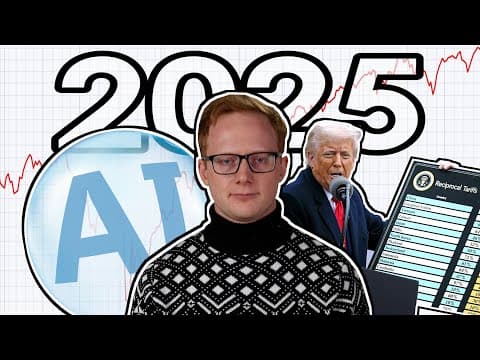
As the year 2025 draws to a close, Richard Coffin of *The Plain Bagel* presents his annual "Finance Rewind," reflecting on a year defined by radical policy shifts, a volatile trade landscape, and the continued dominance of artificial intelligence. This retrospective provides a month-by-month breakdown of the events that shaped the global economy and offers a glimpse into the trends expected to define 2026.
The year began with a series of high-profile events centered on the incoming U.S. administration. On January 17, just days before his inauguration, Donald Trump launched "Trumpcoin," a Solana-based memecoin. While the currency experienced a massive surge followed by a correction, it signaled a new era of crypto-friendly policies. Simultaneously, the long-contested TikTok ban briefly took effect before ByteDance was granted a 75-day window to sell its U.S. operations, a saga that eventually culminated in a December deal involving Oracle and MGX.
Upon his inauguration on January 20, President Trump issued a record-breaking number of executive orders. These actions targeted regulatory agencies like the SEC and FTC, ended government DEI programs, and initiated large-scale deportations. A major highlight was the creation of the Department of Government Efficiency (DOGE), led by Elon Musk. Despite a pledge to cut $2 trillion in government spending, the initiative faced criticism for using inexperienced staff and exaggerating savings. Ultimately, government spending increased slightly, and DOGE disbanded in November.
Trade policy dominated the spring of 2025. In February, the administration imposed 10% tariffs on Chinese goods and 25% on Canadian and Mexican imports. This escalated on April 2, dubbed "Liberation Day," when a 10% baseline tariff was applied to all imports. This triggered a 12% market drop and a fierce trade war with China, where tariffs on certain goods reached as high as 145%. Tensions eventually cooled in May when both nations settled on a 10% baseline, but the period left a lasting mark on global supply chains.
In Canada, political shifts saw Mark Carney elected as Prime Minister on April 28. Leading the Liberal Party toward a centrist position, Carney focused on "nation-building" while axing the carbon tax and tightening immigration. Despite the trade turbulence, Canada maintained a somewhat advantageous position due to existing free trade exemptions, though a 2026 review of these agreements looms.
The corporate world saw a historic transition on May 3, when Warren Buffett announced his retirement from Berkshire Hathaway. After six decades of leadership, he handed the reins to Greg Abel. Meanwhile, in July, the "One Big Beautiful Bill" was signed into law, introducing trillions in tax breaks alongside significant cuts to social programs like SNAP and Medicaid. Despite these cuts, the federal deficit was projected to grow by up to $4 trillion over the next decade, fueled by increased spending on border operations and a new "Golden Dome" missile defense system.
The summer also brought the "Genius Act," the first major national legislation for the cryptocurrency industry. It established a regulatory framework for stablecoins, moving oversight away from the SEC and defining them as neither securities nor commodities. On the monetary front, Federal Reserve Chair Jerome Powell announced a return to flexible inflation targeting at the Jackson Hole symposium. Following months of tension with the White House, the Fed cut rates three times and ended its quantitative tightening program in December.
Artificial Intelligence remained the primary driver of market valuations. In September, Nvidia announced a $100 billion investment in OpenAI, a deal critics labeled as "circular" due to OpenAI’s commitment to using Nvidia chips. Despite concerns over an AI bubble and OpenAI’s massive $1.4 trillion spending plan, Nvidia became the first company to reach a $5 trillion valuation in October. The tech race also moved into the physical realm with the launch of "Neo," a humanoid helper robot from startup 1X, which challenged Elon Musk’s Optimus.
The final quarter of the year was marked by domestic instability and commodity surges. The U.S. experienced its longest government shutdown in history—43 days—over disputes regarding Affordable Care Act subsidies. In the markets, Bitcoin reached an all-time high of $126,000 in October, supported by the establishment of a U.S. strategic reserve, before correcting toward the end of the year. Simultaneously, prediction markets like Polymarket gained institutional legitimacy, with the owner of the NYSE investing $2 billion into the platform.
As December arrived, international markets were rattled by the Bank of Japan, which hiked interest rates to 0.75%, the highest since 1995. This move, combined with rising U.S. bond yields, sparked fears of a carry trade unwinding. Meanwhile, gold and silver reached unprecedented heights, with gold surpassing $4,500 per ounce. Analysts debated whether this was a "debasement trade" reflecting a weak dollar or simply retail FOMO.
Looking toward 2026, the economic outlook is bifurcated. While the stock market remains strong and AI continues to advance, significant risks persist. These include a potential AI bubble, persistent inflation, and a softening labor market. Geopolitical tensions have also escalated, with 2025 seeing direct U.S. military interventions in Yemen, Iran, and Venezuela. As the world navigates these uncertainties, 2026 is expected to be a year of continued deregulation and ongoing legal challenges to the administration’s trade and prediction market policies. Richard Coffin concludes by thanking his audience for reaching the milestone of one million subscribers during this landmark year.