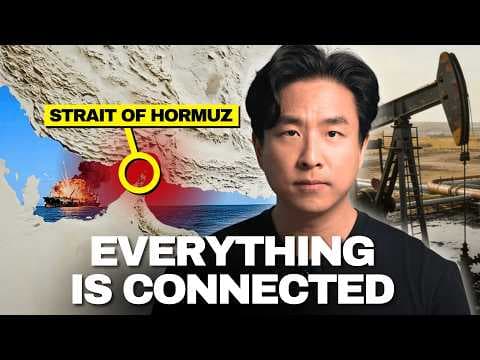
Why The Oil Crisis is Way Worse Than You Think | AB Explained
AI Summary
The world is currently facing a massive oil crisis that is causing gas and grocery prices to surge, with gas prices in the US potentially surpassing the 2022 record of $5 a gallon, and already exceeding $5.60 in California. Diesel prices are climbing even faster, impacting the cost of all delivered goods. This crisis escalated dramatically after February 28, 2026, when the United States and Israel launched a large-scale air campaign against Iran, targeting military and weapons facilities due to Iran's nuclear weapons program. Iran's Supreme Leader, Ayatollah Ali Khamenei, was killed on the first day.
In response, Khamenei's son was quickly installed as the new Supreme Leader and initiated a devastating economic counterattack. Iran launched missiles and drones at Israel, US military bases, and even countries not directly involved in the conflict, such as the UAE and Qatar. Targets included Dubai and Abu Dhabi international airports, and Qatar's Ras Laffan industrial city, the world's largest liquefied natural gas (LNG) facility, causing Qatar to suspend LNG production. These attacks, while seemingly indiscriminate, were strategic. Iran, unable to confront the US militarily directly, aimed to disrupt the global economy by targeting energy infrastructure, signaling that its destruction would lead to global economic collapse.
Central to this conflict is the Strait of Hormuz, a 21-nautical mile wide channel between Iran and Oman, through which approximately 20% of the world's oil and 25% of its LNG supply flows daily. Iran has declared that no oil will pass through this strait. The world's heavy reliance on this single narrow waterway for a significant portion of its energy supply makes it extremely vulnerable to conflict.
To understand the crisis, it's essential to differentiate between various energy terms. Crude oil, the raw material, is refined into products like gasoline, diesel, jet fuel, and petrochemicals. Gasoline (or petrol) is for cars, while natural gas, primarily methane, is used for heating and cooking. When cooled to liquid form, natural gas becomes LNG, transported by specialized tankers. LPG (liquefied petroleum gas), like propane or butane, is a byproduct of both crude oil and natural gas and is crucial for cooking in many Asian countries.
The Persian Gulf region holds about 48% of the world's proven oil reserves, with Iran alone possessing around 12%. Most of these countries, including Saudi Arabia, Iraq, Kuwait, UAE, Qatar, Bahrain, Oman, and Iran, rely on the Strait of Hormuz as their primary exit for oil exports. While Saudi Arabia has a pipeline to the Red Sea, it cannot fully replace the Strait's capacity, and even this alternative route has been targeted by Iran. Other Gulf nations lack such alternatives, making the Strait indispensable.
The Strait of Hormuz has been a strategic chokepoint for 5,000 years, but its global importance surged in the early 1900s with the world's shift to oil, particularly after Winston Churchill decided to convert the British Navy from coal to oil. The first major oil discovery in the Middle East was in Iran in 1908, controlled initially by a British company (later BP). Decades of Western control over Iran's oil resources led to deep mistrust, culminating in the 1953 CIA-orchestrated coup that overthrew Iran's democratically elected Prime Minister Mohammad Mosaddegh, who had nationalized the oil industry. This historical grievance was a key factor in the 1979 Islamic Revolution. Despite this history, global dependence on oil flowing through the Strait of Hormuz only increased, with the US establishing military bases in the region to ensure its flow.
Before February 28, 2026, around 100 ships, two-thirds of which were tankers, traversed the Strait daily, transporting 20 million barrels of oil and over $2 billion worth of energy. The actual shipping lanes are very narrow, with inbound and outbound channels only 2 miles wide. The US Navy's Fifth Fleet, headquartered in Bahrain, along with a 34-country coalition, was responsible for keeping the Strait open.
However, after the US and Israel's attacks on Iran, the regime, feeling it had nothing left to lose, completely shut down the Strait of Hormuz using three main tactics:
1. **Naval Mines:** Iran possesses 5,000-6,000 naval mines, including sophisticated bottom and rising mines, which can be easily deployed by small boats and are difficult to clear.
2. **Swarm Boats:** The Islamic Revolutionary Guard Corps (IRGC) operates a fleet of fast attack speedboats that swarm and attack larger vessels from multiple directions, using heavy machine guns, missiles, and explosive drone boats.
3. **Missiles and Attack Drones from Shore:** Iran controls three islands in the Strait and has underground tunnel systems on Qeshm Island housing mobile missile launchers. These missiles can reach any ship in the Strait within minutes. Additionally, cheap, hard-to-detect attack drones are launched from the mainland and islands.
These asymmetric tactics have been highly effective. As of late March 2026, at least 20 commercial vessels have been attacked, resulting in deaths and severe damage. The indirect impact has been even more devastating: major maritime insurance companies pulled war-risk coverage for vessels in the Persian Gulf on March 5, essentially closing the Strait financially. Without insurance, tankers cannot sail, cargo cannot be financed, and ports will not accept deliveries. This "actuarial warfare" has led to a 95% collapse in daily traffic through the Strait.
Despite US claims of destroying Iran's ballistic missile capabilities and reducing drone attacks, the Strait remains closed because Iran has shifted tactics, using fewer but heavier missiles and new drone strategies, reportedly with Russian assistance. Reopening the Strait by force is complex. The US recently decommissioned its dedicated minesweeping ships, and its current naval assets are insufficient. Any attempt to escort tankers would face thousands of mines, drone swarms, and super-fast anti-ship missiles from Iran's 15,000 km coastline. The cost asymmetry is stark: shooting down a $35,000 drone or a $250,000 missile can cost the US $30-45 million per shot with THAAD interceptors, which are not 100% accurate. Iran has also targeted expensive THAAD radars.
Even a ground invasion to seize Kharg Island, which handles 90% of Iran's oil exports, would not reopen the Strait and could trap US troops on a hostile island.
China significantly complicates the situation. It has become the largest customer of Gulf oil, with 45% of its crude imports passing through the Strait. While the US protected the Strait, China benefited most and invested heavily in the region through its Belt and Road Initiative. China has dispatched a naval task force and conducted joint naval exercises with Iran and Russia in the Gulf. Currently, Iran's own oil tankers, part of a "shadow fleet" operating outside international systems, are still supplying China with about 1.2 million barrels a day, with payments settled in yuan or rubles, bypassing the US dollar. This directly challenges the petrodollar system, which has underpinned the US dollar's status as the world's reserve currency for 52 years.
The shutdown of the Strait has far-reaching consequences beyond fuel. One-third of the world's fertilizer trade passes through it, and Qatar, a major producer of nitrogen-based fertilizer, has shut down its largest plant. This threatens global food security and could lead to less food at higher prices. Qatar also supplies a third of the world's helium, essential for semiconductor manufacturing. Its production shutdown could impact the global tech industry, particularly memory chip production in South Korea.
The crisis is already devastating parts of Asia, with food delivery drivers in India seeing incomes halved, the Philippines on a four-day work week, Thailand promoting work from home, and Bangladesh closing universities to save fuel. The UN World Food Program warns that 45 million more people could face acute food insecurity.
The US economy is also vulnerable. The AI industry, currently a significant driver, is heavily funded by Gulf sovereign wealth funds. If these funds are disrupted by the crisis, it could trigger a collapse in Silicon Valley, Wall Street, and beyond, likely forcing the US to deploy ground troops to protect its Gulf allies, who are facing threats to their oil infrastructure and critical desalination plants.
Historically, every recession since World War II (except the pandemic one) has been preceded by a spike in oil prices. With oil up 40% since the war began, a global recession seems imminent, disproportionately affecting working-class people worldwide. Reopening the Strait of Hormuz is critical, but the path forward remains unclear.