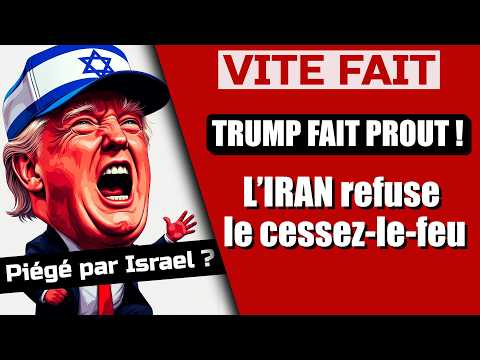
VF - TRUMP fait Prout en IRAN et cherche une porte de sortie ! Le point sur la situation.
AI Summary
In a recent address from Air Force One, Donald Trump provided an update on the ongoing conflict with Iran, characterized by a significant disconnect between official rhetoric and the strategic reality on the ground. While Trump asserts that the war is nearly over and has cost very little, the situation suggests a deepening geopolitical and economic crisis.
**The Rhetoric of Victory and Capitulation**
Trump’s primary claim is that the United States has already won the war "from afar." He describes the Iranian military as "quasi-existent" and claims the "Empire of Evil" has been annihilated. Central to his narrative is the idea that Iran has "capitulated." He bases this on reports that Iran has offered apologies to several Middle Eastern states, which he interprets as a total surrender.
However, the transcript challenges this definition of capitulation. In a military and legal sense, capitulation requires a formal agreement where a defeated party renounces its cause. In reality, Iran has not abandoned its nuclear program, its ballistic missile development, or its current regime. Despite the lack of a bilateral agreement, Trump insists that a formal signing is unnecessary because "everyone knows" the US has won.
**The Failure of "Regime Change" and Strategic Errors**
The conflict was largely predicated on the hope of internal collapse. Benjamin Netanyahu explicitly called for the Iranian people to revolt, suggesting that US and Israeli strikes would create the conditions for "liberation." This strategy has proven to be a fundamental strategic error. The transcript compares this to a foreign power bombing France to "liberate" it from an unpopular president; such actions typically result in nationalistic defiance rather than cooperation.
While the US and Israel have achieved tactical successes—specifically the elimination of top-tier Iranian leaders—they lacked a "Plan B" for when the population failed to rise up. The Iranian leadership is now employing a strategy dubbed "Operation Madman," which aims to increase the cost of the conflict until Washington and Tel Aviv are forced to retreat. This puts Trump in a difficult position, as his political legitimacy is tied to his stated refusal to engage in long, costly "forever wars."
**The Kurdish Factor and Ground Troops**
A major component of the initial plan involved using Kurdish forces as the primary ground infantry, described in the transcript as "sacrificial meat" with low political cost. Trump openly encouraged Kurdish leaders to intervene in Iran. However, the Kurds refused to be instrumentalized, citing past instances where the US abandoned them, notably in Syria.
Following a strike on a Kurdish party in Iraq shortly after Trump’s proposal, the Kurds clarified they would only defend their own territory and would not lead a war for the "Great Satan." This refusal has turned the prospect of ground troops back into a political taboo. Trump has since pivoted, claiming he never wanted the Kurds to intervene because he "didn't want to see them hurt," a stance the transcript labels as hypocritical.
**International Isolation and Putin’s Role**
Trump is actively trying to prevent the conflict from expanding into a global war involving Russia or China. He has downplayed any indication of Russian support for Iran and has rebuffed offers of help from NATO allies. Specifically, he dismissed UK Prime Minister Keir Starmer’s offer of aircraft carriers, claiming they were no longer needed because the war was already "won."
In the vacuum of US diplomatic leadership, other players are stepping in. Countries like Bahrain and the UAE, realizing that US bases on their soil make them targets rather than providing protection, have turned to Vladimir Putin to act as a mediator. Putin has positioned himself as the intermediary capable of de-escalating the situation, while Russian officials like Sergey Lavrov have criticized the "cowardice" of Gulf states that failed to condemn US and Israeli aggression despite their fears of war.
**The "Hollywood" Narrative and Economic Consequences**
The White House recently released a highly stylized, "Hollywood-esque" video promoting the spread of democracy, utilizing imagery reminiscent of films like *Top Gun* or *Starship Troopers*. The speaker suggests that Trump may have actually fallen for this narrative, believing that a few targeted strikes would lead to a pro-Western democratic uprising.
In reality, the "opposition" leaders being groomed by the US, such as Reza Pahlavi, are described as "fantastical" figures with no real power to impose a government on the Iranian people. Meanwhile, the economic fallout is becoming severe. Oil and gas production in Iraq, Saudi Arabia, and Qatar has dropped significantly. If the conflict lasts more than a few weeks, the resulting energy shortage and price spikes could trigger a global recession.
**The Erosion of International Law**
The transcript concludes that the US approach has effectively dismantled the architecture of international law. By targeting civilian infrastructure—including a desalination plant and an elementary school where over 160 children were killed—the US and Israel are accused of massive war crimes. Trump has attempted to "rebalance" these atrocities by citing the events of October 7th, suggesting that both sides should simply "wipe the slate clean."
Ultimately, Trump is trapped between an escalatory Israeli agenda and his own need to exit the conflict. If the US withdraws without achieving a regime change or the neutralization of Iran's military programs, it will be viewed as a total strategic defeat. For now, the administration is attempting to use rhetoric to bridge the gap between a failed intervention and the appearance of victory.