How Plato Changed Christian Theology
AI Summary
In Exodus, Moses encounters God in thick darkness on Mount Sinai and later asks to see God's glory. God refuses, stating no one can see His face and live. While many interpret this as a physical warning, 4th-century bishop Gregory of Nyssa offered a different perspective. He saw the darkness and God's refusal not as a literal danger, but as a symbol of the spiritual encounter with the divine. For Gregory, God's denial was precisely the granting of what Moses truly sought: an unending desire for God, a spiritual yearning that could never be fully satisfied by a concrete image. To grasp God in human terms, to create a mental image, would be to diminish God, to make Him comprehensible and therefore no longer truly God, but a human construct. God, he argued, transcends all characteristics and is inaccessible to knowledge. This vision of God is an unfillable desire, a continuous reaching for something beyond comprehension.
This concept lies at the heart of apophatic theology, also known as negative theology. It's a method of approaching God by articulating what God is not, a tradition spanning from early Christianity through Eastern mystics, medieval Western thinkers, and into modern Eastern Orthodox thought. It challenges conventional understandings of the divine.
To understand apophatic theology, we must first consider its opposite: cataphatic theology. Cataphatic theology, from the Greek "katapasis" (affirmation), involves using positive statements to describe God, such as "God is good," "God is wise," or "God is the creator." Apophatic theology, from "apophasis" (denial or unsaying), negates these affirmations. It suggests God is not good *in the way we understand goodness*, not wise *in the way we know wisdom*, and not even a being *in the same way other beings are*. Essentially, it's speaking about God by refusing to claim definitive knowledge of God, acknowledging that any human language falls short when applied to the infinite.
Apophatic theologians argue that cataphatic statements, while useful, can inadvertently import finite understandings into our concept of God. For instance, the word "good" is learned from finite experiences like a good meal or a good friend. Applying it to God risks smuggling these finite connotations into our understanding of the divine. Negation, conversely, doesn't add new content; it simply refuses to limit God to our finite concepts, making it a sharper tool for describing the ineffable. Gregory of Nyssa's interpretation of Moses on Sinai exemplifies this: God is glorious (cataphatic), but you cannot see that glory and live (apophatic correction). Both affirmation and negation are deemed necessary, with apophatic theology often taking primacy due to its ability to destabilize definitive statements about God.
The impulse for negation also stems from the second commandment: "You shall not make for yourself a carved image." While often interpreted as a prohibition against physical idols, apophatic theologians extend this to conceptual idols – any finite idea or mental image of God that we mistake for the divine. When a Christian becomes too comfortable with a fixed image of God, be it a kindly old man or a cosmic judge, they risk idolizing a small, manageable concept rather than the true God. The English words "idea" and "idol" share a common Greek root, "eidolon," meaning "visible form" or "image," highlighting this conceptual link. Apophatic theology, by constantly questioning and negating our concepts, helps prevent this solidification, reminding us that our idea of God is not God himself.
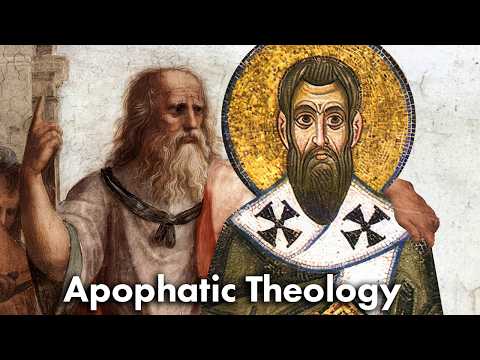
Apophatic thought predates Christianity, with similar ideas found in other religions. In Christianity, its roots lie in the Hebrew Bible and Greek philosophy. Isaiah's question, "To whom then will you compare me?" and God's response to Moses at the burning bush, "I am that I am," are seen as intimations of God's incomparability and refusal to be definitively named. Plato's philosophy, particularly his concept of the Form of the Good as being "beyond being," influenced Christian thinkers. The Form of the Good, for Plato, is not a being among beings but the source of existence itself, analogous to the sun that makes sight possible but cannot be directly stared at. This idea of a reality beyond being resonated with Christian theologians.
The Cappadocian Fathers – Basil of Caesarea, Gregory of Nyssa, and Gregory of Nazianzus – are key early apophatic theologians. Basil distinguished between God's essence (unknowable) and His energies (knowable activities). He argued that while we can know God through His actions in the world, His true essence remains inaccessible, much like the unphotographable black hole whose effects we can observe. This "essence-energies" distinction became central to Eastern Orthodox theology, allowing for knowledge of God's activities without claiming to know His unknowable essence, thus preventing apophatic theology from leading to complete silence.
Gregory of Nyssa further developed this by interpreting Moses' journey on Sinai as an allegory for the soul's spiritual ascent. The progression from light (burning bush) to mixed light and darkness (Sinai's slope) to pure darkness (Sinai's summit) represents the soul's encounter with God's incomprehensibility. True knowledge of God, for Gregory, is the recognition of this unsurpassable mystery, a "seeing that consists in not seeing."
The most influential apophatic theologian is Pseudo-Dionysius the Areopagite, writing around 500 CE. He systematized apophatic and cataphatic theology, borrowing from Neoplatonism. He proposed that we can approach God through analogy (cataphatic) by observing His traces in creation, but also through negation (apophatic) by recognizing that God is not any of these created things. Pseudo-Dionysius coined the term "hyper-" (beyond) to describe God, creating terms like "beyond good" (hyper agathos) and "beyond being" (hyper ousios). He argued that while creation reflects its cause (God), the cause itself is not identical to creation.
Apophatic theology moved beyond intellectual discourse into practice, notably in Eastern Orthodox hymns and mysticism. The "hesychia" tradition, particularly on Mount Athos, involved contemplative prayer (the Jesus Prayer) aimed at quieting the discursive mind and achieving inner stillness. This stillness, practitioners believed, could lead to an experience of God's presence, often perceived as divine light, an experience called theosis or henosis. This practice led to a controversy in the 14th century, with Gregory Palamas defending the hesychasts by reasserting the essence-energies distinction against critics who argued for complete unknowability.
Western Christianity also developed apophatic mystical traditions, such as "The Cloud of Unknowing," which states, "God can be loved but not thought." Apophatic theology has always been a significant current in Christianity, influencing doctrine and liturgy, though it has also faced criticism, particularly in Western Scholasticism, for potentially leading to an inability to speak about God at all. The core challenge apophatic theology addresses—how to speak about the divine, which is by definition beyond human language—is a universal one, with different traditions finding their own solutions.