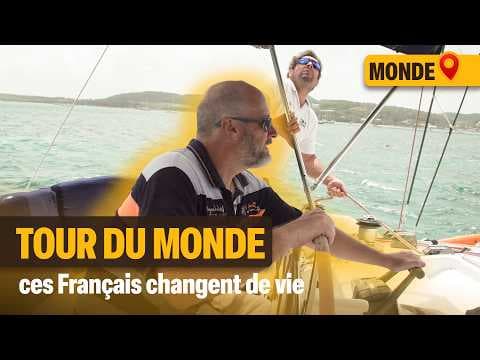
Tour du monde : ces Français ont tout plaqué pour voyager au bout du monde
Audio Summary
AI Summary
This video explores the growing trend of alternative lifestyles and travel, focusing on families and individuals who have chosen to live on boats or in vans, or have embraced travel blogging as a profession. The COVID-19 pandemic is highlighted as a significant catalyst for many of these life-altering decisions.
One story features Paul and Stéphanie, who sold their home in Grenoble and bought a catamaran for 290,000 euros in Martinique, aiming for a round-the-world trip with their two teenage children, Mélina (14) and Matthéo (16), and their cat Onix. Paul, initially inexperienced in sailing, is guided by Frédéric, who sold them the boat. The family plans to take three more lessons before sailing independently. The pandemic, which both Paul and Stéphanie contracted, served as a "wake-up call," prompting them to prioritize their dream. Paul resigned from his e-commerce job, Stéphanie took unpaid leave, and they moved to Martinique with minimal belongings. Their new 100-square-meter floating home features four bedrooms with private bathrooms, a large kitchen, two refrigerators, a freezer, and a water desalination system. Paul is learning boat maintenance through YouTube tutorials, even for basic tasks like splicing ropes, which he needs for the boat's lifelines. The children are homeschooled, but Matthéo struggles with distance learning, especially in math. To foster social connections, Stéphanie used social media to find other teenagers living in the marina, leading to new friendships for her children. The family stocks up on provisions in industrial quantities, planning for at least three weeks of autonomy. Their initial plan to tour the Caribbean is delayed due to quarantine restrictions on many islands, so they will start by navigating along Martinique's coast.
Another family, Claire (22), Thibault (32), and their one-year-old daughter Billy, sailed for 40 days from Brittany to the Caribbean. They invested 40,000 euros of their savings into a small, 9-square-meter monohull. Thibault, an experienced sailor, had previously crossed the Atlantic. Despite concerns from their relatives about traveling with a baby, they were supported by a medical center that provided a well-stocked onboard pharmacy and satellite phone for emergencies. Their boat is basic, with no hot water and a shower on deck. They live on Claire's unemployment benefits and Thibault's odd jobs as a naval technician, a skill highly sought after in the Caribbean. Their dream is to continue traveling for up to 10 years, working periodically to fund their journey. Thibault's parents, who used to see Billy weekly, struggle with the separation.
The video also introduces Eliane and Patrice, who left Geneva with their two children, Naël (7) and Camille (5), to live a nomadic life in the Caribbean. Naël is autistic and previously experienced frequent crises and withdrawal. Despite opposition from some healthcare professionals, Eliane decided to prioritize a less structured environment. She now homeschools Naël for just one hour a day, using the Montessori method, which she believes better respects his rhythm and needs. The family has observed a significant reduction in Naël's crises and allows him to pursue his current obsession with Lego and naval constructions, which he excels at due to his keen observation skills. They actively avoid upsetting him, even allowing him to release a crab from a trap during a hike to prevent a potential crisis. Patrice, a former accountant, now spends more time with his children, strengthening family bonds. They have enough savings to live on their boat for four years without working.
The narrative then shifts to the "van life" trend. Celia, Jimmy, and their two children are seen spending their first night in a custom-built van, which they bought from Loïc. This is their third van, named "Jean-Marie III," and it cost them 60,000 euros. They appreciate its versatility, allowing them to detach the living cell and use the pickup truck for city visits or to access remote forest and mountain areas. Loïc, the previous owner, had to sell Jean-Marie due to lack of time for travel after opening a guesthouse with treehouses. Van sales have surged, with a 150% increase in new vehicle sales in five years.
The video highlights the experience of David, Clotilde, and their children, who rented a vintage 1970s Volkswagen Combi van named Elvis for a weekend for 420 euros. These retro vans are popular for their nostalgic appeal, despite their age and limitations (e.g., maximum 150 km per day). The family enjoys the slower pace and the different perspective of traveling on country roads. However, their first night in the van proves cold, leading them to seek refuge in a cousin's garden for the second night, admitting to "cheating a little" on the full adventure experience.
Bruno, a major collector and restorer of Combi vans in France, owns 50 such vehicles. He rents them out, and his team handles all repairs, like a clutch cable issue shown in the video. Bruno buys old vans, often from Mexico, for 10,000 to 15,000 euros, and after 200 hours of restoration work, sells them for 25,000 to 30,000 euros. He notes that finding restorable vans is becoming increasingly difficult.
Lucas and Louis, both 20, bought their van, "Sully," for 8,000 euros two months prior. They are on a tight budget for renovations and seek inspiration at a van life festival, where they can see other vans and buy specialized equipment like foldable barbecues or external luggage structures. Interior designer Merryl, who specializes in van conversions, showcases her own renovated horse trailer, demonstrating how to create functional and aesthetic spaces, such as a hidden shower. She estimates the cost of a comfortable, well-designed van conversion to be between 30,000 and 40,000 euros. Lucas and Louis plan to do all the work themselves to stay within their budget.
For a premium van life experience, Michel, a concierge in Bordeaux, offers luxury van rentals for 250 euros per day, with an additional 50 euros for his personal assistance. These vans come fully equipped with hotel-like amenities and even a projector for outdoor cinema. Julien and Laura, celebrating Laura's 35th birthday, rent a luxury van for 600 euros for two days for a romantic weekend without their children. Michel helps them find a secluded lakeside spot, ensuring a tranquil experience.
The Pinel family, Eric (45), Alice (38), and their daughters Coline (10) and Eden (7), have lived on their catamaran, "Suricat," in French Polynesia for five years. They bought it for 250,000 euros and embarked on a round-the-world trip in 2012 before returning to Tahiti in 2015. Alice works as a financial director, while Eric, a former marine photographer, now dedicates himself to boat maintenance and homeschooling the girls. He has customized the boat's interior, installed solar panels, and even reassembled a washing machine to fit. They spend 10,000 euros annually on boat maintenance and 750 euros monthly for their marina spot. The girls attend local schools in Papeete, learning Tahitian and local geography. The family enjoys snorkeling and exploring the 118 islands and atolls of French Polynesia. They emphasize the strong bonds formed within the sailing community, often reuniting with friends met years and thousands of kilometers apart. For their school holidays, they are sailing to Bora Bora, where Eric teaches his daughters essential navigation skills, including how to stop the boat and call for help in an emergency.
Finally, the video explores the world of travel blogging. Thibault Perrier (30), a "travel blogger," documents his journeys on "Le tour du monde de mes pieds" (The World Tour of My Feet), a blog with 10,000 monthly visitors, known for photos of his feet in various exotic locations. He funds his travels primarily with rental income from an apartment he owns. He aims to discover unique, off-the-beaten-path locations, sharing GPS coordinates and photos with his readers.
Camille Maleroni (30), creator of "L'oiseau rose" (The Pink Bird) blog, is one of France's most followed travel bloggers, specializing in nature destinations. Her passion for travel began at age nine during a trip to Martinique. She quit her communication job in 2013 to travel the world with her partner, Steven, and grew her blog to 100,000 monthly visitors. She now receives numerous travel invitations from tourism professionals, choosing to promote destinations aligned with her values. For example, she was paid 500 euros per day by a tourism office to promote the Berry region for three days, with all expenses covered. Camille uses various social media platforms to engage with her 70,000 followers, sharing live updates and interacting with her "traveling birds" community. Steven, her boyfriend, acts as her photographer, and they recently invested in a drone to capture unique aerial shots. Despite the glamorous facade, travel blogging is demanding, with long hours spent selecting and editing photos, often working until late at night. Camille admits that her "vacations" are when she's at home, not traveling. While she promotes positive aspects of destinations, she diplomatically avoids negative criticism to maintain good relations with tourism partners.
The video concludes with Guy Cordier (59), a former garage owner from Grenoble who embarked on a round-the-world trip in 1998. He has lived in Tahiti on his sailboat for 10 years, earning about 450 euros a month by repairing other sailors' boats. He anchors 300 meters from shore to avoid marina fees. Guy's life at sea became a form of therapy after a personal tragedy during an earlier leg of his journey. He now shares his life with Mira, a 60-year-old Polish woman he met through a dating site for sailors. They live a modest, nomadic life, finding freedom and fulfillment on the ocean.