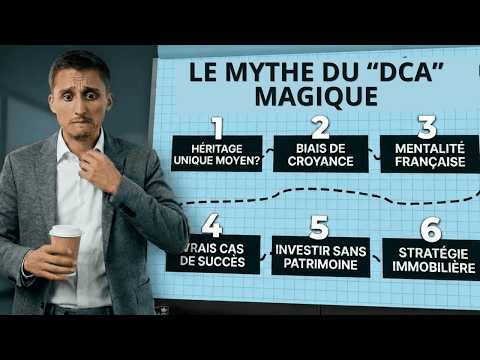
FINARY : Pourquoi le Français reste pauvre ?
AI Summary
The speaker analyzes comments from a previous video discussing the merits of Dollar-Cost Averaging (DCA), particularly in response to a popular video by Finari titled "The healthiest path to your first €100,000." The speaker observes that the comments reveal a "radiography of the French financial mentality in real-time," which he found "chilling" due to the "almost unanimous, deep, and sincere belief" in certain financial principles, which he argues are "terribly costly."
The Finari video, with 33,000 views, focused on compound interest and its limitations, contrasting it with a real estate operation example involving €300,000 properties acquired in 18 months, which was criticized. The speaker highlights Finari's choice of the word "healthiest" instead of "effective," "fast," or "profitable." He explains this linguistic mechanism as a "presupposition," an unstated truth that is accepted without question. By using "healthiest," Finari implicitly categorizes other paths, like leveraged real estate or entrepreneurship, as "unhealthy," "unvirtuous," or "immoral." This rhetorical tactic, the speaker argues, "vaccinates" viewers against alternatives, leading them to instinctively reject different approaches, such as the real estate example, as "unhealthy."
The speaker then introduces a free masterclass called "The Golden Number," which defines financial freedom not as a feeling but as a specific capital amount whose returns cover one's living expenses. The masterclass aims to show the fastest path to this "golden number," emphasizing a "stock" (capital) rather than "flow" (income) mindset. He contrasts this with the DCA approach, noting that €100,000 in capital yields less than minimum social benefits in France.
He revisits a point from Finari's video, which recommends remaining a tenant for 14 years while paying €700 in rent monthly. The speaker calculates that this amounts to nearly €120,000 "thrown out the window" over 14 years, with no capital accumulation or forced savings. He then proposes an alternative: if David, the example from Finari's video, had invested his €300 monthly DCA contribution plus his €700 rent into a property using a zero-interest loan (Prêt à Taux Zéro), he could have acquired a property with a monthly payment of €1,000. After 14 years, with a 1% price appreciation and capital amortization, this could result in a net sale value of €205,000 – twice the amount from DCA without investing a single cent in the stock market, and using an available state mechanism.
The core of the issue, according to the speaker, is "heritocracy," a concept by sociologist Fo Berlin. This refers to the deeply ingrained French cultural belief that wealth is a matter of birth, that bank leverage is reserved for heirs, and that doors don't open without the right contacts or background. This belief leads to two behaviors: first, if something is too difficult to understand, it's easier to label it "impossible" than to try and comprehend it; second, this belief protects against failure, as one doesn't even need to try if it's "structurally impossible," thus avoiding self-questioning. The speaker emphasizes that this is a "deeply human and terribly costly psychological protection mechanism."
He illustrates this with comments like "No bank lends €2.2 million to an employee earning €3,500" or "You inherited, you are rich," presented as the only possible explanations. He contrasts this with the American mentality, where wealth is seen as an acquired skill, and success without inheritance prompts questions of "how did they do it?" rather than accusations of privilege. In the US, difficulty is an invitation to learn, and failure is a step in the process, whereas in France, not trying is preferred to avoid failure.
The speaker provides examples of individuals who achieved significant real estate wealth (e.g., Madeleine with €10 million in 4 years at 52, Auguste with €8 million in one year at 27, Robin Lin who raised €13 million starting as a nursing assistant with a salary under €2,000) to counter the "impossible" narrative.
Analyzing specific comments, he addresses Tokamac's highly-liked comment, which praised the critique of "miracle DCA" but dismissed the real estate strategy as "intellectual dishonesty." The speaker interprets this as a cognitive bias: Tokamac validates the critique of DCA but immediately rejects an alternative without understanding its mechanics, simply because it falls outside his "universe of reference." This illustrates "mental heritocracy," where the absence of examples in one's environment leads to the conviction that certain paths don't exist.
Another comment, from Mator 512, represents "benevolent skepticism." Mator intellectually grasps the "phase 1, phase 2" concept but anchors back to DCA, seeing it as the only viable path to financial independence, even if it only provides a "non-negligible capital at retirement." The speaker argues this reflects an acceptance of retirement as the only financial horizon, rather than early financial freedom. This "mental heritocracy" costs "years that are lost," sacrificing prime years for enjoyment in old age.
Expat 3800's comment, "Fast money is not easy. Easy money is not fast. There are no magic secrets in investment," is seen as revealing. The speaker clarifies that he never spoke of "magic" or "easy money," but of "bank leverage," a tool used by businesses and governments for centuries. He stresses that achieving financial independence often requires doing what 95% of people are unwilling to do.
Olivier Sban's comment, "Our money is finite. Others' money is infinite," is highlighted as a synthesis of the entire video. Our savings are limited by salary, but bank lending capacity is "structurally much larger." Since 90% of money in circulation in Western countries comes from credit, relying only on personal cash means playing with just 10% of available resources, leading to significantly slower progress.
Ergobar's comment is praised for its insightful diagnosis from within the community: "Is it just me, or are we all getting detractors who get stuck on buying seven buildings with a €3,500 salary... without understanding how the acquisitions are made... too formatted by YouTubers these past few years." Ergobar correctly identifies that detractors focus on the total amount (€2.2 million) without understanding the multi-operation strategy or how banks evaluate dossiers beyond a gross salary. The speaker agrees that the prevalence of DCA/ETF content creates an "alternative dominant reality," making anything outside it automatically suspect.
Bevic 3's comment, "DCA requires no competence and can be a model for retirement savings for the entire French population. Your phase 1 requires talent or luck... French people are psychologically compatible with soft, socializing regularity," is deemed both lucid and illustrative of the problem. The speaker argues that this statement reflects a societal programming that encourages mediocrity and discourages ambition, leading individuals to believe they lack the capacity for greater achievements when it's merely a "limit of exposure."
Cleiman's comment, marked by sarcasm, "Why didn't I think of it sooner? It's easy to buy buildings with a €3,500 salary... no stress... while managing €2 million is easy without hassle. No bank will lend you a million with such a salary," reveals "French financial illiteracy." The speaker points out that Cleiman's sarcasm masks a real question he's unwilling to seriously consider, and that he misrepresents the speaker's message (e.g., claiming €2 million management is "without hassle"). The speaker clarifies that intensive effort over 2-3 years (phase 1) is preferable to 14-20 years of "small, regular, constant effort." He also corrects the notion that banks won't lend €1 million, explaining that they might lend €300,000 three times. Cleiman's continued denial in the face of facts exemplifies "cognitive closure," a preference for a quick, definitive answer over the discomfort of re-evaluation, protecting internal coherence at the cost of potential financial freedom.
Magid Secour's comment, "Totally agree. 14 years for €100,000 is way too long. I made €80,000 in 4 years by reselling my well-bought primary residence... Yes, you have to do DCA but not only with your own money, otherwise it's too long," is highlighted as a perfect illustration of "phase 1" without explicitly naming it. It proves that this strategy is not an exception but a natural outcome for those with access to the right information.
No name Name WC9YO's comment, "I stopped the video... the initial approach is good. Except that the example about François starts with a big amount. That alone made me stop the video. Anyway, if François managed to raise €2.2 million in 18 months, I want to point out that it's an exception of exceptions," is seen as an example of cognitive closure. The viewer stops at the point of potential paradigm shift, preferring to dismiss the information as an "exception of exceptions" to maintain their existing beliefs.
Aurel 5130's critique, "I find the substance of the explanation very interesting and I largely agree. Unfortunately, the form seems too simplistic or utopian. The amount of €2.2 million seems extremely high without inheritance or other external contributions," is acknowledged as legitimate regarding the "form." The speaker clarifies that the goal was to show an alternative path, not to sell anything, and emphasizes that the principle of leveraged real estate applies even to more modest scales, like a €300,000 property, which would still yield three times more than 14 years of DCA.
Finally, Chocop's comment, "€100k in 14 years is really very slow, even with a bad building and doing anything without strategy, you do better in a few years," is lauded as "arithmetically brutal and true." It highlights that even poorly executed, leveraged real estate mechanically outperforms 14 years of DCA and deprivation.
In conclusion, the speaker asserts that the commentators are not stupid or malicious but express a deeply ingrained collective belief in "heritocracy"—that wealth is inherited, that certain levers are not for them, and that rapid wealth is suspicious. This belief has a tangible cost: years of lost financial freedom, exemplified by the €117,000 in rent paid by David instead of building capital. The solution, he states, is information and understanding how to build "phase one" according to one's profile. He encourages viewers to decide whether they are on the side of those who say "it's impossible" or those who "seek to understand how it's done."