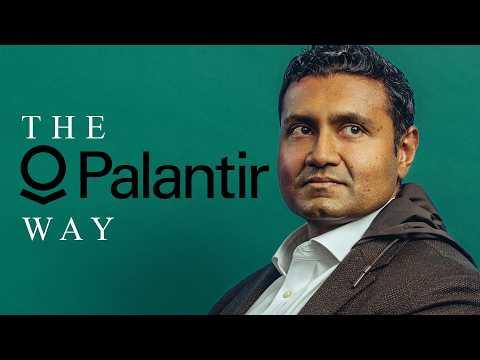
Why Great Builders are Heretics | Palantir CTO
AI Summary
In this wide-ranging conversation, Sham Sankar, the Chief Technology Officer of Palantir Technologies, explores the intersection of historical innovation, corporate culture, and the urgent need for American re-industrialization. Sankar frames his worldview through the lens of "heretics"—visionary figures who defy bureaucracy to deliver transformative results—and argues that the United States must reclaim this spirit to maintain its global standing and security.
### The Philosophy of the Heretic
Sankar defines a "heretic" as a founder-like figure within a large system, particularly the military, who becomes pathologically obsessed with winning. He highlights figures like Hyman Rickover, the father of the nuclear Navy, and John Boyd, the strategist who developed the OODA loop. These individuals often faced extreme professional risks and institutional humiliation. Rickover, for instance, was relegated to a women's restroom as an office, yet he built the first nuclear submarine in just seven years. Sankar argues that almost every major military success in U.S. history resulted from such heretics bypassing "the machine" to deliver what was actually needed rather than what was officially requested.
### Unlocking Human Talent
At Palantir, this heretical spirit is institutionalized through a unique approach to talent. Sankar describes the company as an "artist colony" rather than a traditional software firm. The goal is to identify an individual's "superpower"—an effortless, innate strength—and their "kryptonite," a debilitating weakness that should be avoided rather than "fixed."
Sankar believes in "irradiating" young talent with high-stakes responsibility. He uses the analogy of Bruce Banner becoming the Hulk: growth doesn't come from incremental progress but from a "near-fatal dose of gamma rays." By throwing engineers into global-scale problems without sufficient resources, Palantir forces a maximum rate of learning. This culture of "extreme agency" has turned the company into a "founder factory," producing a generation of entrepreneurs who are comfortable with chaos and high stakes.
### Forward Deployed Engineering and the Ontology
Sankar pioneered the concept of "Forward Deployed Engineering" (FDE) at Palantir. This model rejects the traditional software feedback loop of "can I sell it?" in favor of "does it deliver an outcome?" FDEs work in the "foxhole" alongside end-users—whether soldiers or factory workers—to build software through "back-propagation."
This approach led to the development of Palantir’s "ontology." Sankar explains that Palantir is not a data collection company but an "operating system for decisions." Most institutions suffer from an "impedance mismatch" where data is stored in ways that don't reflect reality. The ontology maps the "kinetics" of a business—the actual actions and decisions—onto the data. For example, at Airbus, Palantir helped engineers on the assembly line identify recurring design defects by mapping quality data directly to the production process. This transformed the business from a collection of spreadsheets into a programmable enterprise.
### The Crisis of Deterrence and the Industrial Base
A significant portion of Sankar’s worldview focuses on the decline of American deterrence. He points to the annexation of Crimea, the militarization of the Spratly Islands, and the invasion of Ukraine as evidence that the U.S. is no longer effectively deterring its adversaries. He traces this back to the "Last Supper" of 1993, a Pentagon meeting where the defense industry was forced to consolidate. This led to a shift from 51 "primes" to just five, resulting in a "financialized" industrial base that prioritizes dividends and buybacks over radical engineering.
Sankar argues that the U.S. has lost the ability to mass-produce. In World War II, the U.S. advantage was its industrial base; today, our adversary, China, is the world leader in mass production while the U.S. focuses on a small number of "exquisite" systems. He critiques the "globalization lie" that the U.S. can innovate while others produce, noting that innovation is actually a consequence of production. If you don't make the product, you eventually lose the ability to innovate the next version.
### Re-industrialization and AI
To restore deterrence, Sankar advocates for a "Marshall Plan" for domestic manufacturing. He suggests using "asymmetric advantages" like AI to make American workers 50 times more productive. He views AI as "David’s slingshot," a tool that can change the efficient frontier of what can be built in America. He proposes practical policy shifts, such as extending pharmaceutical patents for companies that manufacture their entire supply chain domestically, to ensure national security in critical areas like generic drugs.
### The 18 Theses and the Call to Action
Sankar’s public "18 Theses" serve as a diagnostic of this "undeclared state of emergency." He calls for a return to the "primacy of the person," arguing that programs succeed because of specific individuals, not processes. He urges the Department of Defense to move away from "cost-plus" contracting, which disincentivizes risk and innovation, and to embrace "heretical" new entrants who are building in the national interest.
Ultimately, Sankar’s message is a call to "do something" rather than "be someone." He quotes John Boyd’s famous advice to choose between the status of a high-ranking position and the intrinsic reward of actually solving a problem. For Sankar, the future of the U.S. depends on its ability to empower the crazies, the rebels, and the heretics to rebuild the country’s industrial and technological foundations. Success, he concludes, will always be painful and messy, but it is the only path to maintaining freedom and prosperity.