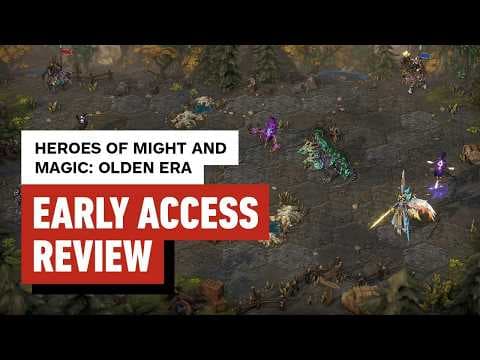
Heroes of Might and Magic: Olden Era Early Access Review
Audio Summary
AI Summary
Heroes of Might and Magic Olden Era aims to revive the essence of Heroes of Might and Magic 3, incorporating some modern elements but largely retaining the classic gameplay. This early access title successfully captures the unique turn-based strategy that has been absent from the gaming scene for decades.
For those unfamiliar, Heroes of Might and Magic involves players managing heroes and towns on a top-down map filled with various structures. Players take turns sending warriors to explore, gather resources, and engage in tactical grid-based battles. The map can feel dense with interactable elements, though the initial thrill of discovery can wane as building and treasure locations, while randomized, become familiar.
The game presents a continuous stream of strategic decisions. Players must weigh the benefits of recruiting convenient, non-faction troops against waiting for faction-specific units that benefit from bonuses. Deciding when to engage guardians of valuable locations is crucial to prevent opponents from seizing opportunities.
Each faction offers a distinct and enjoyable roster of soldiers, from basic grunts to powerful juggernauts. Many factions are reimagined versions of old favorites, such as the Temple, which mirrors the Haven knights with holy warriors and angels. A new favorite is the Skizm, an icy elf cult that brought extraplanar horrors. The demonic Inferno is replaced by the insectoid Hive, a formidable melee force. The Dungeon faction is versatile, with teleporting dark elves, minotaurs, and dragons covering various combat roles.
While all six factions possess distinct identities, not all feel immediately powerful. The Grove's units require significant investment to become strong, while the Skizm's power grows passively through battle victories. Balancing these differences is a common challenge in early access games. Each faction's units are balanced uniquely, demanding different strategic approaches. Units also have diverse mechanics; for instance, the tier one Hive parasite deals extra damage to higher-tier creatures, unlike the Necropolis skeleton, which serves as a cheap defensive unit. Many units also have powerful, focus-point-consuming abilities, adding tactical depth. Additionally, units can be upgraded into two alternative forms, each with unique nuances. However, the impact of these upgrades could be more consistently distinct. While some upgrades offer clear strategic shifts, many are less pronounced, making their consequences harder to discern early on.
Heroes lead these warbands, influencing units with passive abilities and casting powerful spells. The six factions offer a good selection of heroes, each with unique abilities and a generic subclass that can evolve if specific skills are acquired. This evolution can be frustratingly random, as new skills are chosen from a random pool upon level-up, making it difficult to collect the five needed to improve a subclass. Heroes themselves are somewhat bland; while their portrait art is excellent, their personalities don't translate into gameplay. Spells are learned semi-randomly from a broader pool, making magic powerful but unpredictable. Spellbooks rarely reflect character themes.
Settlements, serving as bases, also suffer from identity issues. Players build one structure per turn, providing units, spells, fortifications, or economic benefits. While visually distinct between factions, they largely perform the same functions. Players will often build them similarly, regardless of faction. Unique faction buildings exist, but their utility varies greatly; the Temple's scouting skyship pales in comparison to the Grove's mycelium roots, which allow instant hero travel. The new law system, a research tree, also feels somewhat generic across factions, with only keywords swapped for faction-specific details like unit growth buffs and stat boosts.
Combat is initially straightforward, involving moving units on a hex grid to gain optimal positioning. Units are melee, long-reach, or ranged. Every creature retaliates against melee attacks. While the simplicity of attack options is appreciated, ranged army compositions can feel instinctively safer due to the higher risk of melee engagement, particularly in the early game. Flanking and backstabbing are absent; combat depth comes from initiative, which dictates unit action order. Manipulating initiative by waiting or delaying turns becomes crucial in intense battles. Spells altering movement speed and initiative are more valuable in Olden Era than in previous titles, making for a savvy combat system, though battlefield variety could be improved.
Of the current modes, Campaign is the least favored. It’s more story-focused, offering choices that impact progression, but is plagued by unskippable cutscenes and bugs. Crucially, it renders many interesting systems inert, restricting city dwellings and subclass interactions to control progression, making it a poor introduction to the game.
Conversely, the new Arena mode is highly praised. It's a player-versus-player combat mode where players draft heroes, skills, artifacts, spells, and units like a trading card game. While subject to randomness, it's an excellent way to learn and test synergies without committing to long playthroughs.
Classic mode is suitable for story-driven play, but for pure competition against AI or human opponents, Single Hero mode stands out. It restricts teams to one roaming conqueror, centralizing army strength and faction survival. This mode focuses the gameplay, making it ideal for new players learning the ropes and for returning players seeking a balance between grind and supremacy within limited free time.
Heroes of Might and Magic: Olden Era, while not a remake, exemplifies good remake principles by capturing the spirit of Heroes of Might and Magic 2 and 3 without frame-by-frame recreation. The simple combat remains a highlight, offering depth and mastery. Its fresh take on older factions and new additions are vibrant in combat, but could benefit from more mechanical identity in city management and hero selection. Some signature randomness persists, occasionally frustrating meaningful interaction with interesting systems. However, the core of Olden Era is solid, and despite needing tweaks and rebalancing, this early access title satisfies both veterans and newcomers.
Jared Green, a veteran reviewer for IGN, was drawn to reviewing Olden Era due to his long history with the series. He first encountered Heroes of Might and Magic 2 at a young age on a second-hand computer, which fostered his eclectic gaming interests across various genres. He played Heroes of Might and Magic 3 and, like many fans, found later entries disappointing, leading to excitement for Olden Era's potential return to form.
The unique appeal of Heroes of Might and Magic, according to Jared, lies in its board game-like quality. Battles are simplistic, like chess, with units moving on spaces that perform specific actions. The complexity arises from how these simple interactions combine. The overworld involves extensive exploration and resource gathering, akin to a grand board game where numerous small interactions build into a complex overarching experience. This blend of simple combat and detailed overworld interaction creates a "salad of things you never get anywhere else."
Jared emphasizes that this "secret sauce" requires careful tuning, as demonstrated by the mis