Is Luck Random — or Can You Cultivate It? | Christian Busch | TED
Audio Summary
AI Summary
On January 7, 2025, the speaker's house, his wife's parents' house, and most of their neighborhood were destroyed by the LA wildfires in Pacific Palisades. He was trying to upload a paper for a conference when the evacuation order came in, hosing down the house with one hand and holding his laptop with the other. The document uploaded, but the hosing failed, and their home was gone 24 hours later. He described planes flying low and his wife pumping breast milk while evacuating their newborn and toddler. His three-year-old daughter later expressed a desire to go home. Having researched and taught on the unexpected for over a decade, this personal experience was on a new level. In the aftermath, he focused on controllable aspects, finding micro-moments of joy, like unexpectedly meeting old friends in their evacuation hotel. This became an unwanted opportunity to practice the serendipity mindset framework he had been developing.
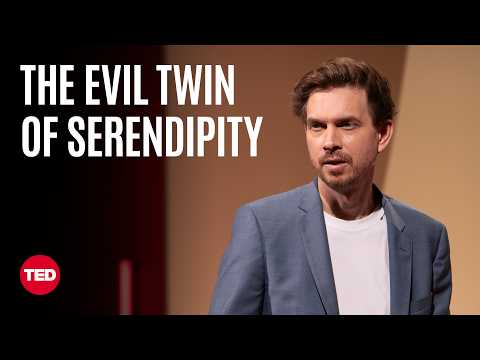
He then discussed "bad luck," realizing that their experience was more than that; it was "zemblanity." Zemblanity is when something unlucky or undesired happens by design, because it's already built into a fragile system. It appears unexpected but, in hindsight, was predictable and avoidable. In their case, the wildfires and winds were triggers, but the real misfortune was embedded in the system: lack of water in reservoirs and hydrants, limited pre-deployment of fire trucks despite warnings, uncleared brush, and a complete lack of coordination. It was a "space of infinite negative possibilities" where misfortune was inevitable. Zemblanity isn't just in large systems like wildfires but also in toxic corporate cultures or even in personal habits, like leaving for the airport with no buffer time, leading to a missed flight, or an elderly person refusing a walking stick and "unexpectedly" falling.
He then introduced the "Luck Matrix," which illustrates four types of luck. Bad luck is negative and unexpected, happening *to* us. Good luck is positive and unexpected, also happening *to* us, without effort. Zemblanity is "misfortune by design," built into fragile systems or habits. Serendipity, however, is "active luck," which depends on how we engage with the unexpected; it can be cultivated. He gave an example of spilling coffee on someone: the outcome (good or bad) depends on whether one simply apologizes or starts a conversation that could lead to a significant relationship. Serendipity is unexpected good luck resulting from unplanned moments where our actions lead to positive outcomes. He cited the Post-it note as an example: Spencer Silver accidentally developed a weak glue, which Arthur Fry later used to keep bookmarks in his hymnal, leading to a major product.
The speaker explained that serendipity follows a consistent process. First, there's a random, unexpected "serendipity trigger" (like the coffee spill or weak glue). Second, one must "imbue meaning" in it, connecting the dots and seeing potential. Third, one must "materialize it" through action. He suggested influencing this process by learning to see more triggers, for example, by asking in meetings, "What surprised you last week?" This encourages focusing on hidden information in unexpected events. Second, one can "seed" more triggers by sharing "rich information points" when asked "What do you do?" Instead of a unidimensional pitch, offering multiple potential connection points allows others to connect dots for you. Third, one can learn to connect dots better by asking, "Can I still find some meaning in this?" in unexpected moments. Finally, and crucially, one must learn to act more on these opportunities, as serendipity is often missed due to inaction, frequently stemming from fear of rejection. He suggested reframing the question from "What's the risk of doing this?" to "What's the risk of not doing it?" often revealing that the latter carries a higher risk of regret.
This "serendipity mindset"—the capacity to turn the unexpected into positive outcomes—is vital because the unexpected is ubiquitous. While the likelihood of any single unexpected event is low, the cumulative probability of *something* unexpected happening is quite high. This mindset helps build a "muscle" for navigating life's unpredictable "squiggle." The same alertness and ability to connect dots that foster serendipity can also guard against zemblanity's impacts. While mindset isn't a cure-all and factors like education and safety nets are crucial, it's a powerful individual tool. It's not "toxic positivity" but rather accepting pain and grief, then asking, "What can I still control now?" In his case, the loss of his house, while painful, sparked new research, a renewed sense of purpose, rallied the community, and deepened his relationship with his in-laws. He concluded with Viktor Frankl's quote about choosing one's attitude in any circumstance, emphasizing that while we can't choose crises, we can choose how we meet them, and that choice is where serendipity begins, offering a new chapter or even a new book. His hope is for a world designed more for serendipity and guarded against zemblanity.