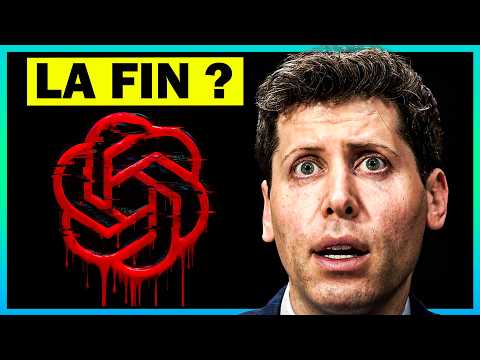
OPEN AI s'effondre sous nos yeux - ILS PANIQUENT !
AI Summary
The recent news suggests a significant shift in the landscape of artificial intelligence, with OpenAI reportedly facing a potential downfall. After receiving substantial investments, estimated at $13 billion, and extensive server support from Microsoft, the tech giant has announced its intention to develop its own AI models, signaling a move towards independence from OpenAI. This decision, reportedly spearheaded by Mustafa Suleyman, the new head of AI at Microsoft and former co-founder of DeepMind, marks a critical turning point.
Microsoft is reportedly considering legal action against OpenAI, accusing them of "flirting" with Amazon, a move that has coincided with OpenAI's preparations for a highly anticipated initial public offering (IPO). This IPO was expected to be the largest in tech history, with a valuation potentially reaching $1 trillion. However, the loss of Microsoft as its primary client and the emergence of a powerful new adversary could jeopardize these ambitious plans.
OpenAI's flagship product, ChatGPT, has reportedly seen a decline in success this year. The company incurred losses of $14 billion last year, yet maintains a substantial operational expenditure. This financial strain has led to investor caution, with even Nvidia reportedly hesitant to commit further funding. Without the financial backing of its partner and the anticipated capital from the markets, OpenAI's future appears uncertain, with some analysts predicting a potential bankruptcy within 18 months. This raises questions about the survival of the company that brought artificial intelligence to the global stage.
The partnership between Microsoft and OpenAI was initially structured as a symbiotic relationship. OpenAI developed advanced AI models like GPT, which power ChatGPT, while Microsoft provided the necessary infrastructure through its Azure cloud services. In return for its billions and server capacity, Microsoft gained exclusive access to OpenAI's models, integrating them into its suite of products, including Word, Excel, Outlook, Bing, and Copilot, its AI assistant designed to compete with ChatGPT in the enterprise sector. This arrangement seemed ideal, with OpenAI offering cutting-edge AI and Microsoft providing market reach and computational power.
However, the partnership has not yielded the expected results. Microsoft's Copilot has reportedly experienced commercial failure, capturing only 1.1% market share despite an $88 billion investment in AI infrastructure for fiscal year 2025. This falls far short of ChatGPT and Google's Gemini. Microsoft is investing heavily in a product with low adoption, powered by AI technology that it does not exclusively control.
Meanwhile, OpenAI has reportedly begun to diverge from Microsoft's interests. The company has launched its own web browser, search engine, and other tools that directly compete with Microsoft's offerings. Furthermore, it has been in discussions with Amazon for alternative cloud infrastructure. In October 2025, the exclusivity agreement was renegotiated, allowing OpenAI to seek computing power elsewhere and Microsoft to explore models from other providers. Microsoft has already integrated Claude, Anthropic's AI model and a key competitor to OpenAI, into its tools, with Windows and Office teams reportedly instructed to prioritize Claude. Microsoft is also developing its own medical AI, leveraging its proprietary Maya 200 chip, designed for independence from external dependencies like Nvidia and OpenAI. This union, which lasted six years, appears to be dissolving.
OpenAI's origins trace back to 2015 as a non-profit organization, with "Open" signifying a commitment to developing AI for the benefit of humanity through open access, without patents or industrial secrets, and no shareholders to enrich. Elon Musk was an early supporter, contributing $44 million. However, by 2017, the escalating costs of training AI models, requiring thousands of processors for months, led to a divergence in vision. Musk proposed taking control and merging OpenAI with Tesla, but Sam Altman refused, opting instead for commercialization and the development of ChatGPT. Musk departed in 2018, predicting OpenAI's downfall.
Following Musk's departure, Sam Altman secured a partnership with Microsoft. In 2019, OpenAI established a commercial subsidiary, with Microsoft investing $1 billion for a 27% stake. This marked a departure from the initial open-access philosophy, with the technology becoming more exclusive. The subsequent explosion of ChatGPT in January 2023, attracting 100 million users in two months, prompted Microsoft to invest an additional $10 billion, bringing its total investment to $13 billion in exchange for exclusive cloud provider status and integration of GPT across its products.
However, internal turmoil erupted just ten months later. The board of directors reportedly cited a lack of transparency and toxic management from Altman. A fundamental disagreement also emerged regarding the pace of AI development: OpenAI scientists advocated for a cautious approach to avoid creating dangerous AI, while Altman pushed for acceleration to maintain market share against Google. The board sided with caution and fired Altman. Microsoft offered Altman and his team refuge, leading to a threat of mass resignation from 738 out of 770 employees. Altman returned to OpenAI within five days, leading to the dismissal of the board and a breakdown of trust. Microsoft reportedly recognized the risk of investing in a company capable of such internal disruption.
OpenAI's non-profit structure presented inherent challenges for profitability. To address the astronomical costs of AI development, a hybrid structure was created in 2019, with a non-profit foundation overseeing a commercial subsidiary with capped profits for investors. In 2025, this evolved into a Public Benefit Corporation, a for-profit entity with a stated mission of general interest. The foundation retained 26% ownership, Microsoft held 27%, and the remainder went to employees and investors, removing profit caps to attract capital.
The core issue for OpenAI appears to be its substantial expenses, including servers, electricity, researchers, model training, and data centers, which consume significant amounts of electricity. Each user query incurs costs, and while revenues are growing, reaching an estimated $20 billion annually by the end of 2025, they reportedly do not cover expenditures, leading to projected losses of $14 billion for 2026. Analysts estimate a funding shortfall of $207 billion for OpenAI's projects by the end of the decade, without guaranteed profitability. Unlike Google, which benefits from advertising revenue, or Amazon, supported by its profitable AWS, or Microsoft with its diverse portfolio, OpenAI's primary revenue stream is ChatGPT, with less than 5% of its 900 million weekly users subscribing.
In this context, OpenAI's planned IPO, intended to be the largest in tech history with a valuation between $500 billion and $1 trillion, was crucial. The narrative relied on OpenAI being the undisputed leader in AI, with Microsoft as its exclusive partner. However, the recent rupture with Microsoft significantly alters this perception for investors. While Microsoft retains its stake and exploitation rights until 2032, its withdrawal as a major investor diminishes the IPO's appeal.
Furthermore, OpenAI faces increasing competition. ChatGPT's share of global web traffic has reportedly dropped from 87% to 64% in a year, and its market share in enterprise solutions has declined from 50% in 2023 to 27%. Competitors are rapidly advancing, with Apple integrating Google's Gemini into Siri and Apple Intelligence. The departure of key talent, including Chief Scientist Ilya Sutskever and Chief Technology Officer Mira Murati, further exacerbates the situation, with engineers reportedly more likely to move to competitors like Anthropic. Retaining existing talent incurs significant annual costs, approaching half of the company's revenue. Some analysts predict OpenAI could face insolvency within 18 months, making a $1 trillion valuation highly improbable.
Without a successful IPO, OpenAI's prospects appear dire. The company is reportedly consuming $1 billion per month, with projected losses and no clear path to profitability before 2029. Available cash is expected to deplete by mid-2027, and without market funding, there is no alternative plan. The departure of its primary partner, intense competition, talent exodus, and unfavorable financial projections all undermine the IPO's viability. The question of which investor would commit $1 trillion to a company whose former primary client is now its main competitor remains unanswered. Sam Altman is reportedly seeking new funding from entities like Nvidia and Abu Dhabi sovereign wealth funds, but each new funding round dilutes existing stakes.
Three potential scenarios are outlined: first, OpenAI successfully executes its IPO, secures sufficient funding to reach profitability, and establishes itself as a leader in generative AI. Second, OpenAI is acquired by Microsoft or Amazon, continuing to operate but not as an independent entity. Third, OpenAI fails to secure funding, postpones or cancels its IPO, experiences further talent loss, and ultimately ceases operations, potentially liquidating its assets. The narrative draws a parallel to Netscape, a once-dominant internet company that was eventually crushed by Microsoft's integrated browser, highlighting that technological innovation does not guarantee survival in the face of established tech giants.
For the general public, the impact of OpenAI's potential demise would be minimal. AI technology is here to stay, and while ChatGPT might change hands or be replaced by competitors, the underlying advancements will persist. The loss would be primarily for Sam Altman and the company itself, but the AI revolution it initiated is irreversible. The video concludes by encouraging viewers to subscribe and consider investing in private equity funds through Fundora.