Samson's Game-Changing Feature GTA 6 Should Steal
Audio Summary
AI Summary
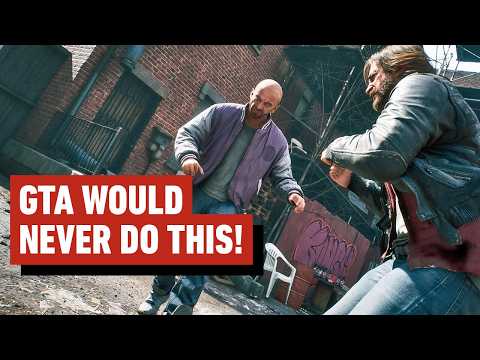
This video review discusses "Samson," a game that many hoped would be a GTA clone to fill the gap before the next Grand Theft Auto release. However, the reviewer finds the game to be complicated, describing it as glitchy and janky, with missions failing due to in-game bugs like getting stuck in decorative bin bags, rather than player error. The reviewer even jokes about the game causing them an eye infection due to stress. Despite these technical issues, which are unlikely to be fixed by the developer Liquid Swords due to their history, the reviewer acknowledges that "Samson" offers a unique and interesting take on the open-world crime genre, making it a potentially worthwhile budget stopgap.
The game's core difference from GTA lies in its departure from a power fantasy. Instead of a rags-to-riches story, "Samson" centers on the protagonist, Samson McCrae, who is burdened with a massive debt of $100,000 after a botched job. To repay this debt, he must complete odd jobs with strict daily targets. Failure to meet these targets results in consequences, including debt collectors and even physical harm. The stakes are heightened by the fact that Samson's sister is being held hostage by a criminal organization as collateral, and she's forced to do their bookkeeping.
The gameplay loop revolves around a limited number of "action points" each day, which represent time. Players must strategically choose jobs based on their risk and reward, as failing a mission can lead to losing all accumulated earnings for the day and incurring further penalties, such as waking up in a clinic and being stripped of progress. This contrasts sharply with GTA, where the financial repercussions of failure, like medical costs, are negligible, questioning GTA's satirical commentary on the American condition.
"Samson" also introduces a layer of realism to driving. Unlike GTA, where cars are treated as disposable, driving in "Samson" involves basic vehicle management. Players may have to spend a portion of their earnings on car repairs, making them more cautious about how they drive and treat their vehicle. This adds a unique dimension to the player's relationship with their car, a gorgeous, albeit temperamental, American muscle car that the protagonist cherishes because he can barely afford to maintain it. This careful management of resources and the constant threat of debt accumulation are presented as a commentary on the cycle of crippling debt.
The game's unique structure wasn't the original plan. It was initially conceived as a more traditional open-world action RPG. However, due to economic pressures and budget constraints following the COVID-19 pandemic, Liquid Swords was forced to pivot. The developer had to lay off half their team, leading to a smaller crew that had to salvage the project into something sellable. This resulted in the current, more focused, roguelike-lite experience with no guns and a smaller city. The reviewer suggests that while the game may not be as polished as the original vision, it has become a more memorable proposition.
The reviewer highlights anecdotal evidence of the game eliciting strong reactions, comparing it to the movie "Drive" due to its police evasion mechanics. Another comparison is made to being a minor character in GTA IV, emphasizing its gritty realism. The game is seen as part of a lineage of experimental GTA clones from the late 90s and early 2000s that explored innovative takes on the genre, such as "Red Faction: Guerrilla," "Mad Max," and "The Precinct."
"Samson's" key differentiator is its roguelike-adjacent structure and its emphasis on consequences. The constant threat of losing progress makes the player feel a genuine physiological effect, unlike the consequence-free nature of most crime fantasies where failure is quickly rectified. Weapons in "Samson" are limited to melee items like crowbars and hammers, which must be stored in the trunk, adding to the grounded and gritty feel.
While the reviewer admires the bold ideas and the sheer determination it took to bring "Samson" to fruition in the current economic climate, they ultimately cannot recommend it in its current state. The game is described as cheap, stupid, and somewhat sleazy, drawing a comparison to Hooters for wings – a place one might go for a quick, unrefined fix but wouldn't necessarily brag about. The reviewer concludes by encouraging viewers to like, subscribe, and check out their playlist, "The Trinka Perspective."