So... Who Is Running The FED Now?
Audio Summary
AI Summary
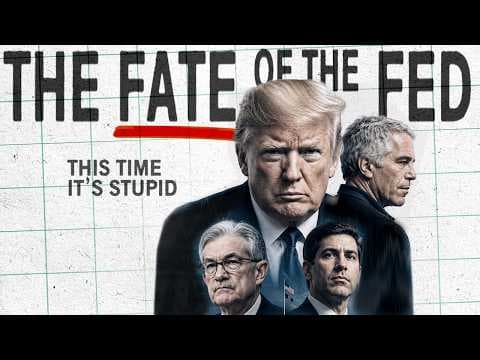
Jerome Powell's tenure as Federal Reserve chairman is ending in two weeks, but his replacement, Kevin Worsh, faces significant hurdles. Worsh's confirmation is stalled in the Senate due to questions about his wealth, potential conflicts of interest, and professional ties to Jeffrey Epstein. A larger, often overlooked problem is that Powell, whose term as governor extends until 2028, could refuse to step down from the board, preventing Worsh from becoming chairman even with Senate approval. Historically, outgoing chairmen resign their governorships to make way for successors, but Powell has been under a criminal investigation by the DOJ, which he may want resolved before relinquishing institutional protection.
The Federal Reserve faces immense political pressure to cut rates, amidst unclear inflation data, potential pricing shocks from the war in Iran, tariffs, and an uncertain job market. The next interest rate decision is due in 45 days, and leadership uncertainty exacerbates economic concerns. The DOJ investigation into Powell was reportedly linked to a $2.5 billion renovation cost for the Fed's headquarters. This investigation, ironically initiated to hasten Powell's departure and facilitate rate cuts, might now be delaying his replacement and maintaining current monetary policy.
Worsh, a former Fed governor with experience during the global financial crisis, brings notable baggage. His considerable personal wealth and his wife's family fortune, with some "dubious connections," are a concern. While Fed officials often come from affluent backgrounds, the nature of Worsh's wealth is more compromising. He also struggled to fully deny professional connections to Jeffrey Epstein during his Senate hearing. Furthermore, his investment portfolio reportedly includes indirect investments in private banks, which are forbidden for a sitting Fed chair. Any one of these issues might be survivable, but their combination has stalled his nomination.
In a twist, the Republican senator blocking Worsh is not doing so over these issues, but to pressure the DOJ to drop its investigation into Powell. The DOJ has since dropped the investigation, likely to expedite Worsh's confirmation. However, Powell has expressed intent to remain on the board, at least until the matter is fully resolved, and possibly to run interference for colleague Lisa Cook, also under investigation.
The chairman is appointed for a four-year term, while a governor serves a 14-year term and is difficult to remove. The governorship, not the chairmanship, holds most of the real power, as each governor gets a vote on the Federal Open Market Committee (FOMC) that sets interest rates. The chairman is more of a "first amongst equals," responsible for communication and running meetings. An administration seeking rate cuts through a friendly chairman could be outvoted by the other 11 members of the FOMC.
If Powell refuses to vacate his governorship, Worsh cannot become chairman because there are exactly seven statutory seats on the board. While one current governor, Steven Myin, is technically serving beyond his term, appointing Worsh to his spot would mean losing a friendly vote on rate cuts, defeating the administration's purpose. The ideal scenario for the White House is Powell's graceful exit, allowing Myin's reappointment for a new term and Worsh to take Powell's old seat, thereby establishing a larger "friendly" voting bloc.
Powell's continued presence as a regular governor until 2028 could also diminish the new chairman's influence. As a respected ex-chair with institutional memory, he would likely retain significant sway.
Beyond the succession struggle, the incoming chairman faces a challenging economic environment. Political pressure for lower rates is strong, as cheaper borrowing boosts the economy short-term and benefits wealthy investors, including Worsh. However, asset markets are already high, while consumer sentiment is low, and further inflation would harm regular citizens.
The reliability of government statistics on inflation and employment is questionable, making the Fed's triple mandate difficult to execute accurately. If the data is politically convenient, incentives to fix it weaken.
Supply-side forces, such as tariffs, are pushing prices up, which the Fed cannot directly control. Tariffs have elevated import prices, and cutting rates into tariff-driven inflation would be counterproductive. The war in Iran also contributes, increasing costs across various sectors, from shipping to food.
While some argue AI could lower costs through productivity gains, current AI development is offset by capital spending and energy costs. Furthermore, AI is fueling layoffs, which the Fed is also tasked with controlling, potentially justifying rate cuts.
The biggest unspoken problem is the declining faith in the US dollar as the global reserve asset. Cutting rates despite visible inflation risks accelerating this shift, leading to a weaker dollar, more expensive imports, and worse domestic inflation. A weaker appetite for US debt would force the Treasury to pay higher yields, increasing borrowing costs for everyone. The market has already repriced US debt due to the war, leading to tens of billions in additional interest payments. If investors lose faith, rate cuts could ironically drive long-term rates even higher.
These problems require diligent, sensible, and potentially unpopular decisions. The current situation is like a ship undergoing a mutiny while sailing into a storm, with uncertainty about who will lead the institution and their objectives.